1992 Edition
CIA World Factbook 1992 (Project Gutenberg)
Geography
Climate
mild and moist; transitional between continental and maritime
Coastline
none - landlocked
Comparative area
slightly smaller than Kansas
Disputes
none
Environment
southern part of Belarus highly contaminated with fallout from 1986 nuclear reactor accident at Chernobyl'
Land area
207,600 km2
Land boundaries
3,098 km total; Latvia 141 km, Lithuania 502 km, Poland 605 km, Russia 959 km, Ukraine 891 km
Land use
arable land NA%; permanent crops NA%; meadows and pastures NA%; forest and woodland NA%; other NA%; includes irrigated NA%
Maritime claims
none - landlocked
Natural resources
forest land and peat deposits
Note
landlocked
Terrain
generally flat and contains much marshland
Total area
207,600 km2
People and Society
Birth rate
15 births/1,000 population (1992)
Death rate
11 deaths/1,000 population (1992)
Ethnic divisions
Byelorussian 77.9%, Russian 13.2%, Poles 4.1%, Ukrainian 2.9%, Jews 1.1%, other 0.8%
Infant mortality rate
20 deaths/1,000 live births (1992)
Labor force
5,418,000; industry and construction 42%, agriculture and forestry 20%, other 38% (1990)
Languages
Byelorussian NA%, Russian NA%, other NA%
Life expectancy at birth
66 years male, 76 years female (1992)
Literacy
NA% (male NA%, female NA%) age 15 and over can read and write
Nationality
noun - Belarusian(s); adjective - Belarusian
Net migration rate
1 migrant/1,000 population (1992)
Organized labor
NA
Population
10,373,881 (July 1992), growth rate 0.5% (1992)
Religions
Russian Orthodox NA%, unknown NA%, none NA%, other NA%
Total fertility rate
2.1 children born/woman (1992)
Government
Administrative divisions
6 oblasts (oblastey, singular - oblast'); Brest, Gomel', Grodno, Minsk, Mogilev, Vitebsk; note - all oblasts have the same name as their administrative center
Capital
Mensk
Chief of State
Chairman of the Supreme Soviet Stanislav S. SHUSHKEVICH (since NA 1991)
Communists
NA
Constitution
adopted April 1978
Diplomatic representation
Ambassador Martynov; Chancery at NA NW, Washington, DC 200__; telephone NA US: Ambassador (vacant); David SWARTZ, Charge d'Affaires; Embassy at Hotel Belarus (telephone 8-011-7-0172-69-08-02) plus 7 hours; (mailing address is APO New York is 09862); telephone NA
Executive branch
NA
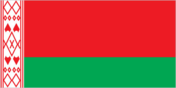
Flag
white, red, and white
Head of Government
Prime Minister Vyacheslav F. KEBICH (since NA April 1990), First Deputy Prime Minister Mikhail MYASNIKOVICH (since early 1991)
Independence
1 January 1919 Belorussian Republic; 30 December 1922 joined with the USSR; 25 August 1991 redeclared independence
Judicial branch
NA
Legal system
based on civil law system
Legislative branch
unicameral with 360 seats
Long-form name
Republic of Belarus
Member of
CE, CIS, CSCE, ECE, IAEA, ILO, INMARSAT, IOC, ITU, NACC, PCA, UN, UNCTAD, UNESCO, UNIDO, UPU, WHO, WIPO, WMO
National holiday
24 August (1991)
Other political or pressure groups
NA
Political parties and leaders
Belarusian Popular Front, Zenon POZNYAK, chairman; United Democratic Party, Stanislav GUSAK, co-chairman; Social Democratic Gramada, Mikhail TKACHEV, chairman; Belarus Workers Union, Mikhail SOBOL, Chairman
President
NA
Suffrage
universal at age 18
Supreme Soviet
last held 4 March 1990 (next to be held NA); results - percent of vote by party NA; seats - (360 total) number of seats by party NA; note - 50 seats are for public bodies
Type
republic
Economy
Agriculture
- accounts for 5.7% of total agricultural output of former Soviet Union; employs 29% of the labor force; in 1988 produced the following (in percent
- (3.0%), meat (6.0%), milk (7.0%); net exporter of meat, milk, eggs, flour, and potatoes
- of total Soviet production)
- grain (3.6%), potatoes (12.2%), vegetables
Budget
revenues $NA million; expenditures $NA million, including capital expenditures of $NA million
Currency
as of May 1992, retaining ruble as currency
Economic aid
NA
Electricity
7,500,000 kW capacity; 38,700 million kWh produced, 3,770 kWh per capita (1991)
Exchange rates
NA
Exports
$4.3 billion (f.o.b., 1990) commodities: machinery and transport equipment, chemicals, foodstuffs partners: NA
External debt
$2.6 billion (end of 1991)
Fiscal year
calendar year
GDP
NA - $NA, per capita $NA; real growth rate --2% (1991)
Illicit drugs
illicit producer of opium mostly for the domestic market; transshipment point for illicit drugs to Western Europe
Imports
$5.6 billion (c.i.f., 1990) commodities: machinery, chemicals, textiles partners: NA
Industrial production
growth rate --1.5% (1991)
Industries
- employ about 27% of labor force and produce a wide variety of products essential to the other states; products include (in percent share of total
- (11%); off-highway dump trucksup to 110-metric- ton load capacity (100%); wheel-type earthmovers for construction and mining (100%); eight- wheel-drive, high-flotation trucks with cargo capacity of 25 metric tons for use in tundra and roadless areas (100%); equipment for animal husbandry and livestock feeding (25%); motorcycles (21.3%); television sets (11%); chemical fibers (28%); fertilizer (18%); linen fabric (11%); wool fabric (7%); radios; refrigerators; and other consumer goods
- output of former Soviet Union)
- tractors(12%); metal-cutting machine tools
Inflation rate (consumer prices)
81% (1991)
Overview
In many ways Belarus resembles the three Baltic states, for example, in its industrial competence, its higher-than-average standard of living, and its critical dependence on the other former Soviet states for fuels and raw materials. Belarus ranks fourth in gross output among the former Soviet republics, producing 4% of the total GDP and employing 4% of the labor force. Once a mainly agricultural area, it now supplies important producer and consumer goods - sometimes as the sole producer - to the other states. The soil in Belarus is not as fertile as the black earth of Ukraine, but by emphasizing favorable crops and livestock (especially pigs and chickens), Belarus has become a net exporter to the other republics of meat, milk, eggs, flour, and potatoes. Belarus produces only small amounts of oil and gas and receives most of its fuel from Russia through the Druzhba oil pipeline and the Northern Lights gas pipeline. These pipelines transit Belarus enroute to Eastern Europe. Belarus produces petrochemicals, plastics, synthetic fibers (nearly 30% of former Soviet output), and fertilizer (20% of former Soviet output). Raw material resources are limited to potash and peat deposits. The peat (more than one-third of the total for the former Soviet Union) is used in domestic heating as boiler fuel for electric power stations and in the production of chemicals. The potash supports fertilizer production.
Unemployment rate
NA%
Communications
Airports
NA
Civil air
NA major transport aircraft
Highways
98,200 km total (1990); 66,100 km hard surfaced, 32,100 km earth
Inland waterways
NA km
Merchant marine
none - landlocked
Pipelines
NA
Ports
none - landlocked
Railroads
5,570 km (includes NA km electrified); does not include industrial lines (1990)
Telecommunications
telephone network has 1.7 million lines, 15% of which are switched automatically; Minsk has 450,000 lines; telephone density is approximately 17 per 100 persons; as of 31 January 1990, 721,000 applications from households for telephones were still unsatisfied; international connections to other former Soviet republics are by landline or microwave and to other countries by leased connection through the Moscow international gateway switch
Military and Security
Branches
Republic Security Forces (internal and border troops); CIS Forces (Ground, Air, Air Defense, Strategic Rocket)
Defense expenditures
$NA, NA% of GDP
Manpower availability
males 15-49, NA; NA fit for military service; NA reach military age (18) annually