2014 Edition
CIA World Factbook 2014 Archive (HTML)
Introduction
Background
The island was uninhabited when first settled by the British in 1627. African slaves worked the sugar plantations established on the island until 1834 when slavery was abolished. The economy remained heavily dependent on sugar, rum, and molasses production through most of the 20th century. The gradual introduction of social and political reforms in the 1940s and 1950s led to complete independence from the UK in 1966. In the 1990s, tourism and manufacturing surpassed the sugar industry in economic importance.
Geography
Area
- 430 sq km 430 sq km 0 sq km
- total
- 430 sq km
- water
- 0 sq km
Area - comparative
2.5 times the size of Washington, DC
Climate
tropical; rainy season (June to October)
Coastline
97 km
Elevation extremes
- Atlantic Ocean 0 m Mount Hillaby 336 m
- highest point
- Mount Hillaby 336 m
- lowest point
- Atlantic Ocean 0 m
Environment - current issues
pollution of coastal waters from waste disposal by ships; soil erosion; illegal solid waste disposal threatens contamination of aquifers
Environment - international agreements
- Biodiversity, Climate Change, Climate Change-Kyoto Protocol, Desertification, Endangered Species, Hazardous Wastes, Law of the Sea, Marine Dumping, Ozone Layer Protection, Ship Pollution, Wetlands none of the selected agreements
- party to
- Biodiversity, Climate Change, Climate Change-Kyoto Protocol, Desertification, Endangered Species, Hazardous Wastes, Law of the Sea, Marine Dumping, Ozone Layer Protection, Ship Pollution, Wetlands
- signed, but not ratified
- none of the selected agreements
Freshwater withdrawal (domestic/industrial/agricultural)
- 0.1 cu km/yr (20%/26%/54%) 371.3 cu m/yr (2009)
- per capita
- 371.3 cu m/yr (2009)
- total
- 0.1 cu km/yr (20%/26%/54%)
Geographic coordinates
13 10 N, 59 32 W
Geography - note
easternmost Caribbean island
Irrigated land
54.35 sq km (2003)
Land boundaries
0 km
Land use
- 27.91% 2.33% 69.77% (2011)
- arable land
- 27.91%
- other
- 69.77% (2011)
- permanent crops
- 2.33%
Location
Caribbean, island in the North Atlantic Ocean, northeast of Venezuela
Map references
Central America and the Caribbean
Maritime claims
- 12 nm 200 nm
- exclusive economic zone
- 200 nm
- territorial sea
- 12 nm
Natural hazards
infrequent hurricanes; periodic landslides
Natural resources
petroleum, fish, natural gas
Terrain
relatively flat; rises gently to central highland region
Total renewable water resources
0.08 cu km (2011)
People and Society
Age structure
- 18.4% (male 26,709/female 26,716) 13.6% (male 19,705/female 19,754) 45% (male 64,821/female 65,394) 12.5% (male 16,837/female 19,286) 10.5% (male 12,068/female 18,390) (2014 est.)
- 0-14 years
- 18.4% (male 26,709/female 26,716)
- 15-24 years
- 13.6% (male 19,705/female 19,754)
- 25-54 years
- 45% (male 64,821/female 65,394)
- 55-64 years
- 12.5% (male 16,837/female 19,286)
- 65 years and over
- 10.5% (male 12,068/female 18,390) (2014 est.)
Birth rate
11.97 births/1,000 population (2014 est.)
Death rate
8.41 deaths/1,000 population (2014 est.)
Dependency ratios
- 42.6 % 26.8 % 15.8 % 6.3 (2014 est.)
- elderly dependency ratio
- 15.8 %
- potential support ratio
- 6.3 (2014 est.)
- total dependency ratio
- 42.6 %
- youth dependency ratio
- 26.8 %
Drinking water source
- urban: 99.8% of population rural: 99.8% of population total: 99.8% of population urban: 0.2% of population rural: 0.2% of population total: 0.2% of population (2012 est.)
- rural
- 0.2% of population
- total
- 0.2% of population (2012 est.)
- urban
- 0.2% of population
Education expenditures
5.6% of GDP (2012)
Ethnic groups
black 92.4%, white 2.7%, mixed 3.1%, East Indian 1.3%, other 0.2%, unspecified 0.2% (2010 est.)
Health expenditures
7.7% of GDP (2011)
HIV/AIDS - adult prevalence rate
0.9% (2012 est.)
HIV/AIDS - deaths
NA (2009 est.)
HIV/AIDS - people living with HIV/AIDS
1,500 (2012 est.)
Hospital bed density
6.6 beds/1,000 population (2010)
Infant mortality rate
- 10.93 deaths/1,000 live births 12.58 deaths/1,000 live births 9.26 deaths/1,000 live births (2014 est.)
- female
- 9.26 deaths/1,000 live births (2014 est.)
- total
- 10.93 deaths/1,000 live births
Languages
English (official), Bajan (English-based creole language, widely spoken in informal settings)
Life expectancy at birth
- 74.99 years 72.64 years 77.37 years (2014 est.)
- female
- 77.37 years (2014 est.)
- total population
- 74.99 years
Literacy
- age 15 and over has ever attended school 99.7% 99.7% 99.7% (2002 est.)
- definition
- age 15 and over has ever attended school
- female
- 99.7% (2002 est.)
- male
- 99.7%
- total population
- 99.7%
Major urban areas - population
BRIDGETOWN (capital) 122,000 (2011)
Maternal mortality rate
51 deaths/100,000 live births (2010)
Median age
- 37.6 years 36.5 years 38.7 years (2014 est.)
- female
- 38.7 years (2014 est.)
- male
- 36.5 years
- total
- 37.6 years
Nationality
- Barbadian(s) or Bajan (colloquial) Barbadian or Bajan (colloquial)
- adjective
- Barbadian or Bajan (colloquial)
- noun
- Barbadian(s) or Bajan (colloquial)
Net migration rate
-0.3 migrant(s)/1,000 population (2014 est.)
Obesity - adult prevalence rate
34.7% (2008)
Physicians density
1.81 physicians/1,000 population (2005)
Population
289,680 (July 2014 est.)
Population growth rate
0.33% (2014 est.)
Religions
Protestant 66.3% (includes Anglican 23.9%, other Pentecostal 19.5%, Adventist 5.9%, Methodist 4.2%, Wesleyan 3.4%, Nazarene 3.2%, Church of God 2.4%, Baptist 1.8%, Moravian 1.2%, other Protestant .8%), Roman Catholic 3.8%, other Christian 5.4% (includes Jehovah's Witness 2.0%, other 3.4%), Rastafarian 1%, other 1.5%, none 20.6%, unspecified 1.2% (2010 est.)
Sanitation facility access
- urban: 91.6% of population rural: 91.6% of population total: 91.6% of population urban: 8.4% of population rural: 8.4% of population total: 8.4% of population (2006 est.)
- rural
- 8.4% of population
- total
- 8.4% of population (2006 est.)
- urban
- 8.4% of population
School life expectancy (primary to tertiary education)
- 15 years 14 years 17 years (2011)
- female
- 17 years (2011)
- male
- 14 years
- total
- 15 years
Sex ratio
- 1.01 male(s)/female 1 male(s)/female 1 male(s)/female 0.99 male(s)/female 0.94 male(s)/female 0.65 male(s)/female 0.94 male(s)/female (2014 est.)
- 0-14 years
- 1 male(s)/female
- 15-24 years
- 1 male(s)/female
- 25-54 years
- 0.99 male(s)/female
- 55-64 years
- 0.94 male(s)/female
- 65 years and over
- 0.65 male(s)/female
- at birth
- 1.01 male(s)/female
- total population
- 0.94 male(s)/female (2014 est.)
Total fertility rate
1.68 children born/woman (2014 est.)
Unemployment, youth ages 15-24
- 26.2% 24.1% 28.7% (2003)
- female
- 28.7% (2003)
- total
- 26.2%
Urbanization
- 44.4% of total population (2011) 1.35% annual rate of change (2010-15 est.)
- rate of urbanization
- 1.35% annual rate of change (2010-15 est.)
- urban population
- 44.4% of total population (2011)
Government
Administrative divisions
11 parishes and 1 city*; Bridgetown*, Christ Church, Saint Andrew, Saint George, Saint James, Saint John, Saint Joseph, Saint Lucy, Saint Michael, Saint Peter, Saint Philip, Saint Thomas
Capital
- Bridgetown 13 06 N, 59 37 W UTC-4 (1 hour ahead of Washington, DC, during Standard Time)
- geographic coordinates
- 13 06 N, 59 37 W
- name
- Bridgetown
- time difference
- UTC-4 (1 hour ahead of Washington, DC, during Standard Time)
Constitution
adopted 22 November 1966, effective 30 November 1966; amended several times, last in 2003 (2011)
Country name
- none Barbados
- conventional long form
- none
- conventional short form
- Barbados
Diplomatic representation from the US
- Ambassador Larry L. PALMER (since 9 May 2012); note - also accredited to Antigua and Barbuda, Dominica, Grenada, Saint Kitts and Nevis, Saint Lucia, and Saint Vincent and the Grenadines U.S. Embassy, Wildey Business Park, Wildey, St. Michael BB 14006 P. O. Box 302, Bridgetown BB 11000; (Department Name) Unit 3120, DPO AA 34055 [1] (246) 227-4000 [1] (246) 431-0179
- chief of mission
- Ambassador Larry L. PALMER (since 9 May 2012); note - also accredited to Antigua and Barbuda, Dominica, Grenada, Saint Kitts and Nevis, Saint Lucia, and Saint Vincent and the Grenadines
- embassy
- U.S. Embassy, Wildey Business Park, Wildey, St. Michael BB 14006
- FAX
- [1] (246) 431-0179
- mailing address
- P. O. Box 302, Bridgetown BB 11000; (Department Name) Unit 3120, DPO AA 34055
- telephone
- [1] (246) 227-4000
Diplomatic representation in the US
- Ambassador John E. BEALE (since 29 January 2009) 2144 Wyoming Avenue NW, Washington, DC 20008 [1] (202) 939-9200 [1] (202) 332-7467 Miami, New York Los Angeles
- chancery
- 2144 Wyoming Avenue NW, Washington, DC 20008
- chief of mission
- Ambassador John E. BEALE (since 29 January 2009)
- consulate(s)
- Los Angeles
- consulate(s) general
- Miami, New York
- FAX
- [1] (202) 332-7467
- telephone
- [1] (202) 939-9200
Executive branch
- Queen ELIZABETH II (since 6 February 1952); represented by Governor General Elliot BELGRAVE (since 1 June 2012) Prime Minister Freundel STUART (since 23 October 2010) Cabinet appointed by the governor general on the advice of the prime minister the monarchy is hereditary; governor general appointed by the monarch; following legislative elections, the leader of the majority party or the leader of the majority coalition is usually appointed prime minister by the governor general; the prime minister recommends the deputy prime minister
- cabinet
- Cabinet appointed by the governor general on the advice of the prime minister
- chief of state
- Queen ELIZABETH II (since 6 February 1952); represented by Governor General Elliot BELGRAVE (since 1 June 2012)
- elections
- the monarchy is hereditary; governor general appointed by the monarch; following legislative elections, the leader of the majority party or the leader of the majority coalition is usually appointed prime minister by the governor general; the prime minister recommends the deputy prime minister
- head of government
- Prime Minister Freundel STUART (since 23 October 2010)
Flag description
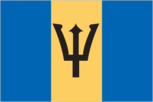
three equal vertical bands of blue (hoist side), gold, and blue with the head of a black trident centered on the gold band; the band colors represent the blue of the sea and sky and the gold of the beaches; the trident head represents independence and a break with the past (the colonial coat of arms contained a complete trident)
Government type
parliamentary democracy and a Commonwealth realm
Independence
30 November 1966 (from the UK)
International law organization participation
accepts compulsory ICJ jurisdiction with reservations; accepts ICCt jurisdiction
International organization participation
ACP, AOSIS, C, Caricom, CDB, CELAC, FAO, G-77, IADB, IBRD, ICAO, ICRM, IDA, IFAD, IFC, IFRCS, ILO, IMF, IMO, Interpol, IOC, ISO, ITSO, ITU, ITUC (NGOs), LAES, MIGA, NAM, OAS, OPANAL, OPCW, UN, UNCTAD, UNESCO, UNIDO, UPU, WCO, WFTU (NGOs), WHO, WIPO, WMO, WTO
Judicial branch
- Supreme Court (consists of the High Court with 8 justices) and the Court of Appeal (consists of the chief Justice and president of the court and 4 justices note - Barbados, a member of the Caribbean Court of Justice, replaced the Judicial Committee of the Privy Council (in London) as the final court of appeal Supreme Court chief justice appointed by the governor-general on the recommendation of the prime minister and opposition leader of Parliament; other justices appointed by the governor-general on the recommendation of the Judicial and Legal Service Commission, a 5-member independent body consisting of the Supreme Court chief justice, the commission head, and governor-general appointees recommended by the prime minister; justices serve until mandatory retirement at age 65 Magistrates' Courts
- highest court(s)
- Supreme Court (consists of the High Court with 8 justices) and the Court of Appeal (consists of the chief Justice and president of the court and 4 justices
- judge selection and term of office
- Supreme Court chief justice appointed by the governor-general on the recommendation of the prime minister and opposition leader of Parliament; other justices appointed by the governor-general on the recommendation of the Judicial and Legal Service Commission, a 5-member independent body consisting of the Supreme Court chief justice, the commission head, and governor-general appointees recommended by the prime minister; justices serve until mandatory retirement at age 65
- subordinate courts
- Magistrates' Courts
Legal system
English common law; no judicial review of legislative acts
Legislative branch
- bicameral Parliament consists of the Senate (21 seats; members appointed by the governor general - 12 on the advice of the Prime Minister, 2 on the advice of the opposition leader, and 7 at his discretion) and the House of Assembly (30 seats; members are elected by direct popular vote to serve five-year terms) House of Assembly - last held on 21 February 2013 (next to be called in 2018) House of Assembly - percent of vote by party - DLP 51.3%, BLP 48.3%, other 0.4%; seats by party - DLP 16, BLP 14
- election results
- House of Assembly - percent of vote by party - DLP 51.3%, BLP 48.3%, other 0.4%; seats by party - DLP 16, BLP 14
- elections
- House of Assembly - last held on 21 February 2013 (next to be called in 2018)
National anthem
- "The National Anthem of Barbados" Irving BURGIE/C. Van Roland EDWARDS adopted 1966; the anthem is also known as "In Plenty and In Time of Need"
- lyrics/music
- Irving BURGIE/C. Van Roland EDWARDS
- name
- "The National Anthem of Barbados"
National holiday
Independence Day, 30 November (1966)
National symbol(s)
Neptune's trident
Political parties and leaders
Barbados Labor Party or BLP [Owen ARTHUR] Democratic Labor Party or DLP [Freundel STUART] People's Empowerment Party or PEP [David COMISSIONG]
Political pressure groups and leaders
Barbados Secondary Teachers' Union or BSTU [Mary REDMAN] Barbados Union of Teachers or BUT [Karen BEST] Congress of Trade Unions and Staff Associations of Barbados or CTUSAB, (includes the BWU, NUPW, BUT, and BSTU) [Leroy TROTMAN] Barbados Workers Union or BWU [Linda BROOKS] Clement Payne Labor Union [David COMISSIONG] National Union of Public Workers [Walter MALONEY]
Suffrage
18 years of age; universal
Economy
Agriculture - products
sugarcane, vegetables, cotton
Budget
- $1.15 billion (2013 est.) $1.45 billion (2013 est.)
- expenditures
- $1.45 billion (2013 est.)
- revenues
- $1.15 billion (2013 est.)
Budget surplus (+) or deficit (-)
-7% of GDP (2013 est.)
Central bank discount rate
7% (31 December 2010 est.) 7% (31 December 2009 est.)
Commercial bank prime lending rate
8.5% (31 December 2013 est.) 8.7% (31 December 2012 est.)
Current account balance
-$276.6 million (2013 est.) -$204.4 million (2012 est.)
Debt - external
$4.49 billion (2010 est.) $668 million (2003 est.)
Economy - overview
Barbados is the wealthiest and most developed country in the Eastern Caribbean and enjoys one of the highest per capita incomes in Latin America. Historically, the Barbadian economy was dependent on sugarcane cultivation and related activities. However, in recent years the economy has diversified into light industry and tourism with about four-fifths of GDP and of exports being attributed to services. Offshore finance and information services are important foreign exchange earners and thrive from having the same time zone as eastern US financial centers and a relatively highly educated workforce. Barbados' tourism, financial services, and construction industries have been hard hit since the onset of the global economic crisis in 2008. Barbados' public debt-to-GDP ratio rose from 56% in 2008 to 90.5% in 2013. Growth prospects are limited because of a weak tourism outlook and planned austerity measures.
Exchange rates
Barbadian dollars (BBD) per US dollar - 2 (2013 est.) 2 (2012 est.) 2 (2010 est.) the Barbadian dollar is pegged to the US dollar
Exports
$1.051 billion (2013 est.) $1.039 billion (2012 est.)
Exports - commodities
manufactures, sugar and molasses, rum, other foods and beverages, chemicals, electrical components
Exports - partners
Trinidad and Tobago 20.8%, US 11.9%, St. Lucia 9.7%, St. Vincent and the Grenadines 6%, Jamaica 5.6%, Antigua and Barbuda 4.9%, St. Kitts and Nevis 4.6%, UK 4.4% (2012)
Fiscal year
1 April - 31 March
GDP - composition, by end use
- 81.7% 15.4% 14.3% 1.9% 40.5% -53.8% (2013 est.)
- exports of goods and services
- 40.5%
- government consumption
- 15.4%
- household consumption
- 81.7%
- imports of goods and services
- -53.8%
- investment in fixed capital
- 14.3%
- investment in inventories
- 1.9%
GDP - composition, by sector of origin
- 3.1% 13.9% 83% (2013 est.)
- agriculture
- 3.1%
- industry
- 13.9%
- services
- 83% (2013 est.)
GDP - per capita (PPP)
$25,100 (2013 est.) $25,400 (2012 est.) $25,400 (2011 est.) data are in 2013 US dollars
GDP - real growth rate
-0.8% (2013 est.) 0% (2012 est.) 0.8% (2011 est.)
GDP (official exchange rate)
$4.262 billion (2013 est.)
GDP (purchasing power parity)
$7.004 billion (2013 est.) $7.056 billion (2012 est.) $7.056 billion (2011 est.) data are in 2013 US dollars
Gross national saving
9% of GDP (2013 est.) 9.4% of GDP (2012 est.) 3.4% of GDP (2011 est.)
Household income or consumption by percentage share
- NA% NA%
- highest 10%
- NA%
- lowest 10%
- NA%
Imports
$1.674 billion (2013 est.) $1.584 billion (2012 est.)
Imports - commodities
consumer goods, machinery, foodstuffs, construction materials, chemicals, fuel, electrical components
Imports - partners
Trinidad and Tobago 35.9%, US 26.9%, China 5.6% (2012)
Industrial production growth rate
-0.7% (2013 est.)
Industries
tourism, sugar, light manufacturing, component assembly for export
Inflation rate (consumer prices)
2.1% (2013 est.) 4.8% (2012 est.)
Labor force
141,800 (2013 est.)
Labor force - by occupation
- 10% 15% 75% (1996 est.)
- agriculture
- 10%
- industry
- 15%
- services
- 75% (1996 est.)
Market value of publicly traded shares
$4.495 billion (31 December 2012 est.) $NA (31 December 2011) $4.366 billion (31 December 2010 est.)
Population below poverty line
NA%
Public debt
90.5% of GDP (2013 est.) 85.6% of GDP (2012 est.)
Reserves of foreign exchange and gold
$712.6 million (31 December 2013 est.) $839.7 million (31 December 2012 est.)
Stock of broad money
$4.229 billion (31 December 2013 est.) $4.198 billion (31 December 2012 est.)
Stock of domestic credit
$5.035 billion (31 December 2013 est.) $4.874 billion (31 December 2012 est.)
Stock of narrow money
$1.749 billion (31 December 2013 est.) $1.711 billion (31 December 2012 est.)
Taxes and other revenues
27% of GDP (2013 est.)
Unemployment rate
11.4% (2013 est.) 11.6% (2012 est.)
Energy
Carbon dioxide emissions from consumption of energy
1.442 million Mt (2011 est.)
Crude oil - exports
764.5 bbl/day (2010 est.)
Crude oil - imports
0 bbl/day (2010 est.)
Crude oil - production
1,001 bbl/day (2012 est.)
Crude oil - proved reserves
2.26 million bbl (1 January 2013 est.)
Electricity - consumption
986 million kWh (2010 est.)
Electricity - exports
0 kWh (2012 est.)
Electricity - from fossil fuels
100% of total installed capacity (2010 est.)
Electricity - from hydroelectric plants
0% of total installed capacity (2010 est.)
Electricity - from nuclear fuels
0% of total installed capacity (2010 est.)
Electricity - from other renewable sources
0% of total installed capacity (2010 est.)
Electricity - imports
0 kWh (2012 est.)
Electricity - installed generating capacity
239,000 kW (2010 est.)
Electricity - production
1.002 billion kWh (2011 est.)
Natural gas - consumption
20 million cu m (2010 est.)
Natural gas - exports
0 cu m (2011 est.)
Natural gas - imports
0 cu m (2011 est.)
Natural gas - production
20 million cu m (2010 est.)
Natural gas - proved reserves
113.3 million cu m (1 January 2013 est.)
Refined petroleum products - consumption
8,339 bbl/day (2011 est.)
Refined petroleum products - exports
0 bbl/day (2010 est.)
Refined petroleum products - imports
8,736 bbl/day (2010 est.)
Refined petroleum products - production
31 bbl/day (2010 est.)
Communications
Broadcast media
government-owned Caribbean Broadcasting Corporation (CBC) operates the lone terrestrial TV station; CBC also operates a multi-channel cable TV subscription service; roughly a dozen radio stations, consisting of a CBC-operated network operating alongside privately owned radio stations (2007)
Internet country code
.bb
Internet hosts
1,524 (2012)
Internet users
188,000 (2008)
Telephone system
- island-wide automatic telephone system fixed-line teledensity of roughly 50 per 100 persons; mobile-cellular telephone density approaching 125 per 100 persons country code - 1-246; landing point for the East Caribbean Fiber System (ECFS) submarine cable with links to 13 other islands in the eastern Caribbean extending from the British Virgin Islands to Trinidad; satellite earth stations - 1 (Intelsat - Atlantic Ocean); tropospheric scatter to Trinidad and Saint Lucia (2009)
- domestic
- fixed-line teledensity of roughly 50 per 100 persons; mobile-cellular telephone density approaching 125 per 100 persons
- general assessment
- island-wide automatic telephone system
- international
- country code - 1-246; landing point for the East Caribbean Fiber System (ECFS) submarine cable with links to 13 other islands in the eastern Caribbean extending from the British Virgin Islands to Trinidad; satellite earth stations - 1 (Intelsat - Atlantic Ocean); tropospheric scatter to Trinidad and Saint Lucia (2009)
Telephones - main lines in use
144,000 (2012)
Telephones - mobile cellular
347,000 (2012)
Transportation
Airports
1 (2013)
Airports - with paved runways
- 1 (2013)
- over 3,047 m
- 1 (2013)
- total
- 1
Merchant marine
- bulk carrier 23, cargo 52, chemical tanker 13, container 6, passenger 1, passenger/cargo 1, petroleum tanker 8, refrigerated cargo 4, roll on/roll off 1 83 (Canada 11, Greece 14, Iran 5, Lebanon 2, Norway 38, Sweden 4, Syria 1, Turkey 1, UAE 1, UK 6) (2010)
- foreign-owned
- 83 (Canada 11, Greece 14, Iran 5, Lebanon 2, Norway 38, Sweden 4, Syria 1, Turkey 1, UAE 1, UK 6) (2010)
- total
- 109
Pipelines
gas 33 km; oil 64 km; refined products 6 km (2013)
Ports and terminals
- Bridgetown
- major seaport(s)
- Bridgetown
Roadways
- 1,600 km 1,600 km (2011)
- total
- 1,600 km
Military and Security
Manpower available for military service
- 73,820 73,835 (2010 est.)
- females age 16-49
- 73,835 (2010 est.)
- males age 16-49
- 73,820
Manpower fit for military service
- 58,125 58,016 (2010 est.)
- females age 16-49
- 58,016 (2010 est.)
- males age 16-49
- 58,125
Manpower reaching militarily significant age annually
- 1,842 1,849 (2010 est.)
- female
- 1,849 (2010 est.)
- male
- 1,842
Military - note
the Royal Barbados Defense Force includes a land-based Troop Command and a small Coast Guard; the primary role of the land element is island defense against external aggression; the Command consists of a single, part-time battalion with a small regular cadre deployed throughout the island; the cadre increasingly supports the police in patrolling the coastline for smuggling and other illicit activities (2007)
Military branches
- Royal Barbados Defense Force: Troops Command, Barbados Coast Guard (2011)
- Royal Barbados Defense Force
- Troops Command, Barbados Coast Guard (2011)
Military service age and obligation
18 years of age for voluntary military service, or earlier with parental consent; no conscription (2013)
Transnational Issues
Disputes - international
Barbados and Trinidad and Tobago abide by the April 2006 Permanent Court of Arbitration decision delimiting a maritime boundary and limiting catches of flying fish in Trinidad and Tobago's exclusive economic zone; joins other Caribbean states to counter Venezuela's claim that Aves Island sustains human habitation, a criterion under the UN Convention on the Law of the Sea, which permits Venezuela to extend its Economic Exclusion Zone/continental shelf over a large portion of the eastern Caribbean Sea
Illicit drugs
one of many Caribbean transshipment points for narcotics bound for Europe and the US; offshore financial center
Trafficking in persons
- Barbados is a source and destination country for men, women, and children subjected to sex trafficking and forced labor; legal and illegal female migrants from Jamaica, the Dominican Republic, and Guyana seem most vulnerable to forced prostitution; Barbadian and immigrant children are prostituted in exchange for material goods; in the past, foreigners are reported to have been forced to work in the domestic service, agriculture, and construction industries Tier 2 Watch List - Barbados does not fully comply with the minimum standards for the elimination of trafficking; however, it is making significant efforts to do so; the country was granted a waiver of an otherwise required downgrade to Tier 3 because the government adopted a national action plan on human trafficking that specifies implementing agencies and addresses prosecution, protection, and prevention measures; the government conducted at least two sex trafficking investigations in 2012, as opposed to none in the previous year but did not report any prosecutions or convictions of trafficking offenses; Barbadian law does not appear to prohibit all forms of human trafficking and does not prescribe sufficiently stringent penalties; government efforts to prevent human trafficking included broadcasting short public awareness messages, holding town hall meetings, and funding a hotline (2013)
- current situation
- Barbados is a source and destination country for men, women, and children subjected to sex trafficking and forced labor; legal and illegal female migrants from Jamaica, the Dominican Republic, and Guyana seem most vulnerable to forced prostitution; Barbadian and immigrant children are prostituted in exchange for material goods; in the past, foreigners are reported to have been forced to work in the domestic service, agriculture, and construction industries
- tier rating
- Tier 2 Watch List - Barbados does not fully comply with the minimum standards for the elimination of trafficking; however, it is making significant efforts to do so; the country was granted a waiver of an otherwise required downgrade to Tier 3 because the government adopted a national action plan on human trafficking that specifies implementing agencies and addresses prosecution, protection, and prevention measures; the government conducted at least two sex trafficking investigations in 2012, as opposed to none in the previous year but did not report any prosecutions or convictions of trafficking offenses; Barbadian law does not appear to prohibit all forms of human trafficking and does not prescribe sufficiently stringent penalties; government efforts to prevent human trafficking included broadcasting short public awareness messages, holding town hall meetings, and funding a hotline (2013)