1990 Edition
CIA World Factbook 1990 (Project Gutenberg)
Geography
Climate
tropical; rainy season (June to October)
Coastline
97 km
Comparative area
slightly less than 2.5 times the size of Washington, DC
Environment
subject to hurricanes (especially June to October)
Extended economic zone
200 nm;
Land boundaries
none
Land use
77% arable land; 0% permanent crops; 9% meadows and pastures; 0% forest and woodland; 14% other
Natural resources
crude oil, fishing, natural gas
Note
easternmost Caribbean island
Terrain
relatively flat; rises gently to central highland region
Territorial sea
12 nm
Total area
430 km2; land area: 430 km2
People and Society
Birth rate
18 births/1,000 population (1990)
Death rate
8 deaths/1,000 population (1990)
Ethnic divisions
80% African, 16% mixed, 4% European
Infant mortality rate
16 deaths/1,000 live births (1990)
Labor force
112,300; 37% services and government; 22% commerce, 22% manufacturing and construction; 9% transportation, storage, communications, and financial institutions; 8% agriculture; 2% utilities (1985 est.)
Language
English
Life expectancy at birth
73 years male, 77 years female (1990)
Literacy
99%
Nationality
noun--Barbadian(s); adjective--Barbadian
Net migration rate
- 5 migrants/1,000 population (1990)
Organized labor
32% of labor force
Population
262,688 (July 1990), growth rate 0.6% (1990)
Religion
70% Anglican, 9% Methodist, 4% Roman Catholic, 17% other, including Moravian
Total fertility rate
2.1 children born/woman (1990)
Government
Administrative divisions
11 parishes; Christ Church, Saint Andrew, Saint George, Saint James, Saint John, Saint Joseph, Saint Lucy, Saint Michael, Saint Peter, Saint Philip, Saint Thomas; note--there may a new city of Bridgetown
Capital
Bridgetown
Communists
negligible
Constitution
30 November 1966
Diplomatic representation
Ambassador Sir William DOUGLAS; Chancery at 2144 Wyoming Avenue NW, Washington DC 20008; telephone (202) 939-9200 through 9202; there is a Barbadian Consulate General in New York and a Consulate in Los Angeles; US--Ambassador-nominee G. Philip HUGHES; Embassy at Canadian Imperial Bank of Commerce Building, Broad Street, Bridgetown (mailing address is P. O. Box 302, Bridgetown or FPO Miami 34054); telephone (809) 436-4950 through 4957
Elections
House of Assembly--last held 28 May 1986 (next to be held by May 1991); results--DLP 59.4%, BLP 40.6%; seats--(27 total) DLP 24, BLP 3; note--a split in the DLP in February 1989 resulted in the formation of the NDP, changing the status of seats to DLP 20, NDP 4, BLP 3
Executive branch
British monarch, governor general, prime minister, deputy prime minister, Cabinet
Flag
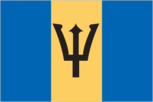
three equal vertical bands of blue (hoist side), yellow, and blue with the head of a black trident centered on the gold band; the trident head represents independence and a break with the past (the colonial coat of arms contained a complete trident)
Independence
30 November 1966 (from UK)
Judicial branch
Supreme Court of Judicature
Leaders
Chief of State--Queen ELIZABETH II (since 6 February 1952), represented by Governor General Sir Hugh SPRINGER (since 24 February 1984); Head of Government--Prime Minister Lloyd Erskine SANDIFORD (since 2 June 1987)
Legal system
English common law; no judicial review of legislative acts
Legislative branch
bicameral Parliament consists of an upper house or Senate and a lower house or House of Assembly
Long-form name
none
Member of
ACP, CARICOM, Commonwealth, FAO, G-77, GATT, IADB, IBRD, ICAO, IDB--Inter-American Development Bank, IFAD, IFC, ILO, IMF, IMO, INTELSAT, INTERPOL, ISO, ITU, IWC--International Wheat Council, NAM, OAS, PAHO, SELA, UN, UNESCO, UPU, WHO, WMO
National holiday
Independence Day, 30 November (1966)
Other political or pressure groups
Industrial and General Workers Union, Bobby Clarke; People's Progressive Movement, Eric Sealy; Workers' Party of Barbados, Dr. George Belle
Political parties and leaders
Democratic Labor Party (DLP), Erskine Sandiford; Barbados Labor Party (BLP), Henry Forde; National Democratic Party (NDP), Richie Haynes
Suffrage
universal at age 18
Type
parliamentary democracy
Economy
Agriculture
accounts for 10% of GDP; major cash crop is sugarcane; other crops--vegetables and cotton; not self-sufficient in food
Aid
US commitments, including Ex-Im (FY70-84), $14 million; Western (non-US) countries, ODA and OOF bilateral commitments (1970-87), $144 million
Budget
revenues $476 million; expenditures $543 million, including capital expenditures of $94 million (FY86)
Currency
Barbadian dollars (plural--dollars); 1 Barbadian dollar (Bds$) = 100 cents
Electricity
132,000 kW capacity; 460 million kWh produced, 1,780 kWh per capita (1989)
Exchange rates
Barbadian dollars (Bds$) per US$1--2.0113 (fixed rate)
Exports
$173 million (f.o.b., 1988); commodities--sugar and molasses, electrical components, clothing, rum, machinery and transport equipment; partners: US 30%, CARICOM, UK, Puerto Rico, Canada
External debt
$635 million (December 1989 est.)
Fiscal year
1 April-31 March
GDP
$1.3 billion, per capita $5,250 (1988 est.); real growth rate 3.7% (1989 est.)
Imports
$582 million (c.i.f., 1988); commodities--foodstuffs, consumer durables, raw materials, crude oil; partners--US 34%, CARICOM, Japan, UK, Canada
Industrial production
growth rate - 5.4% (1987 est.)
Industries
tourism, sugar, light manufacturing, component assembly for export
Inflation rate (consumer prices)
4.7% (1988)
Overview
A per capita income of $5,250 gives Barbados the highest standard of living of all the small island states of the eastern Caribbean. Historically, the economy was based on the cultivation of sugarcane and related activities. In recent years, however, the economy has diversified into manufacturing and tourism. The tourist industry is now a major employer of the labor force and a primary source of foreign exchange. A high unemployment rate of about 19% in 1988 remains one of the most serious economic problems facing the country.
Unemployment
18.6% (1988)
Communications
Airports
1 with permanent-surface runways 2,440-3,659 m
Civil air
2 major transport aircraft
Highways
1,570 km total; 1,475 km paved, 95 km gravel and earth
Merchant marine
2 cargo ships (1,000 GRT or over) totaling 3,200 GRT/7,338 DWT
Ports
Bridgetown
Telecommunications
islandwide automatic telephone system with 89,000 telephones; tropospheric scatter link to Trinidad and St. Lucia; stations--3 AM, 2 FM, 2 (1 is pay) TV; 1 Atlantic Ocean INTELSAT earth station
Military and Security
Branches
Royal Barbados Defense Force, Royal Barbados Police Force, Coast Guard
Defense expenditures
0.6% of GDP (1986)
Military manpower
males 15-49, 67,677; 47,566 fit for military service, no conscription