2019 Edition
CIA World Factbook 2019 Archive (Wayback Machine)
Introduction
Background
The huge delta region formed at the confluence of the Ganges and Brahmaputra River systems - now referred to as Bangladesh - was a loosely incorporated outpost of various empires centered on the Gangetic plain for much of the first millennium A.D. Muslim conversions and settlement in the region began in the 10th century, primarily from Arab and Persian traders and preachers. Europeans established trading posts in the area in the 16th century. Eventually the area known as Bengal, primarily Hindu in the western section and mostly Muslim in the eastern half, became part of British India. Partition in 1947 resulted in an eastern wing of Pakistan in the Muslim-majority area, which became East Pakistan. Calls for greater autonomy and animosity between the eastern and western wings of Pakistan led to a Bengali independence movement. That movement, led by the Awami League (AL) and supported by India, won the independence war for Bangladesh in 1971. The post-independence AL government faced daunting challenges and in 1975 it was overthrown by the military, triggering a series of military coups that resulted in a military-backed government and subsequent creation of the Bangladesh Nationalist Party (BNP) in 1978. That government also ended in a coup in 1981, followed by military-backed rule until democratic elections occurred in 1991. The BNP and AL have alternated in power since 1991, with the exception of a military-backed, emergency caretaker regime that suspended parliamentary elections planned for January 2007 in an effort to reform the political system and root out corruption. That government returned the country to fully democratic rule in December 2008 with the election of the AL and Prime Minister Sheikh HASINA. In January 2014, the incumbent AL won the national election by an overwhelming majority after the BNP boycotted the election, which extended HASINA's term as prime minister. In December 2018, HASINA secured a third consecutive term (fourth overall) with the AL coalition securing 96% of available seats, amid widespread claims of election irregularities. With the help of international development assistance, Bangladesh has reduced the poverty rate from over half of the population to less than a third, achieved Millennium Development Goals for maternal and child health, and made great progress in food security since independence. The economy has grown at an annual average of about 6% for the last two decades and the country reached World Bank lower-middle income status in 2014.
Geography
Area
- Land
- 130,170 sq km
- Total
- 148,460 sq km
- Water
- 18,290 sq km
Area Comparative
slightly larger than Pennsylvania and New Jersey combined; slightly smaller than Iowa
Climate
tropical; mild winter (October to March); hot, humid summer (March to June); humid, warm rainy monsoon (June to October)
Coastline
580 km
Elevation
- Highest Point
- Keokradong 1,230 m
- Lowest Point
- Indian Ocean 0 m
- Mean Elevation
- 85 m
Environment Current Issues
many people are landless and forced to live on and cultivate flood-prone land; waterborne diseases prevalent in surface water; water pollution, especially of fishing areas, results from the use of commercial pesticides; ground water contaminated by naturally occurring arsenic; intermittent water shortages because of falling water tables in the northern and central parts of the country; soil degradation and erosion; deforestation; destruction of wetlands; severe overpopulation with noise pollution
Environment International Agreements
- Party To
- Biodiversity, Climate Change, Climate Change-Kyoto Protocol, Desertification, Endangered Species, Environmental Modification, Hazardous Wastes, Law of the Sea, Ozone Layer Protection, Ship Pollution, Wetlands
- Signed But Not Ratified
- none of the selected agreements
Geographic Coordinates
24 00 N, 90 00 E
Geography Note
most of the country is situated on deltas of large rivers flowing from the Himalayas: the Ganges unites with the Jamuna (main channel of the Brahmaputra) and later joins the Meghna to eventually empty into the Bay of Bengal
Irrigated Land
53,000 sq km (2012)
Land Boundaries
- Border Countries
- Burma 271 km, India 4142 km
- Total
- 4,413 km
Land Use
- Agricultural Land
- 70.1% (2016 est.)
- Agricultural Land Arable Land
- 59% (2016 est.)
- Agricultural Land Permanent Crops
- 6.5% (2016 est.)
- Agricultural Land Permanent Pasture
- 4.6% (2016 est.)
- Forest
- 11.1% (2016 est.)
- Other
- 18.8% (2016 est.)
Location
Southern Asia, bordering the Bay of Bengal, between Burma and India
Map References
Asia
Maritime Claims
- Contiguous Zone
- 18 nm
- Continental Shelf
- to the outer limits of the continental margin
- Exclusive Economic Zone
- 200 nm
- Territorial Sea
- 12 nm
Natural Hazards
droughts; cyclones; much of the country routinely inundated during the summer monsoon season
Natural Resources
natural gas, arable land, timber, coal
Terrain
mostly flat alluvial plain; hilly in southeast
People and Society
Age Structure
- 0 14 Years
- 27.29% (male 22,135,349 /female 21,373,470)
- 15 24 Years
- 19.14% (male 15,313,674 /female 15,200,861)
- 25 54 Years
- 40.07% (male 30,626,005 /female 33,267,339)
- 55 64 Years
- 7.09% (male 5,582,450 /female 5,716,763)
- 65 Years And Over
- 6.42% (male 4,844,612 /female 5,392,478) (2018 est.)
Birth Rate
18.6 births/1,000 population (2018 est.)
Children Under The Age Of 5 Years Underweight
32.8% (2014)
Contraceptive Prevalence Rate
62.3% (2014)
Current Health Expenditure
2.4% (2016)
Death Rate
5.4 deaths/1,000 population (2018 est.)
Dependency Ratios
- Elderly Dependency Ratio
- 7.7 (2015 est.)
- Potential Support Ratio
- 13 (2015 est.)
- Total Dependency Ratio
- 52.6 (2015 est.)
- Youth Dependency Ratio
- 44.9 (2015 est.)
Drinking Water Source
- Improved Rural
- 87% of population
- Improved Total
- 86.9% of population
- Improved Urban
- 86.5% of population
- Unimproved Rural
- 13% of population
- Unimproved Total
- 13.1% of population (2015 est.)
- Unimproved Urban
- 13.5% of population
Education Expenditures
2% of GDP (2018)
Ethnic Groups
Bengali at least 98%, other indigenous ethnic groups 1.1% (2011 est.)
HIV/AIDS Adult Prevalence Rate
<.1% (2018 est.)
HIV/AIDS Deaths
<1000 (2018 est.)
HIV/AIDS People Living With HIV/AIDS
14,000 (2018 est.)
Hospital Bed Density
0.8 beds/1,000 population (2015)
Infant Mortality Rate
- Female
- 28.1 deaths/1,000 live births
- Male
- 32.8 deaths/1,000 live births
- Total
- 30.5 deaths/1,000 live births (2018 est.)
Languages
Bangla 98.8% (official, also known as Bengali), other 1.2% (2011 est.)
Life Expectancy at Birth
- Female
- 75.9 years
- Male
- 71.5 years
- Total Population
- 73.7 years (2018 est.)
Literacy
- Definition
- age 15 and over can read and write
- Female
- 70.1% (2017)
- Male
- 75.7%
- Total Population
- 72.9%
Major Infectious Diseases
- Animal Contact Diseases
- rabies (2019)
- Degree Of Risk
- high (2019)
- Food Or Waterborne Diseases
- bacterial and protozoal diarrhea, hepatitis A and E, and typhoid fever (2019)
- Vectorborne Diseases
- dengue fever and malaria are high risks in some locations (2019)
- Water Contact Diseases
- leptospirosis (2019)
Major Urban Areas Population
20.284 million DHAKA (capital), 4.915 million Chittagong, 963,000 Khulna, 893,000 Rajshahi, 814,000 Sylhet (2019)
Maternal Mortality Rate
173 deaths/100,000 live births (2017 est.)
Median Age
- Female
- 27.8 years
- Male
- 26.3 years
- Total
- 27.1 years (2018 est.)
Mother's Mean Age at First Birth
18.5 years (2014 est.)
Nationality
- Adjective
- Bangladeshi
- Noun
- Bangladeshi(s)
Net Migration Rate
-3 migrant(s)/1,000 population (2018 est.)
Obesity Adult Prevalence Rate
3.6% (2016)
Physicians Density
0.53 physicians/1,000 population (2015)
Population
159,453,001 (July 2018 est.)
Population Growth Rate
1.02% (2018 est.)
Religions
Muslim 89.1%, Hindu 10%, other 0.9% (includes Buddhist, Christian) (2013 est.)
Sanitation Facility Access
- Improved Rural
- 62.1% of population (2015 est.)
- Improved Total
- 60.6% of population (2015 est.)
- Improved Urban
- 57.7% of population (2015 est.)
- Unimproved Rural
- 37.9% of population (2015 est.)
- Unimproved Total
- 39.4% of population (2015 est.)
- Unimproved Urban
- 42.3% of population (2015 est.)
School Life Expectancy Primary To Tertiary Education
- Female
- 12 years (2017)
- Male
- 11 years
- Total
- 11 years
Sex Ratio
- 0 14 Years
- 1.04 male(s)/female
- 15 24 Years
- 1.01 male(s)/female
- 25 54 Years
- 0.92 male(s)/female
- 55 64 Years
- 0.98 male(s)/female
- 65 Years And Over
- 0.9 male(s)/female
- At Birth
- 1.04 male(s)/female
- Total Population
- 0.97 male(s)/female (2018 est.)
Total Fertility Rate
2.15 children born/woman (2018 est.)
Unemployment Youth Ages 15 24
- Female
- 16.8% (2017 est.)
- Male
- 10.8%
- Total
- 12.8%
Urbanization
- Rate Of Urbanization
- 3.17% annual rate of change (2015-20 est.)
- Urban Population
- 37.4% of total population (2019)
Government
Administrative Divisions
8 divisions; Barisal, Chittagong, Dhaka, Khulna, Mymensingh, Rajshahi, Rangpur, Sylhet
Capital
- Geographic Coordinates
- 23 43 N, 90 24 E
- Name
- Dhaka
- Time Difference
- UTC+6 (11 hours ahead of Washington, DC, during Standard Time)
Citizenship
- Citizenship By Birth
- no
- Citizenship By Descent Only
- at least one parent must be a citizen of Bangladesh
- Dual Citizenship Recognized
- yes, but limited to select countries
- Residency Requirement For Naturalization
- 5 years
Constitution
- Amendments
- proposed by the House of the Nation; approval requires at least two-thirds majority vote of the House membership and assent of the president of the republic; amended many times, last in 2018 (2019)
- History
- previous 1935, 1956, 1962 (preindependence); latest enacted 4 November 1972, effective 16 December 1972, suspended March 1982, restored November 1986
Country Name
- Conventional Long Form
- People's Republic of Bangladesh
- Conventional Short Form
- Bangladesh
- Etymology
- the name - a compound of the Bengali words "Bangla" (Bengal) and "desh" (country) - means "Country of Bengal"
- Former
- East Bengal, East Pakistan
- Local Long Form
- Gana Prajatantri Bangladesh
- Local Short Form
- Bangladesh
Diplomatic Representation From The Us
- Chief Of Mission
- Ambassador Earl Robert MILLER (since 29 November 2018)
- Embassy
- Madani Avenue, Baridhara, Dhaka 1212
- Fax
- [880] (2) 5566-2915
- Mailing Address
- G. P. O. Box 323, Dhaka 1000
- Telephone
- [880] (2) 5566-2000
Diplomatic Representation In The Us
- Chancery
- 3510 International Drive NW, Washington, DC 20008
- Chief Of Mission
- Ambassador Mohammad ZIAUDDIN (since 18 September 2014)
- Consulate's General
- Los Angeles, New York
- Fax
- [1] (202) 244-2771
- Telephone
- [1] (202) 244-0183
Executive Branch
- Cabinet
- Cabinet selected by the prime minister, appointed by the president
- Chief Of State
- President Abdul HAMID (since 24 April 2013); note - Abdul HAMID served as acting president following the death of Zillur RAHMAN in March 2013; HAMID was subsequently indirectly elected by the National Parliament and sworn in 24 April 2013
- Election Results
- President Abdul HAMID (AL) reelected by the National Parliament unopposed for a second term; Sheikh HASINA reappointed prime minister as leader of the majority AL party following parliamentary elections in 2018
- Elections Appointments
- president indirectly elected by the National Parliament for a 5-year term (eligible for a second term); election last held on 7 February 2018 (next to be held by 2023); the president appoints as prime minister the majority party leader in the National Parliament
- Head Of Government
- Prime Minister Sheikh HASINA (since 6 January 2009)
Flag Description
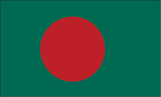
green field with a large red disk shifted slightly to the hoist side of center; the red disk represents the rising sun and the sacrifice to achieve independence; the green field symbolizes the lush vegetation of Bangladesh
Government Type
parliamentary republic
Independence
16 December 1971 (from Pakistan)
International Law Organization Participation
has not submitted an ICJ jurisdiction declaration; accepts ICCt jurisdiction
International Organization Participation
ADB, ARF, BIMSTEC, C, CD, CICA (observer), CP, D-8, FAO, G-77, IAEA, IBRD, ICAO, ICC (national committees), ICRM, IDA, IDB, IFAD, IFC, IFRCS, IHO, ILO, IMF, IMO, IMSO, Interpol, IOC, IOM, IPU, ISO, ITSO, ITU, ITUC (NGOs), MIGA, MINURSO, MINUSMA, MONUSCO, NAM, OIC, OPCW, PCA, SAARC, SACEP, UN, UNAMID, UNCTAD, UNESCO, UNHCR, UNIDO, UNIFIL, UNMIL, UNMISS, UNOCI, UNWTO, UPU, WCO, WFTU (NGOs), WHO, WIPO, WMO, WTO
Judicial Branch
- Highest Courts
- Supreme Court of Bangladesh (organized into the Appellate Division with 7 justices and the High Court Division with 99 justices)
- Judge Selection And Term Of Office
- chief justice and justices appointed by the president; justices serve until retirement at age 67
- Subordinate Courts
- civil courts include: Assistant Judge's Court; Joint District Judge's Court; Additional District Judge's Court; District Judge's Court; criminal courts include: Court of Sessions; Court of Metropolitan Sessions; Metropolitan Magistrate Courts; Magistrate Court; special courts/tribunals
Legal System
mixed legal system of mostly English common law and Islamic law
Legislative Branch
- Description
- unicameral House of the Nation or Jatiya Sangsad (350 seats; 300 members in single-seat territorial constituencies directly elected by simple majority popular vote; 50 members - reserved for women only - indirectly elected by the elected members by proportional representation vote using single transferable vote; all members serve 5-year terms)
- Election Results
- percent of vote by party - NA; seats by party - AL 289, BNP 7, other 3; composition - men 279, women 72, percent of women 20.6%
- Elections
- last held on 30 December 2018 (next to be held in 2023)
National Anthem
- Lyrics Music
- Rabindranath TAGORE
- Name
- "Amar Shonar Bangla" (My Golden Bengal)
National Holiday
Independence Day, 26 March (1971); Victory Day, 16 December (1971); note - 26 March 1971 is the date of the Awami League's declaration of an independent Bangladesh, and 16 December (Victory Day) memorializes the military victory over Pakistan and the official creation of the state of Bangladesh
National Symbol S
Bengal tiger, water lily; national colors: green, red
Political Parties And Leaders
Awami League or AL [Sheikh HASINA] Bangladesh Nationalist Front or BNF [Abdul Kalam AZADI] Bangladesh Nationalist Party or BNP [Khaleda ZIA] Bangladesh Tariqat Federation or BTF [Syed Nozibul Bashar MAIZBHANDARI] Jamaat-i-Islami Bangladesh or JIB (Makbul AHMAD) Jatiya Party or JP (Ershad faction) [Hussain Mohammad ERSHAD] Jatiya Party or JP (Manju faction) [Anwar Hossain MANJU] Liberal Democratic Party or LDP [Oli AHMED] National Socialist Party or JSD [KHALEQUZZAMAN] Workers Party or WP [Rashed Khan MENON]
Suffrage
18 years of age; universal
Economy
Agriculture Products
rice, jute, tea, wheat, sugarcane, potatoes, tobacco, pulses, oilseeds, spices, fruit; beef, milk, poultry
Budget
- Expenditures
- 33.5 billion (2017 est.)
- Revenues
- 25.1 billion (2017 est.)
Budget Surplus Or Deficit
-3.2% (of GDP) (2017 est.)
Central Bank Discount Rate
- 11 December 2017
- 5%
- 30 October 2015
- 5%
Commercial Bank Prime Lending Rate
- 31 December 2016
- 10.41%
- 31 December 2017
- 9.54%
Current Account Balance
- 2016
- $1.391 billion
- 2017
- -$5.322 billion
Debt External
- 31 December 2016
- $41.85 billion
- 31 December 2017
- $50.26 billion
Distribution Of Family Income Gini Index
- 2005
- 33.2
- 2010
- 32.1
Economy Overview
Bangladesh's economy has grown roughly 6% per year since 2005 despite prolonged periods of political instability, poor infrastructure, endemic corruption, insufficient power supplies, and slow implementation of economic reforms. Although more than half of GDP is generated through the services sector, almost half of Bangladeshis are employed in the agriculture sector, with rice as the single-most-important product. Garments, the backbone of Bangladesh's industrial sector, accounted for more than 80% of total exports in FY 2016-17. The industrial sector continues to grow, despite the need for improvements in factory safety conditions. Steady export growth in the garment sector, combined with $13 billion in remittances from overseas Bangladeshis, contributed to Bangladesh's rising foreign exchange reserves in FY 2016-17. Recent improvements to energy infrastructure, including the start of liquefied natural gas imports in 2018, represent a major step forward in resolving a key growth bottleneck.
Exchange Rates
- 2013
- 77.614
- 2014
- 77.947
- 2015
- 78.468
- 2016
- 78.468
- 2017
- 80.69
- Currency
- taka (BDT) per US dollar -
Exports
- 2016
- $34.14 billion
- 2017
- $35.3 billion
Exports Commodities
garments, knitwear, agricultural products, frozen food (fish and seafood), jute and jute goods, leather
Exports Partners
Germany 12.9%, US 12.2%, UK 8.7%, Spain 5.3%, France 5.1%, Italy 4.1% (2017)
Fiscal Year
1 July - 30 June
GDP Composition By End Use
- Exports Of Goods And Services
- 15% (2017 est.)
- Government Consumption
- 6% (2017 est.)
- Household Consumption
- 68.7% (2017 est.)
- Imports Of Goods And Services
- -20.3% (2017 est.)
- Investment In Fixed Capital
- 30.5% (2017 est.)
- Investment In Inventories
- 1% (2017 est.)
GDP Composition By Sector Of Origin
- Agriculture
- 14.2% (2017 est.)
- Industry
- 29.3% (2017 est.)
- Services
- 56.5% (2017 est.)
GDP Official Exchange Rate
$261.5 billion (2017 est.)
GDP Per Capita Ppp
- 2015
- $3,800
- 2016
- $4,000
- 2017
- $4,200
GDP Purchasing Power Parity
- 2015
- $599.5 billion
- 2016
- $642.7 billion
- 2017
- $690.3 billion
GDP Real Growth Rate
- 2015
- 6.8%
- 2016
- 7.2%
- 2017
- 7.4%
Gross National Saving
- 2015
- 30.3% of GDP
- 2016
- 30.6% of GDP
- 2017
- 30.2% of GDP
Household Income Or Consumption By Percentage Share
- Highest 10
- 27% (2010 est.)
- Lowest 10
- 4%
Imports
- 2016
- $40.28 billion
- 2017
- $47.56 billion
Imports Commodities
cotton, machinery and equipment, chemicals, iron and steel, foodstuffs
Imports Partners
China 21.9%, India 15.3%, Singapore 5.7% (2017)
Industrial Production Growth Rate
10.2% (2017 est.)
Industries
jute, cotton, garments, paper, leather, fertilizer, iron and steel, cement, petroleum products, tobacco, pharmaceuticals, ceramics, tea, salt, sugar, edible oils, soap and detergent, fabricated metal products, electricity, natural gas
Inflation Rate Consumer Prices
- 2016
- 5.7%
- 2017
- 5.6%
Labor Force
66.64 million (2017 est.)
Labor Force By Occupation
- Agriculture
- 42.7%
- Industry
- 20.5%
- Services
- 36.9% (2016 est.)
Market Value Of Publicly Traded Shares
- 30 September 2017
- $92.33 billion
- 31 December 2015
- $71.73 billion
- 31 December 2016
- $77.99 billion
Population Below Poverty Line
24.3% (2016 est.)
Public Debt
- 2016
- 33.3% of GDP
- 2017
- 33.1% of GDP
Reserves Of Foreign Exchange And Gold
- 31 December 2016
- $32.28 billion
- 31 December 2017
- $33.42 billion
Stock Of Broad Money
- 31 December 2016
- $25.98 billion
- 31 December 2017
- $28.68 billion
Stock Of Direct Foreign Investment Abroad
- 31 December 2016
- $228.5 million
- 31 December 2017
- $369.6 million
Stock Of Direct Foreign Investment at Home
- 31 December 2016
- $13.24 billion
- 31 December 2017
- $14.62 billion
Stock Of Domestic Credit
- 31 December 2016
- $135.3 billion
- 31 December 2017
- $152.1 billion
Stock Of Narrow Money
- 31 December 2016
- $25.98 billion
- 31 December 2017
- $28.68 billion
Taxes And Other Revenues
9.6% (of GDP) (2017 est.)
Unemployment Rate
- 2016
- 4.4%
- 2017
- 4.4%
Energy
Carbon Dioxide Emissions From Consumption Of Energy
79.97 million Mt (2017 est.)
Crude Oil Exports
0 bbl/day (2015 est.)
Crude Oil Imports
21,860 bbl/day (2015 est.)
Crude Oil Production
3,000 bbl/day (2018 est.)
Crude Oil Proved Reserves
28 million bbl (1 January 2018 est.)
Electricity Access
- Electrification Rural Areas
- 68.9% (2016)
- Electrification Total Population
- 75.9% (2016)
- Electrification Urban Areas
- 94% (2016)
- Population Without Electricity
- 60.3 million (2013)
Electricity Consumption
53.65 billion kWh (2016 est.)
Electricity Exports
0 kWh (2016 est.)
Electricity From Fossil Fuels
97% of total installed capacity (2016 est.)
Electricity From Hydroelectric Plants
2% of total installed capacity (2017 est.)
Electricity From Nuclear Fuels
0% of total installed capacity (2017 est.)
Electricity From Other Renewable Sources
2% of total installed capacity (2017 est.)
Electricity Imports
0 kWh (2016 est.)
Electricity Installed Generating Capacity
11.9 million kW (2016 est.)
Electricity Production
60.51 billion kWh (2016 est.)
Natural Gas Consumption
29.53 billion cu m (2017 est.)
Natural Gas Exports
0 cu m (2017 est.)
Natural Gas Imports
0 cu m (2017 est.)
Natural Gas Production
29.53 billion cu m (2017 est.)
Natural Gas Proved Reserves
185.8 billion cu m (1 January 2018 est.)
Refined Petroleum Products Consumption
106,000 bbl/day (2016 est.)
Refined Petroleum Products Exports
901 bbl/day (2015 est.)
Refined Petroleum Products Imports
81,570 bbl/day (2015 est.)
Refined Petroleum Products Production
26,280 bbl/day (2015 est.)
Communications
Broadband Fixed Subscriptions
- Subscriptions Per 100 Inhabitants
- 5 (2017 est.)
- Total
- 7.296 million
Broadcast Media
state-owned Bangladesh Television (BTV) broadcasts throughout the country. Some channels, such as BTV World, operate via satellite. The government also owns a medium wave radio channel and some private FM radio broadcast news channels. Of the 41 Bangladesh approved TV stations, 26 are currently being used to broadcast. Of those, 23 operate under private management via cable distribution. Collectively, TV channels can reach more than 50 million people across the country.
Internet Country Code
.bd
Internet Users
- Percent Of Population
- 18.2% (July 2016 est.)
- Total
- 28,499,324
Telephone System
- Domestic
- fixed-line teledensity remains less than 1 per 100 persons; mobile-cellular telephone subscribership has been increasing rapidly and now exceeds 92 telephones per 100 persons; slow to moderate mobile subscriber growth is anticipated over the next five years to 2023; strong local competition (2018)
- General Assessment
- inadequate for a modern country; introducing digital systems; trunk systems include VHF and UHF microwave radio relay links, and some fiber-optic cable in cities; fixed broadband penetration in Bangladesh remains very low mainly due to the dominance of the mobile platform; in July 2018 first test run of 5G technology in Bangladesh took place in Dhaka (2018)
- International
- country code - 880; landing points for the SeaMeWe-4 and SeaMeWe-5 fiber-optic submarine cable system that provides links to Europe, the Middle East, and Asia; satellite earth stations - 6; international radiotelephone communications and landline service to neighboring countries (2019)
Telephones Fixed Lines
- Subscriptions Per 100 Inhabitants
- less than 1 (2017 est.)
- Total Subscriptions
- 710,189
Telephones Mobile Cellular
- Subscriptions Per 100 Inhabitants
- 92 (2017 est.)
- Total Subscriptions
- 145,113,669
Transportation
Airports
18 (2013)
Airports With Paved Runways
- 1 524 To 2 437 M
- 6 (2017)
- 2 438 To 3 047 M
- 2 (2017)
- 914 To 1 523 M
- 1 (2017)
- Over 3 047 M
- 2 (2017)
- Total
- 16 (2017)
- Under 914 M
- 5 (2017)
Airports With Unpaved Runways
- 1 524 To 2 437 M
- 1 (2013)
- Total
- 2 (2013)
- Under 914 M
- 1 (2013)
Civil Aircraft Registration Country Code Prefix
S2 (2016)
Heliports
3 (2013)
Merchant Marine
- By Type
- bulk carrier 33, container ship 4, general cargo 77, oil tanker 122, other 93 (2018)
- Total
- 329
National Air Transport System
- Annual Freight Traffic On Registered Air Carriers
- 182,692,553 mt-km (2015)
- Annual Passenger Traffic On Registered Air Carriers
- 2,906,799 (2015)
- Inventory Of Registered Aircraft Operated By Air Carriers
- 30 (2015)
- Number Of Registered Air Carriers
- 6 (2015)
Pipelines
2950 km gas (2013)
Ports And Terminals
- Container Port's Teus
- Chittagong (2,566,597) (2017)
- Major Seaport S
- Chittagong
- River Port S
- Mongla Port (Sela River)
Railways
- Broad Gauge
- 659 km 1.676-m gauge (2014)
- Narrow Gauge
- 1,801 km 1.000-m gauge (2014)
- Total
- 2,460 km (2014)
Roadways
- Paved
- 110,311 km (2018)
- Total
- 369,105 km (2018)
- Unpaved
- 258,794 km (2018)
Waterways
8,370 km (includes up to 3,060 km of main cargo routes; network reduced to 5,200 km in the dry season) (2011)
Military and Security
Maritime Threats
the International Maritime Bureau reports the territorial waters of Bangladesh remain a risk for armed robbery against ships; in 2018, the number of attacks against commercial vessels increased to 12 over the 11 such incidents in 2017
Military And Security Forces
Bangladesh Defense Force: Bangladesh Army, Bangladesh Navy, Bangladesh Air Force (2019)
Military Expenditures
- 2014
- 1.36% of GDP
- 2015
- 1.46% of GDP
- 2016
- 1.44% of GDP
- 2017
- 1.38% of GDP
- 2018
- 1.37% of GDP
Military Service Age And Obligation
16-21 years of age for voluntary military service; Bangladeshi nationality and 10th grade education required; officers: 17-21 years of age, Bangladeshi nationality, and 12th grade education required (2018)
Transnational Issues
Disputes International
Bangladesh referred its maritime boundary claims with Burma and India to the International Tribunal on the Law of the Sea; Indian Prime Minister Singh's September 2011 visit to Bangladesh resulted in the signing of a Protocol to the 1974 Land Boundary Agreement between India and Bangladesh, which had called for the settlement of longstanding boundary disputes over undemarcated areas and the exchange of territorial enclaves, but which had never been implemented; Bangladesh struggles to accommodate 912,000 Rohingya, Burmese Muslim minority from Rakhine State, living as refugees in Cox's Bazar; Burmese border authorities are constructing a 200 km (124 mi) wire fence designed to deter illegal cross-border transit and tensions from the military build-up along border
Illicit Drugs
transit country for illegal drugs produced in neighboring countries
Refugees And Internally Displaced Persons
- Idps
- 426,000 (conflict, development, human rights violations, religious persecution, natural disasters) (2018)
- Refugees Country Of Origin
- 914,998 (Burma) (2019) (includes an estimated 744,400 Rohingya refugees who have fled conflict since 25 August 2017)
Terrorism
Terrorist Groups Foreign Based
- Al Qa Ida Aq
- aim(s): overthrow the Bangladesh Government and, ultimately, establish a pan-Islamic caliphate under a strict Salafi Muslim interpretation of sharia area(s) of operation: operates in collaboration with its al-Qa'ida in the Indian Subcontinent affiliate note: also known as Ansar al-Islam in Bangladesh (2019)
- Al Qa Ida In The Indian Subcontinent Aqis
- aim(s): protect Muslims in Bangladesh from perceived injustices and, ultimately, establish an Islamic caliphate in the Indian subcontinent area(s) of operation: active throughout the country, targeting primarily military and security personnel, but also activists, bloggers, academics, and religious minorities note: also known as Ansar al-Islam in Bangladesh (2019)
Terrorist Groups Home Based
- Harakat Ul Jihad I Islami Bangladesh Huji B
- aim(s): install an Islamic state in Bangladesh area(s) of operation: headquartered in Bangladesh and mostly active in the southeast; maintains a network of madrassas in Bangladesh; has links with al-Qa'ida and Pakistan-based terror groups advocating similar objectives, including Harakat-ul Jihad Islami (HUJI) and Lashkar e-Tayibba (LeT) (2019)
- Islamic State Of Iraq And Ash Sham Isis Networks In Bangladesh
- aim(s): replace the Bangladesh Government with an Islamic state and implement ISIS's strict interpretation of Sharia; ISIS operates in Bangladesh under the name Islamic State in Bangladesh (ISB) area(s) of operation: operates primarily in Dhaka note: targets foreigners, foreign aid workers, university professors, students, and secular bloggers for assassination; core ISIS refers to its Bangladesh branch as Bengal (2019)