2002 Edition
CIA World Factbook 2002 (Project Gutenberg)
Introduction
Background
Bangladesh came into existence in 1971 when Bengali East Pakistan seceded from its union with West Pakistan. About a third of this extremely poor country floods annually during the monsoon rainy season, hampering economic development.
Geography
Area
total: 144,000 sq km land: 133,910 sq km water: 10,090 sq km
Area - comparative
slightly smaller than Iowa
Climate
tropical; mild winter (October to March); hot, humid summer (March to June); humid, warm rainy monsoon (June to October)
Coastline
580 km
Elevation extremes
lowest point: Indian Ocean 0 m highest point: Keokradong 1,230 m
Environment - current issues
many people are landless and forced to live on and cultivate flood-prone land; water-borne diseases prevalent in surface water; water pollution, especially of fishing areas, results from the use of commercial pesticides; ground water contaminated by naturally occurring arsenic; intermittent water shortages because of falling water tables in the northern and central parts of the country; soil degradation and erosion; deforestation; severe overpopulation
Environment - international agreements
party to: Biodiversity, Climate Change, Climate Change-Kyoto Protocol, Desertification, Endangered Species, Environmental Modification, Hazardous Wastes, Law of the Sea, Nuclear Test Ban, Ozone Layer Protection, Wetlands signed, but not ratified: none of the selected agreements
Geographic coordinates
24 00 N, 90 00 E
Geography - note
most of the country is situated on deltas of large rivers flowing from the Himalayas: the Ganges unites with the Jamuna (main channel of the Brahmaputra) and later joins the Meghna to eventually empty into the Bay of Bengal
Irrigated land
38,440 sq km (1998 est.)
Land boundaries
total: 4,246 km border countries: Burma 193 km, India 4,053 km
Land use
arable land: 61% permanent crops: 3% other: 36% (1998 est.)
Location
Southern Asia, bordering the Bay of Bengal, between Burma and India
Map references
Asia
Maritime claims
contiguous zone: 18 NM territorial sea: 12 NM continental shelf: up to the outer limits of the continental margin exclusive economic zone: 200 NM
Natural hazards
droughts, cyclones; much of the country routinely inundated during the summer monsoon season
Natural resources
natural gas, arable land, timber, coal
Terrain
mostly flat alluvial plain; hilly in southeast
People and Society
Age structure
33.8% (male 23,069,242; female 21,995,457) 15-64 years: (male 2,444,314; female 2,069,816) (2002 est.)
Birth rate
25.12 births/1,000 population (2002 est.)
Death rate
8.47 deaths/1,000 population (2002 est.)
Ethnic groups
Bengali 98%, tribal groups, non-Bengali Muslims (1998)
HIV/AIDS - adult prevalence rate
0.02% (1999 est.)
HIV/AIDS - deaths
1,000 (1999 est.)
HIV/AIDS - people living with HIV/AIDS
13,000 (1999 est.)
Infant mortality rate
68.05 deaths/1,000 live births (2002 est.)
Languages
Bangla (official, also known as Bengali), English
Life expectancy at birth
60.74 years (2002 est.) male: Total fertility rate: 2.72 children born/woman (2002 est.)
Literacy
definition: age 15 and over can read and write total population: 56% male: 63% female: 49% (2000 est.)
Nationality
noun: Bangladeshi(s) adjective: Bangladeshi
Net migration rate
-0.75 migrant(s)/1,000 population (2002 est.)
Population
133,376,684 (July 2002 est.)
Population growth rate
1.59% (2002 est.)
Religions
Muslim 83%, Hindu 16%, other 1% (1998)
Sex ratio
at birth: 1.06 male(s)/female under 15 years: 1.05 male(s)/female 15-64 years: 1.05 male(s)/female 65 years and over: 1.18 male(s)/female total population: 1.05 male(s)/female (2002 est.)
Government
Administrative divisions
5 divisions; Barisal, Chittagong, Dhaka, Khulna, Rajshahi; note - there may be one additional division named Sylhet
Capital
Dhaka
Constitution
4 November 1972, effective 16 December 1972, suspended following coup of 24 March 1982, restored 10 November 1986, amended many times
Country name
conventional long form: People's Republic of Bangladesh conventional short form: Bangladesh former: East Pakistan
Diplomatic representation from the US
chief of mission: Ambassador Mary Ann PETERS embassy: Madani Avenue, G. P. O. Box 323, Dhaka 1000 telephone:
Diplomatic representation in the US
Ambassador Ahmad Tariq KARIM consulate(s) general: 244-0183 chancery: 3510 International Drive NW, Washington, DC 20008
Executive branch
chief of state: President A. Q. M. Badruddoza CHOWDHURY (since 12 November 2001); note - the president's duties are normally ceremonial, but with the 13th amendment to the constitution ("Caretaker Government Amendment"), the president's role becomes significant at times when Parliament is dissolved and a caretaker government is installed - at presidential direction - to supervise the elections head of government: selected by the prime minister and appointed by the president elections: last held 1 October 2001 (next to be held by NA October 2006); following legislative elections, the leader of the party that wins the most seats is usually appointed prime minister by the president election results: percent of National Parliament vote - NA%
Flag description
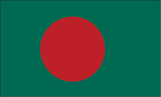
green with a large red disk slightly to the hoist side of center; the red sun of freedom represents the blood shed to achieve independence; the green field symbolizes the lush countryside, and secondarily, the traditional color of Islam
Government type
parliamentary democracy
Independence
16 December 1971 (from West Pakistan); note - 26 March 1971 is the date of independence from West Pakistan, 16 December 1971 is known as Victory Day and commemorates the official creation of the state of Bangladesh
International organization participation
AsDB, C, CCC, CP, ESCAP, FAO, G-77, IAEA, IBRD, ICAO, ICC, ICFTU, ICRM, IDA, IDB, IFAD, IFC, IFRCS, IHO, ILO, IMF, IMO, Interpol, IOC, IOM, ISO, ITU, MINURSO, MONUC, NAM, OIC, OPCW, SAARC, UN, UNAMSIL, UNCTAD, UNESCO, UNHCR, UNIDO, UNIKOM, UNMEE, UNMIBH, UNMIK, UNMOP, UNMOT, UNOMIG, UNTAET, UNU, UPU, WCL, WFTU, WHO, WIPO, WMO, WToO, WTrO
Judicial branch
Supreme Court (the chief justices and other judges are appointed by the president)
Legal system
based on English common law
Legislative branch
unicameral National Parliament or Jatiya Sangsad; 300 seats elected by popular vote from single territorial constituencies (the constitutional amendment reserving 30 seats for women over and above the 300 regular parliament seats expired in May 2001); members serve five-year terms elections: last held 1 October 2001 (next to be held before October 2006) election results: percent of vote by party - BNP and alliance partners 46%, AL 42%; seats by party - BNP 201, AL 62, JI 18, JP (Ershad faction) 14, IOJ 2, JP (Naziur) 1, other 4; note - the election of October 2001 brought a majority BNP government aligned with three other smaller parties - Jamaat-i-Islami, Islami Oikya Jote, and Jatiya Party (Naziur)
National holiday
Independence Day, 26 March (1971); note - 26 March 1971 is the date of independence from West Pakistan, 16 December 1971 is Victory Day and commemorates the official creation of the state of Bangladesh
Political parties and leaders
Awami League or AL [Sheikh HASINA]; Bangladesh Communist Party or BCP [Saifuddin Ahmed MANIK]; Bangladesh Nationalist Party or BNP [Khaleda ZIA, chairperson]; Islami Oikya Jote or IOJ [Mufti Fazlul Haq AMINI]; Jamaat-E-Islami or JI [Motiur Rahman NIZAMI]; Jatiya Party or JP (Ershad faction) [Hussain Mohammad ERSHAD]; Jatiya Party (Manzur faction) [[Naziur Rahman MANZUR]
Political pressure groups and leaders
NA
Suffrage
18 years of age; universal
Economy
Agriculture - products
rice, jute, tea, wheat, sugarcane, potatoes, tobacco, pulses, oilseeds, spices, fruit; beef, milk, poultry
Budget
revenues: $4.9 billion expenditures: $6.8 billion, including capital expenditures of $NA (FY99/00 est.)
Currency
taka (BDT)
Currency code
BDT
Debt - external
$17 billion (2000)
Distribution of family income - Gini index
33.6 (1995-96)
Economic aid - recipient
$1.575 billion (2000 est.)
Economy - overview
Despite sustained domestic and international efforts to improve economic and demographic prospects, Bangladesh remains a poor, overpopulated, and ill-governed nation. Although more than half of GDP is generated through the service sector, nearly two-thirds of Bangladeshis are employed in the agriculture sector, with rice as the single most important product. Major impediments to growth include frequent cyclones and floods, inefficient state-owned enterprises, inadequate port facilities, a rapidly growing labor force that cannot be absorbed by agriculture, delays in exploiting energy resources (natural gas), insufficient power supplies, and slow implementation of economic reforms. Economic reform is stalled in many instances by political infighting and corruption at all levels of government. Progress also has been blocked by opposition from the bureaucracy, public sector unions, and other vested interest groups. The newly-elected BNP government, led by Prime Minister Khaleda ZIA, has the parliamentary strength to push through needed reforms, but the party's level of political will to do so remains undetermined.
Electricity - consumption
12.548 billion kWh (2000)
Electricity - exports
0 kWh (2000)
Electricity - imports
0 kWh (2000)
Electricity - production
13.493 billion kWh (2000)
Electricity - production by source
fossil fuel: 92.45% hydro: 7.55% other: 0% (2000) nuclear: 0%
Exchange rates
taka per US dollar - 57.756 (January 2002), 55.807 (2001), 52.142 (2000), 49.085 (1999), 46.906 (1998), 43.892 (1997)
Exports
$6.6 billion (2001)
Exports - commodities
garments, jute and jute goods, leather, frozen fish and seafood
Exports - partners
US 31.8%, Germany 10.9%, UK 7.9%, France 5.2%, Netherlands 5.2%, Italy 4.42% (2000)
Fiscal year
1 July - 30 June
GDP
purchasing power parity - $230 billion (2001 est.)
GDP - composition by sector
agriculture: 30% industry: 18% services: 52% (2000 est.)
GDP - per capita
purchasing power parity - $1,750 (2001 est.)
GDP - real growth rate
5.6% (2001 est.)
Household income or consumption by percentage share
lowest 10%: 3.9% highest 10%: 28.6% (1995-96 est.)
Imports
$8.7 billion (2001)
Imports - commodities
machinery and equipment, chemicals, iron and steel, textiles, raw cotton, food, crude oil and petroleum products, cement
Imports - partners
India 10.5%, EU 9.5%, Japan 9.5%, Singapore 8.5%, China 7.4% (2000)
Industrial production growth rate
6.2% (2001 est.)
Industries
cotton textiles, jute, garments, tea processing, paper newsprint, cement, chemical fertilizer, light engineering, sugar
Inflation rate (consumer prices)
5.8% (2000 est.)
Labor force
64.1 million (1998) note: extensive export of labor to Saudi Arabia, Kuwait, UAE, Oman, Qatar, and Malaysia; workers' remittances estimated at $1.71 billion in 1998-99
Labor force - by occupation
agriculture 63%, services 26%, industry 11% (FY95/96)
Population below poverty line
35.6% (FY95/96 est.)
Unemployment rate
35% (2001 est.)
Communications
Internet country code
.bd
Internet Service Providers (ISPs)
10 (2000)
Internet users
30,000 (2000)
Radio broadcast stations
AM 12, FM 12, shortwave 2 (1999)
Radios
6.15 million (1997)
Telephone system
totally inadequate for a modern country domestic: UHF microwave radio relay links, and some fiber-optic cable in cities international: satellite earth stations - 2 Intelsat (Indian Ocean); international radiotelephone communications and landline service to neighboring countries (2000)
Telephones - main lines in use
500,000 (2000)
Telephones - mobile cellular
283,000 (2000)
Television broadcast stations
15 (1999)
Televisions
770,000 (1997)
Transportation
Airports
18 (2001)
Airports - with paved runways
total: 15 over 3,047 m: 1 2,438 to 3,047 m: 4 1,524 to 2,437 m: 4 914 to 1,523 m: 1 under 914 m: 5 (2001)
Airports - with unpaved runways
total: 3 1,524 to 2,437 m: 1 under 914 m: 2 (2001)
Highways
total: 201,182 km paved: 19,112 km unpaved: 182,070 km (1997)
Merchant marine
total: 34 ships (1,000 GRT or over) totaling 269,932 GRT/379,271 DWT ships by type: bulk 2, cargo 26, container 3, petroleum tanker 2, refrigerated cargo 1, includes s foreign-owned ship registered here as a flag of convenience: Singapore 5 (2002 est.)
Pipelines
natural gas 1,250 km
Ports and harbors
Chittagong, Dhaka, Mongla Port, Narayanganj (2001)
Railways
total: 2,745 km broad gauge: 923 km 1.676-m gauge narrow gauge: 1,822 km 1.000-m gauge (2000 est.)
Waterways
up to 8,046 km depending on season note: includes 3,058 km main cargo routes
Military and Security
Military branches
Army, Navy, Air Force, Coast Guard, paramilitary forces (includes Bangladesh Rifles, Bangladesh Ansars, Village Defense Parties, Armed Police Battalions, National Cadet Corps)
Military expenditures - dollar figure
$559 million (FY96/97)
Military expenditures - percent of GDP
1.8% (FY96/97)
Military manpower - availability
males age 15-49: 37,303,372 (2002 est.)
Military manpower - fit for military service
males age 15-49: 22,139,736 (2002 est.)
Transnational Issues
Disputes - international
only a small portion of the boundary with India remains undelimited; discussions to demarcate the boundary, exchange 162 miniscule enclaves, and allocate divided villages remain stalled; skirmishes, illegal border trafficking, and violence along the border continue; Bangladesh has protested India's attempts to fence off high traffic sections of the porous boundary; Burmese attempts to construct a dam on the border stream in 2001 prompted an armed response halting construction; Burmese Muslim refugees migrate into Bangladesh straining meager resources
Illicit drugs
transit country for illegal drugs produced in neighboring countries This page was last updated on 1 January 2002 Belize