1995 Edition
CIA World Factbook 1995 (Project Gutenberg)
Geography
Area
total area: 144,000 sq km land area: 133,910 sq km comparative area: slightly smaller than Wisconsin
Climate
tropical; cool, dry winter (October to March); hot, humid summer (March to June); cool, rainy monsoon (June to October)
Coastline
580 km
Environment
current issues: many people are landless and forced to live on and cultivate flood-prone land; limited access to potable water; water-borne diseases prevalent; water pollution especially of fishing areas results from the use of commercial pesticides; intermittent water shortages because of falling water tables in the northern and central parts of the country; soil degradation; deforestation; severe overpopulation natural hazards: droughts, cyclones; much of the country routinely flooded during the summer monsoon season international agreements: party to - Biodiversity, Climate Change, Endangered Species, Environmental Modification, Hazardous Wastes, Nuclear Test Ban, Ozone Layer Protection, Wetlands; signed, but not ratified - Desertification, Law of the Sea
International disputes
a portion of the boundary with India is in dispute; water-sharing problems with upstream riparian India over the Ganges
Irrigated land
27,380 sq km (1989)
Land boundaries
total 4,246 km, Burma 193 km, India 4,053 km
Land use
arable land: 67% permanent crops: 2% meadows and pastures: 4% forest and woodland: 16% other: 11%
Location
Southern Asia, bordering the Bay of Bengal, between Burma and India
Map references
Asia
Maritime claims
contiguous zone: 18 nm continental shelf: up to the outer limits of the continental margin exclusive economic zone: 200 nm territorial sea: 12 nm
Natural resources
natural gas, arable land, timber
Terrain
mostly flat alluvial plain; hilly in southeast
People and Society
Age structure
0-14 years: 40% (female 25,195,262; male 26,352,299) 15-64 years: 57% (female 34,862,105; male 37,867,705) 65 years and over: 3% (female 1,761,336; male 2,056,241) (July 1995 est.)
Birth rate
34.62 births/1,000 population (1995 est.)
Death rate
11.43 deaths/1,000 population (1995 est.)
Ethnic divisions
Bengali 98%, Biharis 250,000, tribals less than 1 million
Infant mortality rate
104.6 deaths/1,000 live births (1995 est.)
Labor force
50.1 million by occupation: agriculture 65%, services 21%, industry and mining 14% (1989) note: extensive export of labor to Saudi Arabia, UAE, and Oman (1991)
Languages
Bangla (official), English
Life expectancy at birth
total population: 55.46 years male: 55.69 years female: 55.22 years (1995 est.)
Literacy
age 15 and over can read and write (1990) total population: 35% male: 47% female: 22%
Nationality
noun: Bangladeshi(s) adjective: Bangladesh
Net migration rate
0 migrant(s)/1,000 population (1995 est.)
Population
128,094,948 (July 1995 est.)
Population growth rate
2.32% (1995 est.)
Religions
Muslim 83%, Hindu 16%, Buddhist, Christian, other
Total fertility rate
4.39 children born/woman (1995 est.)
Government
Administrative divisions
4 divisions; Chittagong, Dhaka, Khulna, Rajshahi
Capital
Dhaka
Constitution
4 November 1972, effective 16 December 1972, suspended following coup of 24 March 1982, restored 10 November 1986, amended many times
Digraph
BG
Diplomatic representation in US
chief of mission: Ambassador Humayun KABIR chancery: 2201 Wisconsin Avenue NW, Washington, DC 20007 telephone: [1] (202) 342-8372 through 8376 consulate(s) general: New York
Executive branch
chief of state: President Abdur Rahman BISWAS (since 8 October 1991); election last held 8 October 1991 (next to be held by NA October 1996); results - Abdur Rahman BISWAS received 52.1% of parliamentary vote head of government: Prime Minister Khaleda ZIAur RAHMAN (since 20 March 1991) cabinet: Council of Ministers; appointed by the president
FAX
[880] (2) 883-744
Flag
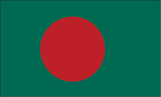
green with a large red disk slightly to the hoist side of center; green is the traditional color of Islam
Independence
16 December 1971 (from Pakistan)
Judicial branch
Supreme Court
Legal system
based on English common law
Legislative branch
unicameral
Member of
AsDB, C, CCC, CP, ESCAP, FAO, G-77, GATT, IAEA, IBRD, ICAO, ICFTU, ICRM, IDA, IDB, IFAD, IFC, IFRCS, ILO, IMF, IMO, INMARSAT, INTELSAT, INTERPOL, IOC, IOM, ISO, ITU, MINURSO, NAM, OIC, SAARC, UN, UNAMIR, UNCTAD, UNESCO, UNIDO, UNIKOM, UNOMIG, UNOMIL, UNOMOZ, UNOMUR, UNOSOM, UNPROFOR, UNU, UPU, WCL, WFTU, WHO, WIPO, WMO, WTO
Names
conventional long form: People's Republic of Bangladesh conventional short form: Bangladesh former: East Pakistan
National holiday
Independence Day, 26 March (1971)
National Parliament (Jatiya Sangsad)
elections last held 27 February 1991 (next to be held by February 1996); results - percent of vote by party NA; seats - (330 total, 300 elected and 30 seats reserved for women) BNP 168, AL 93, JP 35, JI 20, BCP 5, National Awami Party (Muzaffar) 1, Workers Party 1, JSD 1, Ganotantri Party 1, Islami Oikya Jote 1, NDP 1, independents 3
Political parties and leaders
Bangladesh Nationalist Party (BNP), Khaleda ZIAur RAHMAN; Awami League (AL), Sheikh Hasina WAJED; Jatiyo Party (JP), Hussain Mohammad ERSHAD (in jail); Jamaat-E-Islami (JI), Ali KHAN; Bangladesh Communist Party (BCP), Saifuddin Ahmed MANIK; National Awami Party (Muzaffar); Workers Party, leader NA; Jatiyo Samajtantik Dal (JSD), Serajul ALAM KHAN; Ganotantri Party, leader NA; Islami Oikya Jote, leader NA; National Democratic Party (NDP), leader NA; Muslim League, Khan A. SABUR; Democratic League, Khondakar MUSHTAQUE Ahmed; Democratic League, Khondakar MUSHTAQUE Ahmed; United People's Party, Kazi ZAFAR Ahmed
Suffrage
18 years of age; universal
Type
republic
US diplomatic representation
chief of mission: Ambassador David N. MERRILL embassy: Diplomatic Enclave, Madani Avenue, Baridhara, Dhaka mailing address: G. P. O. Box 323, Dhaka 1212 telephone: [880] (2) 884700 through 884722
Economy
Agriculture
accounts for 33% of GDP, 65% of employment, and one-fifth of exports; world's largest exporter of jute; commercial products - jute, rice, wheat, tea, sugarcane, potatoes, beef, milk, poultry; shortages include wheat, vegetable oils, cotton
Budget
revenues: $2.8 billion expenditures: $4.1 billion, including capital expenditures of $1.8 billion (FY92/93)
Currency
1 taka (Tk) = 100 poiska
Economic aid
recipient: US commitments, including Ex-Im (FY70-89), $3.4 billion; Western (non-US) countries, ODA and OOF bilateral commitments (1980-89), $11.65 million; OPEC bilateral aid (1979-89), $6.52 million; Communist countries (1970-89), $1.5 billion
Electricity
capacity: 2,740,000 kW production: 9.2 billion kWh consumption per capita: 70 kWh (1993)
Exchange rates
taka (Tk) per US$1 - 40.250 (January 1995), 40.212 (1994), 39.567 (1993), 38.951 (1992), 36.596 (1991), 34.569 (1990)
Exports
$2.38 billion (1993) commodities: garments, jute and jute goods, leather, shrimp partners: US 33%, Western Europe 39% (Germany 8.4%, Italy 6%) (FY91/92 est.)
External debt
$13.5 billion (June 1993)
Fiscal year
1 July - 30 June
Illicit drugs
transit country for illegal drugs produced in neighboring countries
Imports
$3.99 billion (1993) commodities: capital goods, petroleum, food, textiles partners: Hong Kong 7.5%, Singapore 7.4%, China 7.4%, Japan 7.1% (FY91/92 est.)
Industrial production
growth rate 6.9% (FY92/93 est.); accounts for 9.4% of GDP
Industries
jute manufacturing, cotton textiles, food processing, steel, fertilizer
Inflation rate (consumer prices)
4.3% (1992 est.)
National product
GDP - purchasing power parity - $130.1 billion (1994 est.)
National product per capita
$1,040 (1994 est.)
National product real growth rate
4.5% (1994 est.)
Overview
Despite sustained domestic and international efforts to improve economic and demographic prospects, Bangladesh remains one of the world's poorest, most densely populated, and least developed nations. Its economy is overwhelmingly agricultural, with the cultivation of rice the single most important activity in the economy. Major impediments to growth include frequent cyclones and floods, the inefficiency of state-owned enterprises, a rapidly growing labor force that cannot be absorbed by agriculture, delays in exploiting energy resources (natural gas), and inadequate power supplies. Excellent rice crops and expansion of the export garment industry led to real growth of 4% in 1992 and again in 1993. Policy measures intended to reduce government regulation of private industry, to curb population growth, and to expand employment opportunities have had only partial success given the serious nature of Bangladesh's basic problems.
Unemployment rate
NA%
Communications
Radio
broadcast stations: AM 9, FM 6, shortwave 0 radios: NA
Telephone system
241,250 telephones; 1 telephone/522 persons; poor domestic telephone service local: NA intercity: NA international: 2 INTELSAT (Indian Ocean) earth stations; adequate international radio communications and landline service
Television
broadcast stations: 11 televisions: NA
Transportation
Airports
total: 16 with paved runways over 3,047 m: 2 with paved runways 2,438 to 3,047 m: 2 with paved runways 1,524 to 2,437 m: 4 with paved runways 914 to 1,523 m: 1 with paved runways under 914 m: 7
Highways
total: 7,240 km paved: 3,840 km unpaved: 3,400 km (1985)
Inland waterways
5,150-8,046 km navigable waterways (includes 2,575-3,058 km main cargo routes)
Merchant marine
total: 38 ships (1,000 GRT or over) totaling 293,304 GRT/428,013 DWT ships by type: bulk 2, cargo 31, oil tanker 2, refrigerated cargo 3
Pipelines
natural gas 1,220 km
Ports
Barisal, Chandpur, Chittagong, Cox's Bazar, Dacca, Khulna, Mongla (includes Chalna), Narayanganj
Railroads
total: 2,892 km broad gauge: 978 km 1.676-m gauge narrow gauge: 1,914 km 1.000-m gauge (1992)
Military and Security
Branches
Army, Navy, Air Force paramilitary forces: Bangladesh Rifles, Bangladesh Ansars, Armed Police Reserve, Village Defense Parties, National Cadet Corps
Defense expenditures
exchange rate conversion - $448 million, 1.7% of GDP (FY93/94) ________________________________________________________________________ BARBADOS
Manpower availability
males age 15-49 33,039,035; males fit for military service 19,607,817 (1995 est.)