1991 Edition
CIA World Factbook 1991 (Project Gutenberg)
Geography
Climate
tropical; cool, dry winter (October to March); hot, humid summer (March to June); cool, rainy monsoon (June to October)
Coastline
580 km
Comparative area
slightly smaller than Wisconsin
Disputes
a portion of the boundary with India is in dispute; water sharing problems with upstream riparian India over the Ganges
Environment
vulnerable to droughts; much of country routinely flooded during summer monsoon season; overpopulation; deforestation
Land boundaries
4,246 km total; Burma 193 km, India 4,053 km
Land use
arable land 67%; permanent crops 2%; meadows and pastures 4%; forest and woodland 16%; other 11%; includes irrigated 14%
Maritime claims
Contiguous zone: 18 nm; Continental shelf: up to outer limits of continental margin; Exclusive economic zone: 200 nm; Territorial sea: 12 nm
Natural resources
natural gas, uranium, arable land, timber
Note
almost completely surrounded by India
Terrain
mostly flat alluvial plain; hilly in southeast
Total area
144,000 km2; land area: 133,910 km2
People and Society
Birth rate
36 births/1,000 population (1991)
Death rate
13 deaths/1,000 population (1991)
Ethnic divisions
Bengali 98%, Biharis 250,000, and tribals less than 1 million
Infant mortality rate
118 deaths/1,000 live births (1991)
Labor force
35,100,000; agriculture 74%, services 15%, industry and commerce 11% (FY86); extensive export of labor to Saudi Arabia, UAE, and Oman (1991)
Language
Bangla (official), English widely used
Life expectancy at birth
54 years male, 52 years female (1991)
Literacy
35% (male 47%, female 22%) age 15 and over can read and write (1990 est.)
Nationality
noun--Bangladeshi(s); adjective--Bangladesh
Net migration rate
0 migrants/1,000 population (1991)
Organized labor
3% of labor force belongs to 2,614 registered unions (1986 est.)
Population
116,601,424 (July 1991), growth rate 2.3% (1991)
Religion
Muslim 83%, Hindu 16%, Buddhist, Christian, and other less than 1%
Total fertility rate
4.7 children born/woman (1991)
Government
Administrative divisions
64 districts (zillagulo, singular--zilla); Bagerhat, Bandarban, Barguna, Barisal, Bhola, Bogra, Brahmanbaria, Chandpur, Chapai Nawabganj, Chattagram, Chuadanga, Comilla, Cox's Bazar, Dhaka, Dinajpur, Faridpur, Feni, Gaibandha, Gazipur, Gopalganj, Habiganj, Jaipurhat, Jamalpur, Jessore, Jhalakati, Jhenaidah, Khagrachari, Khulna, Kishorganj, Kurigram, Kushtia, Laksmipur, Lalmonirhat, Madaripur, Magura, Manikganj, Meherpur, Moulavibazar, Munshiganj, Mymensingh, Naogaon, Narail, Narayanganj, Narsingdi, Nator, Netrakona, Nilphamari, Noakhali, Pabna, Panchagar, Parbattya Chattagram, Patuakhali, Pirojpur, Rajbari, Rajshahi, Rangpur, Satkhira, Shariyatpur, Sherpur, Sirajganj, Sunamganj, Sylhet, Tangail, Thakurgaon
Capital
Dhaka
Communists
5,000 members (1987 est.)
Constitution
4 November 1972, effective 16 December 1972, suspended following coup of 24 March 1982, restored 10 November 1986, amended NA March 1991
Diplomatic representation
Ambassador A. H. S. Ataul KARIM; Chancery at 2201 Wisconsin Avenue NW, Washington DC 20007; telephone (202) 342-8372 through 8376; there is a Bangladesh Consulate General in New York; US--Ambassador William B. MILAM; Embassy at Diplomatic Enclave, Madani Avenue, Baridhara, Dhaka (mailing address is G. P. O. Box 323, Dhaka 1212); telephone [880] (2) 884700-22
Elections
President--last held 8 October 1991 (next to be held by October 1996); results--Abdur Rahman BISWAS received 52.1% of parliamentary vote National Parliament--last held 27 February 1991 (next to be held February 1996); results--percent of vote by party NA; seats--(330 total, 300 elected and 30 seats reserved for women) BNP 168, AL 93, JP 35, JI 20, CBP 5, National Awami Party (Muzaffar) 1, Workers Party 1, SIRAJ 1, Ganotantri Party 1, Islami Oikya Jote 1, NDP 1, independents 3
Executive branch
president, prime minister, Cabinet
Flag
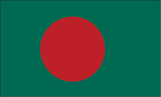
green with a large red disk slightly to the hoist side of center; green is the traditional color of Islam
Independence
16 December 1971 (from Pakistan; formerly East Pakistan)
Judicial branch
Supreme Court
Leaders
Chief of State--President Abdur Rahman BISWAS (since 8 October 1991) Head of Government--Prime Minister Khaleda ZIAUR Rahman (since 20 March 1991)
Legal system
based on English common law
Legislative branch
unicameral National Parliament (Jatiya Sangsad)
Long-form name
People's Republic of Bangladesh
Member of
AsDB, C, CCC, CP, ESCAP, FAO, G-77, GATT, IAEA, IBRD, ICAO, ICFTU, IDA, IDB, IFAD, IFC, ILO, IMF, IMO, INTELSAT, INTERPOL, IOC, ISO, ITU, LORCS, NAM, OIC, SAARC, UN, UNCTAD, UNESCO, UNIDO, UNIIMOG, UPU, WHO, WFTU, WIPO, WCL, WMO, WTO
National holiday
Independence Day, 26 March (1971)
Political parties and leaders
Bangladesh Nationalist Party, Khaleda ZIAUR Rahman; Awami League, Sheikh Hasina WAZED; Jatiyo Party, Hussain Mohammad ERSHAD; Jamaat-E-Islami, Ali KHAN; Bangladesh Communist Party (pro-Soviet), Saifuddin Ahmed MANIK; National Awami Party (Muzaffar); Workers Party, leader NA; Jatiyo Samajtantik Dal (National Socialist Party--SIRAJ), M. A. JALIL; Ganotantri Party, leader NA; Islami Oikya Jote, leader NA; National Democratic Party, leader NA; Muslim League, Khan A. SABUR; Democratic League, Khondakar MUSHTAQUE Ahmed; United People's Party, Kazi ZAFAR Ahmed
Suffrage
universal at age 18
Type
republic
Economy
Agriculture
accounts for about 40% of GDP, 60% of employment, and one third of exports; imports 10% of food grain requirements; world's largest exporter of jute; commercial products--jute, rice, wheat, tea, sugarcane, potatoes, beef, milk, poultry; shortages include wheat, vegetable oils and cotton; fish catch 778,000 metric tons in 1986
Budget
revenues $2.2 billion; expenditures $3.9 billion, including capital expenditures of $1.6 billion (FY90)
Currency
taka (plural--taka); 1 taka (Tk) = 100 paise
Economic aid
US commitments, including Ex-Im (FY70-89), $3.4 billion; Western (non-US) countries, ODA and OOF bilateral commitments (1980-88), $10.6 billion; OPEC bilateral aid (1979-89), $652 million; Communist countries (1970-89), $1.5 billion
Electricity
1,990,000 kW capacity; 5,700 million kWh produced, 50 kWh per capita (1990)
Exchange rates
taka (Tk) per US$1--35.790 (January 1991), 34.567 (1990), 32.270 (1989), 31.733 (1988), 30.950 (1987), 30.407 (1986), 27.995 (1985)
Exports
$1.5 billion (FY90 est.); commodities--jute, tea, leather, shrimp, textiles; partners--US 25%, Western Europe 22%, Middle East 9%, Japan 8%, Eastern Europe 7%
External debt
$10.9 billion (FY90 est.)
Fiscal year
1 July-30 June
GDP
$20.4 billion, per capita $180; real growth rate 4.0% (1990 est.)
Imports
$3.6 billion (FY90 est.); commodities--food, petroleum and other energy, nonfood consumer goods, semiprocessed goods, and capital equipment; partners--Western Europe 18%, Japan 14%, Middle East 9%, US 8%
Industrial production
growth rate 4.1% (FY90 est.); accounts for 15% of GDP
Industries
jute manufacturing, base metals, food processing, cotton textiles, tobacco processing, chemicals
Inflation rate (consumer prices)
10% (FY90 est.)
Overview
Bangladesh is one of the poorest nations in the world. The economy is based on the output of a narrow range of agricultural products, such as jute, which is the main cash crop and major source of export earnings. Bangladesh is hampered by a relative lack of natural resources, population growth of more than 2% a year, large-scale unemployment, and a limited infrastructure; furthermore, it is highly vulnerable to natural disasters. Despite these constraints, real GDP growth averaged about 3.5% annually during 1985-89. A strong agricultural performance in FY90 pushed the growth rate up to 5.5%. Alleviation of poverty remains the cornerstone of the government's development strategy.
Unemployment rate
30% (FY90 est.)
Communications
Airports
16 total, 12 usable; 12 with permanent-surface runways; none with runways over 3,659 m; 4 with runways 2,440-3,659 m; 6 with runways 1,220-2,439 m
Civil air
15 major transport aircraft
Highways
7,240 km total (1985); 3,840 km paved, 3,400 km unpaved
Inland waterways
5,150-8,046 km navigable waterways (includes 2,575-3,058 km main cargo routes)
Merchant marine
47 ships (1,000 GRT or over) totaling 339,081 GRT/500,008 DWT; includes 38 cargo, 2 petroleum, oils, and lubricants (POL) tanker, 3 refrigerated cargo, 1 roll-on/roll-off, 3 bulk
Pipelines
1,220 km natural gas
Ports
Chittagong, Chalna
Railroads
2,892 km total (1986); 1,914 km 1.000 meter gauge, 978 km 1.676 meter broad gauge
Telecommunications
adequate international radio communications and landline service; fair domestic wire and microwave service; fair broadcast service; 241,250 telephones; stations--9 AM, 6 FM, 11 TV; 2 Indian Ocean INTELSAT satellite earth stations
Military and Security
Branches
Army, Navy, Air Force; paramilitary forces--Bangladesh Rifles, Bangladesh Ansars, Armed Police Reserve, Coastal Police
Defense expenditures
$319 million, 1.5% of GDP (FY91) _%_
Manpower availability
males 15-49, 28,896,632; 17,154,593 fit for military service