1995 Edition
CIA World Factbook 1995 (Project Gutenberg)
Geography
Area
total area: 86,600 sq km land area: 86,100 sq km comparative area: slightly larger than Maine note: includes the exclave of Naxcivan Autonomous Republic and the Nagorno-Karabakh region; the region's autonomy was abolished by Azerbaijani Supreme Soviet on 26 November 1991
Climate
dry, semiarid steppe
Coastline
0 km (landlocked) note: Azerbaijan borders the Caspian Sea (800 km, est.)
Environment
current issues: local scientists consider the Abseron (Apsheron) Peninsula (including Baku and Sumqayit) and the Caspian Sea to be the ecologically most devastated area in the world because of severe air, water, and soil pollution; soil pollution results from the use of DDT as a pesticide and also from toxic defoliants used in the production of cotton natural hazards: droughts; some lowland areas threatened by rising levels of the Caspian Sea international agreements: signed, but not ratified - Biodiversity, Climate Change
International disputes
violent and longstanding dispute with ethnic Armenians of Nagorno-Karabakh over its status; Caspian Sea boundaries are not yet determined
Irrigated land
14,010 sq km (1990)
Land boundaries
total 2,013 km, Armenia (west) 566 km, Armenia (southwest) 221 km, Georgia 322 km, Iran (south) 432 km, Iran (southwest) 179 km, Russia 284 km, Turkey 9 km
Land use
arable land: 18% permanent crops: 4% meadows and pastures: 25% forest and woodland: 0% other: 53%
Location
Southwestern Asia, bordering the Caspian Sea, between Iran and Russia
Map references
Commonwealth of Independent States - European States
Maritime claims
none; landlocked
Natural resources
petroleum, natural gas, iron ore, nonferrous metals, alumina
Note
landlocked
Terrain
large, flat Kur-Araz Lowland (much of it below sea level) with Great Caucasus Mountains to the north, Qarabag (Karabakh) Upland in west; Baku lies on Abseron (Apsheron) Peninsula that juts into Caspian Sea
People and Society
Age structure
0-14 years: 33% (female 1,241,952; male 1,315,313) 15-64 years: 61% (female 2,437,810; male 2,307,496) 65 years and over: 6% (female 303,926; male 183,389) (July 1995 est.)
Birth rate
22.05 births/1,000 population (1995 est.)
Death rate
6.56 deaths/1,000 population (1995 est.)
Ethnic divisions
Azeri 90%, Dagestani Peoples 3.2%, Russian 2.5%, Armenian 2.3%, other 2% (1995 est.) note: almost all Armenians live in the separatist Nagorno-Karabakh region
Infant mortality rate
33.9 deaths/1,000 live births (1995 est.)
Labor force
2.789 million by occupation: agriculture and forestry 32%, industry and construction 26%, other 42% (1990)
Languages
Azeri 89%, Russian 3%, Armenian 2%, other 6% (1995 est.)
Life expectancy at birth
total population: 71.09 years male: 67.4 years female: 74.97 years (1995 est.)
Literacy
age 15 and over can read and write (1989) total population: 97% male: 99% female: 96%
Nationality
noun: Azerbaijani(s) adjective: Azerbaijani
Net migration rate
-2.32 migrant(s)/1,000 population (1995 est.)
Population
7,789,886 (July 1995 est.)
Population growth rate
1.32% (1995 est.)
Religions
Muslim 93.4%, Russian Orthodox 2.5%, Armenian Orthodox 2.3%, other 1.8% (1995 est.) note: religious affiliation is still nominal in Azerbaijan; actual practicing adherents are much lower
Total fertility rate
2.64 children born/woman (1995 est.)
Government
Administrative divisions
59 rayons (rayonlar; rayon - singular), 11 cities* (saharlar; sahar - singular), 1 autonomous republic** (muxtar respublika); Abscron Rayonu, Agcabadi Rayonu, Agdam Rayonu, Agdas Rayonu, Agstafa Rayonu, Agsu Rayonu, AliBayramli Sahari*, Astara Rayonu, Baki Sahari*, Balakan Rayonu, Barda Rayonu, Beylaqan Rayonu, Bilasuvar Rayonu, Cabrayil Rayonu, Calilabad Rayonu, Daskasan Rayonu, Davaci Rayonu, Fuzuli Rayonu, Gadabay Rayonu, Ganca Sahari*, Goranboy Rayonu, Goycay Rayonu, Haciqabul Rayonu, Imisli Rayonu, Ismayilli Rayonu, Kalbacar Rayonu, Kurdamir Rayonu, Lacin Rayonu, Lankaran Rayonu, Lankaran Sahari*, Lerik Rayonu, Masalli Rayonu, Mingacevir Sahari*, Naftalan Sahari*, Naxcivan Muxtar Respublikasi**, Neftcala Rayonu, Oguz Rayonu, Qabala Rayonu, Qax Rayonu, Qazax Rayonu, Qobustan Rayonu, Quba Rayonu, Qubadli Rayonu, Qusar Rayonu, Saatli Rayonu, Sabirabad Rayonu, Saki Rayonu, Saki Sahari*, Salyan Rayonu, Samaxi Rayonu, Samkir Rayonu, Samux Rayonu, Siyazan Rayonu, Sumqayit Sahari*, Susa Rayonu, Susa Sahari*, Tartar Rayonu, Tovuz Rayonu, Ucar Rayonu, Xacmaz Rayonu, Xankandi Sahari*, Xanlar Rayonu, Xizi Rayonu, Xocali Rayonu, Xocavand Rayonu, Yardimb Rayonu, Yevlax Rayonu, Yevlax Sahari*, Zangilan Rayonu, Zaqatala Rayonu, Zardab Rayonu
Capital
Baku (Baki)
Constitution
adopted NA April 1978; writing a new constitution
Digraph
AJ
Diplomatic representation in US
chief of mission: Ambassador Hafiz Mir Jalal PASHAYEV chancery: (temporary) Suite 700, 927 15th Street NW, Washington, DC 20005 telephone: [1] (202) 842-0001
Executive branch
chief of state: President Heydar ALIYEV (since 18 June 1993); election last held 3 October 1993 (next to be held NA); results - Heydar ALIYEV won 97% of vote head of government: Acting Prime Minister Fuad QULIYEV (since 9 October 1994); First Deputy Prime Ministers Abbas ABBASOV, Samed SADYKOV, Vahid AKHMEDOV (since NA) cabinet: Council of Ministers; appointed by the president and confirmed by the Mejlis
FAX
- [1] (202) 842-0004
- [9] (9412) 98-37-55
Flag
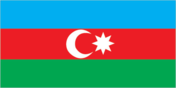
three equal horizontal bands of blue (top), red, and green; a crescent and eight-pointed star in white are centered in red band
Independence
30 August 1991 (from Soviet Union)
Judicial branch
Supreme Court
Legal system
based on civil law system
Legislative branch
unicameral
Member of
BSEC, CCC, CIS, EBRD, ECE, ECO, ESCAP, IBRD, ICAO, IDB, IFAD, ILO, IMF, INTELSAT, INTERPOL, IOC, ITU, NACC, OIC, OSCE, PFP, UN, UNCTAD, UNESCO, UPU, WHO, WMO
Names
conventional long form: Azerbaijani Republic conventional short form: Azerbaijan local long form: Azarbaycan Respublikasi local short form: none former: Azerbaijan Soviet Socialist Republic
National Assembly (Milli Mejlis)
elections last held 30 September and 14 October 1990 for the Supreme Soviet (next expected to be held September 1995 for the National Assembly); seats for Supreme Soviet - (360 total) Communists 280, Democratic Bloc 45 (grouping of opposition parties), other 15, vacant 20; note - on 19 May 1992 the Supreme Soviet was prorogued in favor of a Popular Front-dominated National Council; seats - (50 total) Popular Front 25, opposition elements 25 note: since June 1993 ALIYEV has rotated in several supporters to replace Popular Front adherents
National holiday
Independence Day, 28 May
Other political or pressure groups
self-proclaimed Armenian Nagorno-Karabakh Republic; Talysh independence movement
Political parties and leaders
Azerbaijan Popular Front (APF), Ebulfez ELCIBEY, chairman; Musavat Party, Isa GAMBAR, chairman; National Independence Party, Etibar MAMEDOV, chairman; Social Democratic Party (SDP), Araz ALIZADE, chairman; Communist Party, Ramiz AKHMEDOV, chairman; People's Freedom Party, Yunus OGUZ, chairman; Independent Social Democratic Party, Arif YUNUSOV and Leila YUNOSOVA, cochairmen; New Azerbaijan Party, Heydar ALIYEV, chairman; Boz Gurd Party, Iskander HAMIDOV, chairman; Azerbaijan Democratic Independence Party, Qabil HUSEYNLI, chairman; Islamic Party of Azerbaijan, Ali Akram, chairman; Ana Veten Party, Fazail AGAMALIYEV; Azerbaijan Democratic Party, Sardar Jalaloglu MAMEDOV; Azerbaijan Democratic Party of Proprietors (DPOP), Makhmud MAMEDOV; Azerbaijan Patriotic Solidarity Party, Sabir RUSTAMHANLI; Azerbaijan Republic Reform Party, Fuad ASADOV; Communist Party of Azerbaijan (unregistered), Sayad SAYADOV; Equality of the Peoples Party, Faukhraddin AYDAYEV; Independent Azerbaijan Party, Nizami SULEYMANOV; Labor Party of Azerbaijan, Sabutai HAJIYEV; Liberal-Democratic Party of Azerbaijan, Lyudmila NIKOLAYEVNA; National Enlightenment Party, Hajy Osman EFENDIYEV; National Liberation Party, Panak SHAKHSEVEV; Peasant Party, Firuz MUSTAFAYEV; Radical Party of Azerbaijan, Malik SHARIFOV; United Azerbaijan Party, Kerrar ABILOV; Vetan Adzhagy Party, Zakir TAGIYEV
Suffrage
18 years of age; universal
Type
republic
US diplomatic representation
chief of mission: Ambassador Richard D. KAUZLARICH embassy: Azadliq Prospect 83, Baku mailing address: use embassy street address telephone: [9] (9412) 96-00-19, 98-03-37
Economy
Agriculture
cotton, grain, rice, grapes, fruit, vegetables, tea, tobacco; cattle, pigs, sheep and goats
Budget
revenues: $167.5 million expenditures: $234.6 million, including capital expenditures of $NA (1994)
Currency
1 manat = 100 gopik
Economic aid
recipient: wheat from Turkey
Electricity
capacity: 4,900,000 kW production: 17.5 billion kWh consumption per capita: 2,270 kWh (1994)
Exchange rates
manats per US$1 - 4500 (April 1995), 4168 (end of December 1994)
Exports
$366 million to non-FSU countries (f.o.b., 1994) commodities: oil and gas, chemicals, oilfield equipment, textiles, cotton (1991) partners: mostly CIS and European countries
External debt
$NA
Fiscal year
calendar year
Illicit drugs
illicit cultivator of cannabis and opium poppy; mostly for CIS consumption; limited government eradication program; transshipment point for illicit drugs to Western Europe
Imports
$296 million from non-FSU countries (c.i.f., 1994) commodities: machinery and parts, consumer durables, foodstuffs, textiles (1991) partners: European countries
Industrial production
growth rate -25% (1994)
Industries
petroleum and natural gas, petroleum products, oilfield equipment; steel, iron ore, cement; chemicals and petrochemicals; textiles
Inflation rate (consumer prices)
28% monthly average (1994)
National product
GDP - purchasing power parity - $13.8 billion (1994 estimate as extrapolated from World Bank estimate for 1992)
National product per capita
$1,790 (1994 est.)
National product real growth rate
-22% (1994 est.)
Overview
Azerbaijan is less developed industrially than either Armenia or Georgia, the other Transcaucasian states. It resembles the Central Asian states in its majority nominally Muslim population, high structural unemployment, and low standard of living. The economy's most prominent products are oil, cotton, and gas. Production from the Caspian oil and gas field has been in decline for several years, but the November 1994 ratification of the $7.5 billion oil deal with a consortium of Western companies should generate the funds needed to spur future industrial development. Azerbaijan accounted for 1.5% to 2% of the capital stock and output of the former Soviet Union. Azerbaijan shares all the formidable problems of the ex-Soviet republics in making the transition from a command to a market economy, but its considerable energy resources brighten its long-term prospects. Baku has only recently begun making progress on economic reform, and old economic ties and structures have yet to be replaced.
Unemployment rate
0.9% includes officially registered unemployed; also large numbers of other unemployed and underemployed workers (December 1994)
Communications
Radio
broadcast stations: AM NA, FM NA, shortwave NA radios: NA
Telephone system
710,000 telephones; 90 telephones/1,000 persons (1991); 202,000 persons waiting for telephone installations (January 1991); domestic telephone service is of poor quality and inadequate local: a joint venture to establish a cellular telephone system (Bakcel) in the Baku area is supposed to become operational in 1994 intercity: NA international: connections to other former USSR republics by cable and microwave and to other countries via the Moscow international gateway switch; INTELSAT link installed in late 1992 in Baku with Turkish financial assistance with access to 200 countries through Turkey; since August 1993 an earth station near Baku has provided direct communications with New York through Russia's Stationar-11 satellite
Television
broadcast stations: NA; domestic and Russian TV programs are received locally and Turkish and Iranian TV is received from an INTELSAT satellite through a receive-only earth station televisions: NA
Transportation
Airports
total: 69 with paved runways over 3,047 m: 2 with paved runways 2,438 to 3,047 m: 6 with paved runways 1,524 to 2,437 m: 17 with paved runways 914 to 1,523 m: 3 with paved runways under 914 m: 1 with unpaved runways 914 to 1,523 m: 7 with unpaved runways under 914 m: 33
Highways
total: 36,700 km paved or graveled: 31,800 km unpaved: earth 4,900 km (1990)
Pipelines
crude oil 1,130 km; petroleum products 630 km; natural gas 1,240 km
Ports
Baku (Baki)
Railroads
total: 2,090 km in common carrier service; does not include industrial lines broad gauge: 2,090 km 1.520-m gauge (1990)
Military and Security
Branches
Army, Air Force, Navy, Maritime Border Guard, National Guard, Security Forces (internal and border troops)
Defense expenditures
70.5 billion rubles, 10% of GDP (1993 budget allocation); note - conversion of the military budget into US dollars using the current exchange rate could produce misleading results ________________________________________________________________________ THE BAHAMAS
Manpower availability
males age 15-49 1,927,955; males fit for military service 1,553,736; males reach military age (18) annually 68,407 (1995 est.)