2010 Edition
CIA World Factbook 2010 (Project Gutenberg)
Introduction
Background
Once the center of power for the large Austro-Hungarian Empire, Austria was reduced to a small republic after its defeat in World War I. Following annexation by Nazi Germany in 1938 and subsequent occupation by the victorious Allies in 1945, Austria's status remained unclear for a decade. A State Treaty signed in 1955 ended the occupation, recognized Austria's independence, and forbade unification with Germany. A constitutional law that same year declared the country's "perpetual neutrality" as a condition for Soviet military withdrawal. The Soviet Union's collapse in 1991 and Austria's entry into the European Union in 1995 have altered the meaning of this neutrality. A prosperous, democratic country, Austria entered the EU Economic and Monetary Union in 1999.
Geography
Area
- land
- 82,445 sq km
- total
- 83,871 sq km
- water
- 1,426 sq km
Area - comparative
slightly smaller than Maine
Climate
temperate; continental, cloudy; cold winters with frequent rain and some snow in lowlands and snow in mountains; moderate summers with occasional showers
Coastline
0 km (landlocked)
Elevation extremes
- highest point
- Grossglockner 3,798 m
- lowest point
- Neusiedler See 115 m
Environment - current issues
some forest degradation caused by air and soil pollution; soil pollution results from the use of agricultural chemicals; air pollution results from emissions by coal- and oil-fired power stations and industrial plants and from trucks transiting Austria between northern and southern Europe
Environment - international agreements
- party to
- Air Pollution, Air Pollution-Nitrogen Oxides, Air Pollution-Persistent Organic Pollutants, Air Pollution-Sulfur 85, Air Pollution-Sulphur 94, Air Pollution-Volatile Organic Compounds, Antarctic Treaty, Biodiversity, Climate Change, Climate Change-Kyoto Protocol, Desertification, Endangered Species, Environmental Modification, Hazardous Wastes, Law of the Sea, Ozone Layer Protection, Ship Pollution, Tropical Timber 83, Tropical Timber 94, Wetlands, Whaling signed, but not ratified: none of the selected agreements
Freshwater withdrawal (domestic/industrial/agricultural)
- per capita
- 448 cu m/yr (1999)
- total
- 3.67 cu km/yr (35%/64%/1%)
Geographic coordinates
47 20 N, 13 20 E
Geography - note
landlocked; strategic location at the crossroads of central Europe with many easily traversable Alpine passes and valleys; major river is the Danube; population is concentrated on eastern lowlands because of steep slopes, poor soils, and low temperatures elsewhere
Irrigated land
40 sq km (2003)
Land boundaries
- border countries
- Czech Republic 362 km, Germany 784 km, Hungary 366 km, Italy 430 km, Liechtenstein 35 km, Slovakia 91 km, Slovenia 330 km, Switzerland 164 km
- total
- 2,562 km
Land use
- arable land
- 16.59%
- other
- 82.56% (2005)
- permanent crops
- 0.85%
Location
Central Europe, north of Italy and Slovenia
Map references
Europe
Maritime claims
none (landlocked)
Natural hazards
landslides; avalanches; earthquakes
Natural resources
oil, coal, lignite, timber, iron ore, copper, zinc, antimony, magnesite, tungsten, graphite, salt, hydropower
Terrain
in the west and south mostly mountains (Alps); along the eastern and northern margins mostly flat or gently sloping
Total renewable water resources
84 cu km (2005)
People and Society
Age structure
0-14 years: 14.5% (male 609,748/female 581,144) 15-64 years: 67.5% (male 2,785,091/female 2,756,402) 65 years and over: 18% (male 612,613/female 865,283) (2010 est.)
Birth rate
8.65 births/1,000 population (2010 est.)
Death rate
10.05 deaths/1,000 population (July 2010 est.)
Education expenditures
5.4% of GDP (2007)
Ethnic groups
Austrians 91.1%, former Yugoslavs 4% (includes Croatians, Slovenes, Serbs, and Bosniaks), Turks 1.6%, German 0.9%, other or unspecified 2.4% (2001 census)
HIV/AIDS - adult prevalence rate
0.2% (2007 est.)
HIV/AIDS - deaths
fewer than 100 (2003 est.)
HIV/AIDS - people living with HIV/AIDS
9,800 (2007 est.)
Infant mortality rate
- female
- 3.38 deaths/1,000 live births (2010 est.)
- male
- 5.31 deaths/1,000 live births
- total
- 4.37 deaths/1,000 live births
Languages
German (official nationwide) 88.6%, Turkish 2.3%, Serbian 2.2%, Croatian (official in Burgenland) 1.6%, other (includes Slovene, official in Carinthia, and Hungarian, official in Burgenland) 5.3% (2001 census)
Life expectancy at birth
- female
- 82.71 years (2010 est.)
- male
- 76.74 years
- total population
- 79.65 years
Literacy
- definition: age 15 and over can read and write
- female
- NA
- male
- NA
- total population
- 98%
Median age
- female
- 43.6 years (2010 est.)
- male
- 41.5 years
- total
- 42.6 years
Nationality
- adjective
- Austrian
- noun
- Austrian(s)
Net migration rate
1.83 migrant(s)/1,000 population (2010 est.)
Population
8,214,160 (July 2010 est.)
Population growth rate
0.042% (2010 est.)
Religions
Roman Catholic 73.6%, Protestant 4.7%, Muslim 4.2%, other 3.5%, unspecified 2%, none 12% (2001 census)
School life expectancy (primary to tertiary education)
- female
- 15 years (2008)
- male
- 15 years
- total
- 15 years
Sex ratio
- at birth
- 1.051 male(s)/female under 15 years: 1.05 male(s)/female 15-64 years: 1.01 male(s)/female 65 years and over: 0.71 male(s)/female
- total population
- 0.95 male(s)/female (2010 est.)
Total fertility rate
1.39 children born/woman (2010 est.)
Urbanization
- rate of urbanization
- 0.7% annual rate of change (2005-10 est.)
- urban population
- 67% of total population (2008)
Government
Administrative divisions
9 states (Bundeslaender, singular - Bundesland); Burgenland, Kaernten (Carinthia), Niederoesterreich (Lower Austria), Oberoesterreich (Upper Austria), Salzburg, Steiermark (Styria), Tirol (Tyrol), Vorarlberg, Wien (Vienna)
Capital
- daylight saving time
- +1hr, begins last Sunday in March; ends last Sunday in October
- geographic coordinates
- 48 12 N, 16 22 E
- name
- Vienna
- time difference
- UTC+1 (6 hours ahead of Washington, DC during Standard Time)
Constitution
1920; revised 1929; reinstated 1 May 1945; note - during the period 1 May 1934-1 May 1945 there was a fascist (corporative) constitution in place
Country name
- conventional long form
- Republic of Austria
- conventional short form
- Austria
- local long form
- Republik Oesterreich
- local short form
- Oesterreich
Diplomatic representation from the US
- chief of mission
- Ambassador William C. EACHO III
- embassy
- Boltzmanngasse 16, A-1090, Vienna
- FAX
- [43] (1) 3100682
- mailing address
- use embassy street address
- telephone
- [43] (1) 31339-0
Diplomatic representation in the US
- chancery
- 3524 International Court NW, Washington, DC 20008-3035
- chief of mission
- Ambassador Christian PROSL
- consulate(s) general
- Chicago, Los Angeles, New York
- FAX
- [1] (202) 895-6750
- telephone
- [1] (202) 895-6700
Executive branch
- cabinet
- Council of Ministers chosen by the president on the advice of the chancellor (For more information visit the World Leaders website )
- chief of state
- President Heinz FISCHER (SPOe) (since 8 July 2004)
- election results
- Heinz FISCHER reelected president with 79.3% of the vote note: government coalition - SPOe and OeVP
- elections
- president elected for a six-year term (eligible for a second term) by direct popular vote and formally sworn into office before the Federal Assembly or Bundesversammlung; presidential election last held on 25 April 2010 (next to be held on 25 April 2016); chancellor formally chosen by the president but determined by the coalition parties forming a parliamentary majority; vice chancellor chosen by the president on the advice of the chancellor
- head of government
- Chancellor Werner FAYMANN (SPOe) (since 2 December 2008); Vice Chancellor Josef PROELL (OeVP) (since 2 December 2008)
Flag description
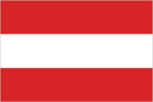
three equal horizontal bands of red (top), white, and red; the flag design is certainly one of the oldest - if not the oldest - national banners in the world; according to tradition, in 1191, following a fierce battle in the Third Crusade, Duke Leopold V of Austria's white tunic became completely blood-spattered; upon removal of his wide belt or sash, a white band was revealed; the red-white-red color combination was subsequently adopted as his banner
Government type
federal republic
Independence
12 November 1918 (republic proclaimed); notable earlier dates: 976 (Margravate of Austria established); 17 September 1156 (Duchy of Austria founded); 11 August 1804 (Austrian Empire proclaimed)
International organization participation
ADB (nonregional member), AfDB (nonregional member), Australia Group, BIS, BSEC (observer), CE, CEI, CERN, EAPC, EBRD, EIB, EMU, ESA, EU, FAO, FATF, G-9, IADB, IAEA, IBRD, ICAO, ICC, ICCt, ICRM, IDA, IEA, IFAD, IFC, IFRCS, ILO, IMF, IMO, Interpol, IOC, IOM, IPU, ISO, ITSO, ITU, ITUC, MIGA, MINURSO, NEA, NSG, OAS (observer), OECD, OIF (observer), OPCW, OSCE, Paris Club, PCA, PFP, Schengen Convention, SECI (observer), UN, UNCTAD, UNDOF, UNESCO, UNFICYP, UNHCR, UNTSO, UNWTO, UPU, WCO, WFTU, WHO, WIPO, WMO, WTO, ZC
Judicial branch
Supreme Judicial Court or Oberster Gerichtshof; Administrative Court or Verwaltungsgerichtshof; Constitutional Court or Verfassungsgerichtshof
Legal system
civil law system with Roman law origin; judicial review of legislative acts by the Constitutional Court; separate administrative and civil/penal supreme courts; accepts compulsory ICJ jurisdiction
Legislative branch
- bicameral Federal Assembly or Bundesversammlung consists of Federal Council or Bundesrat (62 seats; delegates appointed by state parliaments with each state receiving 3 to 12 seats in proportion to its population; members serve five- or six-year terms) and the National Council or Nationalrat (183 seats; members elected by popular vote for a five-year term under a system of proportional representation with partially-open party lists)
- election results
- National Council - percent of vote by party - SPOe 29.3%, OeVP 26%, FPOe 17.5%, BZOe 10.7%, Greens 10.4%, other 6.1%; seats by party - SPOe 57, OeVP 51, FPOe 34, BZOe 21, Greens 20
- elections
- National Council - last held on 28 September 2008 (next to be held by September 2013)
National anthem
- lyrics/music
- Paula von PRERADOVIC/Wolfgang Amadeus MOZART or Johann HOLZER (disputed) note: adopted 1947; the anthem is also known as "Land der Berge, Land am Strome" (Land of the Mountains, Land on the River); Austria adopted a new national anthem after World War II to replace the former imperial anthem composed by Franz Josef HAYDN, which had been appropriated by Germany in 1922 and was now associated with the Nazi regime
- name
- "Bundeshymne" (Federal Hymn)
National holiday
National Day, 26 October (1955); note - commemorates the passage of the law on permanent neutrality
Political parties and leaders
Alliance for the Future of Austria or BZOe [Josef BUCHER]; Austrian People's Party or OeVP [Josef PROELL]; Freedom Party of Austria or FPOe [Heinz Christian STRACHE]; Social Democratic Party of Austria or SPOe [Werner FAYMANN]; The Greens [Eva GLAWISCHNIG]
Political pressure groups and leaders
- Austrian Trade Union Federation or OeGB (nominally independent but primarily Social Democratic); Federal Economic Chamber; OeVP-oriented Association of Austrian Industrialists or IV; Roman Catholic Church, including its chief lay organization, Catholic Action
- other
- three composite leagues of the Austrian People's Party or OeVP representing business, labor, farmers, and other nongovernment organizations in the areas of environment and human rights
Suffrage
16 years of age; universal; note - reduced from 18 years of age in 2007
Economy
Agriculture - products
grains, potatoes, sugar beets, wine, fruit; dairy products, cattle, pigs, poultry; lumber
Commercial bank prime lending rate
5.03% (31 December 2009 est.) 6.82% (31 December 2008 est.)
Current account balance
$8.012 billion (2010 est.) $8.73 billion (2009 est.)
Debt - external
$755 billion (30 June 2010) $864.2 billion (31 December 2008)
Distribution of family income - Gini index
26 (2007) 31 (1995)
Economy - overview
Austria, with its well-developed market economy and high standard of living, is closely tied to other EU economies, especially Germany's. Its economy features a large service sector, a sound industrial sector, and a small, but highly developed agricultural sector. Following several years of solid foreign demand for Austrian exports and record employment growth, the international financial crisis and global economic downturn in 2008 led to a recession that persisted until the third quarter of 2009. Austrian GDP contracted 3.8% in 2009 but saw positive growth of about 2% in 2010. Unemployment has not risen as steeply in Austria as elsewhere in Europe, partly because its government has subsidized reduced working hour schemes to allow companies to retain employees. Such stabilization measures, stimulus initiatives, and the government's income tax reforms pushed the budget deficit to 3.5% of GDP in 2009 and about 5% in 2010, from only about 1.3% in 2008. The international financial crisis caused difficulties for some of Austria's largest banks whose extensive operations in central, eastern, and southeastern Europe faced large losses. The government provided bank support - including in some instances, nationalization - to prevent insolvency and possible regional contagion. In the medium-term all large Austrian banks will need additional capital. Even after the global economic outlook improves, Austria will need to continue restructuring, emphasizing knowledge-based sectors of the economy, and encouraging greater labor flexibility and greater labor participation to offset growing unemployment and Austria's aging population and exceedingly low fertility rate.
Electricity - consumption
68.37 billion kWh (2008 est.)
Electricity - exports
14.93 billion kWh (2008 est.)
Electricity - imports
19.8 billion kWh (2008 est.)
Electricity - production
66.78 billion kWh (2008 est.)
Exchange rates
euros (EUR) per US dollar - 0.7715 (2010), 0.7179 (2009), 0.6827 (2008), 0.7345 (2007), 0.7964 (2006)
Exports
$157.4 billion (2010 est.) $135.7 billion (2009 est.)
Exports - commodities
machinery and equipment, motor vehicles and parts, paper and paperboard, metal goods, chemicals, iron and steel, textiles, foodstuffs
Exports - partners
Germany 30.96%, Italy 8.17%, Switzerland 4.99%, US 3.99% (2009)
GDP - composition by sector
- agriculture
- 1.5%
- industry
- 29.4%
- services
- 69.1% (2010 est.)
GDP - per capita (PPP)
$40,300 (2010 est.) $39,800 (2009 est.) $41,300 (2008 est.) note: data are in 2010 US dollars
GDP - real growth rate
2% (2010 est.) -3.8% (2009 est.) 1.9% (2008 est.)
GDP (official exchange rate)
$366.3 billion (2010 est.)
GDP (purchasing power parity)
$332.9 billion (2010 est.) $326.4 billion (2009 est.) $339.3 billion (2008 est.) note: data are in 2010 US dollars
Household income or consumption by percentage share
lowest 10%: 4% highest 10%: 22% (2007)
Imports
$156 billion (2010 est.) $138.7 billion (2009 est.)
Imports - commodities
machinery and equipment, motor vehicles, chemicals, metal goods, oil and oil products; foodstuffs
Imports - partners
Germany 45.07%, Switzerland 6.76%, Italy 6.66%, Netherlands 4.03% (2009)
Industrial production growth rate
3% (2010 est.)
Industries
construction, machinery, vehicles and parts, food, metals, chemicals, lumber and wood processing, paper and paperboard, communications equipment, tourism
Inflation rate (consumer prices)
1.5% (2010 est.) 0.4% (2009 est.)
Investment (gross fixed)
21% of GDP (2010 est.)
Labor force
3.63 million (2010 est.)
Labor force - by occupation
- agriculture
- 5.5%
- industry
- 27.5%
- services
- 67% (2005 est.)
Market value of publicly traded shares
$53.58 billion (31 December 2009) $72.3 billion (31 December 2008) $228.7 billion (31 December 2007)
Natural gas - consumption
8.232 billion cu m (2009)
Natural gas - exports
3.961 billion cu m (2009 est.)
Natural gas - imports
10.96 billion cu m (2009)
Natural gas - production
1.668 billion cu m (2009)
Natural gas - proved reserves
16.14 billion cu m (1 January 2010 est.)
Oil - consumption
273,700 bbl/day (2009 est.)
Oil - exports
52,970 bbl/day (2008 est.)
Oil - imports
298,400 bbl/day (2008 est.)
Oil - production
25,410 bbl/day (2009 est.)
Oil - proved reserves
50 million bbl (1 January 2010 est.)
Population below poverty line
6% (2008)
Public debt
68.6% of GDP (2010 est.) 66.4% of GDP (2009 est.)
Reserves of foreign exchange and gold
$NA (31 December 2010 est.) $18.05 billion (31 December 2009 est.)
Stock of broad money
$402.8 billion (31 December 2010 est.) $402.2 billion (31 December 2009 est.)
Stock of direct foreign investment - abroad
$297.2 billion (31 December 2010 est.) $290.5 billion (31 December 2009 est.)
Stock of direct foreign investment - at home
$290.7 billion (31 December 2010 est.) $286.4 billion (31 December 2009 est.)
Stock of domestic credit
$659.2 billion (31 December 2009 est.) $606.2 billion (31 December 2008 est.)
Stock of narrow money
$173.4 billion (31 December 2010 est) $175.6 billion (31 December 2009 est) note: see entry for the European Union for money supply for the entire euro area; the European Central Bank (ECB) controls monetary policy for the 16 members of the Economic and Monetary Union (EMU); individual members of the EMU do not control the quantity of money circulating within their own borders
Unemployment rate
4.6% (2010 est.) 4.8% (2009 est.)
Communications
Broadcast media
Austria's public broadcaster, ORF, was the main broadcast source until commercial radio and television service was introduced in the 1990s; cable and satellite TV are available, including German TV stations (2008)
Internet country code
.at
Internet hosts
3.266 million (2010)
Internet users
6.143 million (2009)
Telephone system
- domestic
- fixed-line subscribership has been in decline since the mid-1990s with mobile-cellular subscribership eclipsing it by the late 1990s; the fiber-optic net is very extensive; all telephone applications and Internet services are available
- general assessment
- highly developed and efficient
- international
- country code - 43; satellite earth stations - 15; in addition, there are about 600 VSATs (very small aperture terminals) (2007)
Telephones - main lines in use
3.253 million (2009)
Telephones - mobile cellular
11.773 million (2009)
Transportation
Airports
55 (2010)
Airports - with paved runways
- total
- 25 over 3,047 m: 1 2,438 to 3,047 m: 5 1,524 to 2,437 m: 1 914 to 1,523 m: 4 under 914 m: 14 (2010)
Airports - with unpaved runways
- total
- 30 1,524 to 2,437 m: 1 914 to 1,523 m: 3 under 914 m: 26 (2010)
Heliports
1 (2010)
Merchant marine
- by type
- cargo 2
- registered in other countries
- 4 (Cyprus 1, Malta 1, Saint Vincent and the Grenadines 2) (2010)
- total
- 2
Pipelines
gas 2,721 km; oil 663 km; refined products 157 km (2009)
Ports and terminals
Enns, Krems, Linz, Vienna
Railways
- narrow gauge
- 384 km 1.000-m gauge (15 km electrified); 88 km 0.760-m gauge (10 km electrified) (2008)
- standard gauge
- 5,927 km 1.435-m gauge (3,688 km electrified)
- total
- 6,399 km
Roadways
- paved
- 107,262 km (includes 1,696 km of expressways) (2006)
- total
- 107,262 km
Waterways
358 km (2007)
Military and Security
Manpower available for military service
males age 16-49: 1,960,781 females age 16-49: 1,926,134 (2010 est.)
Manpower fit for military service
males age 16-49: 1,595,379 females age 16-49: 1,566,884 (2010 est.)
Manpower reaching militarily significant age annually
- female
- 47,046 (2010 est.)
- male
- 49,455
Military branches
Land Forces (KdoLdSK), Air Forces (KdoLuSK)
Military expenditures
0.8% of GDP (2009)
Military service age and obligation
18-35 years of age for compulsory military service; 16 years of age for male or female voluntary service; service obligation 6 months of training, followed by an 8-year reserve obligation; conscripts cannot be deployed in military operations outside Austria (2009)
Transnational Issues
Disputes - international
while threats of international legal action never materialized in 2007, 915,220 Austrians, with the support of the newly elected Freedom Party, signed a petition in January 2008, demanding that Austria block the Czech Republic's accession to the EU unless Prague closed its nuclear power plant in Temelin, bordering Austria
Illicit drugs
transshipment point for Southwest Asian heroin and South American cocaine destined for Western Europe; increasing consumption of European-produced synthetic drugs page last updated on January 20, 2011 ======================================================================