2004 Edition
CIA World Factbook 2004 (Project Gutenberg)
Introduction
Background
Once the center of power for the large Austro-Hungarian Empire, Austria was reduced to a small republic after its defeat in World War I. Following annexation by Nazi Germany in 1938 and subsequent occupation by the victorious Allies in 1945, Austria's status remained unclear for a decade. A State Treaty signed in 1955 ended the occupation, recognized Austria's independence, and forbade unification with Germany. A constitutional law that same year declared the country's "perpetual neutrality" as a condition for Soviet military withdrawal. Following the Soviet Union's collapse in 1991 and Austria's entry into the European Union in 1995, some Austrian's have called into question this neutrality. A prosperous, democratic country, Austria entered the European Monetary Union in 1999.
Geography
Area
- land
- 82,444 sq km
- total
- 83,870 sq km
- water
- 1,426 sq km
Area - comparative
slightly smaller than Maine
Climate
temperate; continental, cloudy; cold winters with frequent rain and some snow in lowlands and snow in mountains; moderate summers with occasional showers
Coastline
0 km (landlocked)
Elevation extremes
- highest point
- Grossglockner 3,798 m
- lowest point
- Neusiedler See 115 m
Environment - current issues
some forest degradation caused by air and soil pollution; soil pollution results from the use of agricultural chemicals; air pollution results from emissions by coal- and oil-fired power stations and industrial plants and from trucks transiting Austria between northern and southern Europe
Environment - international agreements
- Pollution-Sulfur 85, Air Pollution-Sulphur 94, Air Pollution-Volatile Organic Compounds, Antarctic Treaty, Biodiversity, Climate Change, Climate Change-Kyoto Protocol, Desertification, Endangered Species, Environmental Modification, Hazardous Wastes, Law of the Sea, Ozone Layer Protection, Ship Pollution, Tropical Timber 83, Tropical Timber 94, Wetlands, Whaling
- party to
- Air Pollution, Air Pollution-Nitrogen Oxides, Air
- signed, but not ratified
- Air Pollution-Persistent Organic Pollutants
Geographic coordinates
47 20 N, 13 20 E
Geography - note
landlocked; strategic location at the crossroads of central Europe with many easily traversable Alpine passes and valleys; major river is the Danube; population is concentrated on eastern lowlands because of steep slopes, poor soils, and low temperatures elsewhere
Irrigated land
457 sq km (2000 est.)
Land boundaries
- km, Italy 430 km, Liechtenstein 35 km, Slovakia 91 km, Slovenia 330 km, Switzerland 164 km
- border countries
- Czech Republic 362 km, Germany 784 km, Hungary 366
- total
- 2,562 km
Land use
- arable land
- 16.91%
- other
- 82.23% (2001)
- permanent crops
- 0.86%
Location
Central Europe, north of Italy and Slovenia
Map references
Europe
Maritime claims
none (landlocked)
Natural hazards
landslides; avalanches; earthquakes
Natural resources
oil, coal, lignite, timber, iron ore, copper, zinc, antimony, magnesite, tungsten, graphite, salt, hydropower
Terrain
in the west and south mostly mountains (Alps); along the eastern and northern margins mostly flat or gently sloping
People and Society
Age structure
0-14 years: 15.9% (male 665,680; female 633,560) 15-64 years: 68.1% (male 2,799,411; female 2,764,426) 65 years and over: 16% (male 518,748; female 792,937) (2004 est.)
Birth rate
8.9 births/1,000 population (2004 est.)
Death rate
9.56 deaths/1,000 population (2004 est.)
Ethnic groups
German 88.5%, indigenous minorities 1.5% (includes Croatians, Slovenes, Hungarians, Czechs, Slovaks, Roma), recent immigrant groups 10% (includes Turks, Bosnians, Serbians, Croatians) (2001)
HIV/AIDS - adult prevalence rate
0.3% (2003 est.)
HIV/AIDS - deaths
less than 100 (2003 est.)
HIV/AIDS - people living with HIV/AIDS
10,000 (2003 est.)
Infant mortality rate
- female
- 3.55 deaths/1,000 live births (2004 est.)
- male
- 5.76 deaths/1,000 live births
- total
- 4.68 deaths/1,000 live births
Languages
German (official nationwide), Slovene (official in Carinthia), Croatian (official in Burgenland), Hungarian (official in Burgenland)
Life expectancy at birth
- female
- 81.89 years (2004 est.)
- male
- 76 years
- total population
- 78.87 years
Literacy
- definition
- age 15 and over can read and write
- female
- NA
- male
- NA
- total population
- 98%
Median age
- female
- 41.2 years (2004 est.)
- male
- 38.8 years
- total
- 40 years
Nationality
- adjective
- Austrian
- noun
- Austrian(s)
Net migration rate
2 migrant(s)/1,000 population (2004 est.)
Population
8,174,762 (July 2004 est.)
Population growth rate
0.14% (2004 est.)
Religions
Roman Catholic 73.6%, Protestant 4.7%, Muslim 4.2%, other 0.1%, none 17.4%
Sex ratio
- 15-64 years: 1.01 male(s)/female 65 years and over: 0.65 male(s)/female
- at birth
- 1.05 male(s)/female
- total population
- 0.95 male(s)/female (2004 est.)
- under 15 years
- 1.05 male(s)/female
Total fertility rate
1.35 children born/woman (2004 est.)
Government
Administrative divisions
9 states (Bundeslaender, singular - Bundesland); Burgenland, Kaernten, Niederoesterreich, Oberoesterreich, Salzburg, Steiermark, Tirol, Vorarlberg, Wien
Capital
Vienna
Constitution
1920; revised 1929 (reinstated 1 May 1945)
Country name
- conventional long form
- Republic of Austria
- conventional short form
- Austria
- local long form
- Republik Oesterreich
- local short form
- Oesterreich
Diplomatic representation from the US
- FAX: [43] (1) 3100682
- chief of mission
- Ambassador William Lee LYONS BROWN, Jr.
- embassy
- Boltzmanngasse 16, A-1090, Vienna
- mailing address
- use embassy street address
- telephone
- [43] (1) 31339-0, 31375, 31335
Diplomatic representation in the US
- FAX: [1] (202) 895-6750
- chancery
- 3524 International Court NW, Washington, DC 20008-3035
- chief of mission
- Ambassador Eva NOWOTNY
- consulate(s) general
- Chicago, Los Angeles, and New York
- telephone
- [1] (202) 895-6700
Executive branch
- February 2000); Vice Chancellor Hubert GORBACH (since 21 October 2003)
- of the chancellor
- term; presidential election last held 25 April 2004 (next to be held NA April 2010); chancellor traditionally chosen by the president from the plurality party in the National Council; vice chancellor chosen by the president on the advice of the chancellor
- Heinz FISCHER (SPOe) 52.4%, Benita FERRERO-WALDNER (OeVP) 47.6%
- cabinet
- Council of Ministers chosen by the president on the advice
- chief of state
- President Heinz FISCHER (since 8 July 2004)
- election results
- Heinz FISCHER elected president; percent of vote -
- elections
- president elected by direct popular vote for a six-year
- head of government
- Chancellor Wolfgang SCHUESSEL (OeVP)(since 4
- note
- government coalition - OeVP and FPOe
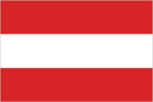
Flag description
three equal horizontal bands of red (top), white, and red
Government type
federal republic
Independence
1156 (Duchy of Austria founded); 12 November 1918 (republic proclaimed)
International organization participation
AfDB, AsDB, Australia Group, BIS, BSEC (observer), CE, CEI, CERN, EAPC, EBRD, EIB, EMU, ESA, EU, FAO, G- 9, IADB, IAEA, IBRD, ICAO, ICC, ICCt, ICFTU, ICRM, IDA, IEA, IFAD, IFC, IFRCS, ILO, IMF, IMO, Interpol, IOC, IOM, ISO, ITU, MIGA, MINURSO, NAM (guest), NEA, NSG, OAS (observer), OECD, OPCW, OSCE, Paris Club, PCA, PFP, UN, UNCTAD, UNDOF, UNESCO, UNFICYP, UNHCR, UNIDO, UNITAR, UNMEE, UNMIK, UNOMIG, UNTSO, UPU, WCL, WCO, WEU (observer), WFTU, WHO, WIPO, WMO, WToO, WTO, ZC
Judicial branch
Supreme Judicial Court or Oberster Gerichtshof; Administrative Court or Verwaltungsgerichtshof; Constitutional Court or Verfassungsgerichtshof
Legal system
civil law system with Roman law origin; judicial review of legislative acts by the Constitutional Court; separate administrative and civil/penal supreme courts; accepts compulsory ICJ jurisdiction
Legislative branch
- bicameral Federal Assembly or Bundesversammlung consists of Federal Council or Bundesrat (62 members; members represent each of the states on the basis of population, but with each state having at least three representatives; members serve a five- or six-year term) and the National Council or Nationalrat (183 seats; members elected by direct popular vote to serve four-year terms)
- 42.3%, SPOe 36.5%, FPOe 10.0%, Greens 9.5%; seats by party - OeVP 79, SPOe 69, FPOe 18, Greens 17
- held in the fall of 2006)
- election results
- National Council - percent of vote by party - OeVP
- elections
- National Council - last held 24 November 2002 (next to be
National holiday
National Day, 26 October (1955); note - commemorates the State Treaty restoring national sovereignty and the end of occupation and the passage of the law on permanent neutrality
Political parties and leaders
Austrian People's Party or OeVP [Wolfgang SCHUESSEL]; Freedom Party of Austria or FPOe [Ursula HAUBNER]; Social Democratic Party of Austria or SPOe [Alfred GUSENBAUER]; The Greens [Alexander VAN DER BELLEN]
Political pressure groups and leaders
Austrian Trade Union Federation (nominally independent but primarily Socialist) or OeGB; Federal Economic Chamber; OeVP-oriented League of Austrian Industrialists or VOeI; Roman Catholic Church, including its chief lay organization, Catholic Action; three composite leagues of the Austrian People's Party or OeVP representing business, labor, and farmers and other non-government organizations in the areas of environment and human rights
Suffrage
18 years of age; universal; compulsory for presidential elections
Economy
Agriculture - products
grains, potatoes, sugar beets, wine, fruit; dairy products, cattle, pigs, poultry; lumber
Budget
- (2004 est.)
- expenditures
- $70 billion, including capital expenditures of NA
- revenues
- $67 billion
Currency
- euro (EUR)
- euro as a common currency to be used by the financial institutions of member countries; as of 1 January 2002, the euro became the only legal tender in EMU member countries, including Austria
- note
- on 1 January 1999, the European Monetary Union introduced the
Currency code
EUR
Current account balance
$-1.353 billion (2003)
Debt - external
$15.5 billion (2003 est.)
Distribution of family income - Gini index
31 (1995)
Economic aid - donor
ODA, $520 million (2002)
Economy - overview
Austria, with its well-developed market economy and high standard of living, is closely tied to other EU economies, especially Germany's. Membership in the EU has drawn an influx of foreign investors attracted by Austria's access to the single European market and proximity to EU aspirant economies. Slow growth in Germany and elsewhere in the world held the economy to 0.7% growth in 2001, 1.4% in 2002, and again less than 1% in 2003. However, recent data signal that the recovery has started. The government estimates economic growth in 2004 of 1.7-2.1% and of 2.5% in 2005. The government is planning a EURO 500 billion income tax cut in 2004, though some economists doubt it will have stimulative effects in 2004, because it will be offset by higher health insurance contributions and higher taxes on energy. For 2005, Austria plans a tax cut of EURO 2.5 billion and harmonization of the various pension schemes. To meet increased competition from both EU and Central European countries, particularly the new EU members, Austria will need to emphasize knowledge-based sectors of the economy, continue to deregulate the service sector, and lower its tax burden. A key issue is the encouragement of much greater participation in the labor market by its aging population.
Electricity - consumption
54.85 billion kWh (2001)
Electricity - exports
14.25 billion kWh (2001)
Electricity - imports
14.47 billion kWh (2001)
Electricity - production
58.75 billion kWh (2001)
Exchange rates
euros per US dollar - 0.886 (2003), 1.0626 (2002), 1.1175 (2001), 1.0854 (2000), 0.9386 (1999)
Exports
$83.45 billion f.o.b. (2003 est.)
Exports - commodities
machinery and equipment, motor vehicles and parts, paper and paperboard, metal goods, chemicals, iron and steel; textiles, foodstuffs
Exports - partners
Germany 31.9%, Italy 9.6%, Switzerland 5.2%, US 4.9%, France 4.8%, UK 4.7% (2003)
Fiscal year
calendar year
GDP
purchasing power parity - $245.3 billion (2003 est.)
GDP - composition by sector
- agriculture
- 3.5%
- industry
- 25.7%
- services
- 70.9% (2003 est.)
GDP - per capita
purchasing power parity - $30,000 (2003 est.)
GDP - real growth rate
0.7% (2003 est.)
Household income or consumption by percentage share
- highest 10%
- 22.5% (1995)
- lowest 10%
- 2.5%
Imports
$81.59 billion f.o.b. (2003 est.)
Imports - commodities
machinery and equipment, motor vehicles, chemicals, metal goods, oil and oil products; foodstuffs
Imports - partners
Germany 43.2%, Italy 6.7%, Hungary 5.4%, Switzerland 5%, Netherlands 4.2% (2003) Reserves of foreign exchange & gold: $12.73 billion (2003)
Industrial production growth rate
1.9% (2003 est.)
Industries
construction, machinery, vehicles and parts, food, chemicals, lumber and wood processing, paper and paperboard, communications equipment, tourism
Inflation rate (consumer prices)
1.4% (2003 est.)
Investment (gross fixed)
22.5% of GDP (2003)
Labor force
3.425 million (2003)
Labor force - by occupation
agriculture and forestry 4%, industry and crafts 29%, services 67% (2001 est.)
Natural gas - consumption
7.81 billion cu m (2001 est.)
Natural gas - exports
403 million cu m (2001 est.)
Natural gas - imports
6.033 billion cu m (2001 est.)
Natural gas - production
1.731 billion cu m (2001 est.)
Natural gas - proved reserves
24.9 billion cu m (1 January 2002)
Oil - consumption
262,400 bbl/day (2001 est.)
Oil - exports
35,470 bbl/day (2001)
Oil - imports
262,000 bbl/day (2001)
Oil - production
20,670 bbl/day (2001 est.)
Oil - proved reserves
85.69 million bbl (1 January 2002)
Population below poverty line
3.9% (1999)
Public debt
67.6% of GDP (2003)
Unemployment rate
4.4% (2003 est.)
Communications
Internet country code
.at
Internet hosts
387,006 (2004)
Internet Service Providers (ISPs)
37 (2000)
Internet users
3.73 million (2003)
Radio broadcast stations
AM 2, FM 65 (plus several hundred repeaters), shortwave 1 (2001)
Radios
6.08 million (1997)
Telephone system
- optic net is very extensive; all telephone applications and Internet services are available
- Intelsat (1 Atlantic Ocean and 1 Indian Ocean) and 1 Eutelsat; in addition, there are about 600 VSAT (very small aperture terminals) (2002)
- domestic
- there are 48 main lines for every 100 persons; the fiber
- general assessment
- highly developed and efficient
- international
- country code - 43; satellite earth stations - 2
Telephones - main lines in use
3.881 million (2003)
Telephones - mobile cellular
7,094,500 (2003)
Television broadcast stations
10 (plus more than 1,000 repeaters) (2001)
Televisions
4.25 million (1997)
Transportation
Airports
55 (2003 est.)
Airports - with paved runways
- 2,438 to 3,047 m: 5 914 to 1,523 m: 3
- 1,524 to 2,437 m: 1
- over 3,047 m
- 1
- total
- 24
- under 914 m
- 14 (2004 est.)
Airports - with unpaved runways
- 1,524 to 2,437 m: 1 914 to 1,523 m: 3
- total
- 31
- under 914 m
- 27 (2004 est.)
Heliports
1 (2003 est.)
Highways
- paved
- 200,000 km (including 1,633 km of expressways)
- total
- 200,000 km
- unpaved
- 0 km (2000)
Merchant marine
- by type
- cargo 4, container 2
- foreign-owned
- Netherlands 1
- registered in other countries
- 34 (2004 est.)
- total
- 6 ships (1,000 GRT or over) 29,624 GRT/37,425 DWT
Pipelines
gas 2,722 km; oil 663 km; refined products 149 km (2004)
Ports and harbors
Enns, Krems, Linz, Vienna
Railways
- 0.760-m gauge (94 km electrified) (2003)
- narrow gauge
- 34 km 1.000-m gauge (28 km electrified); 422 km
- standard gauge
- 5,565 km 1.435-m gauge (3,430 km electrified)
- total
- 6,021 km (3,552 km electrified)
Waterways
358 km (2003)
Military and Security
Military branches
Land Forces (KdoLdSK), Air Forces (KdoLuSK)
Military expenditures - dollar figure
$1.497 billion (FY01/02)
Military expenditures - percent of GDP
0.85% (June 2004)
Military manpower - availability
- males age 15-49
- 2,066,467 (2004 est.)
Military manpower - fit for military service
- males age 15-49
- 1,699,384 (2004 est.)
Military manpower - military age and obligation
18 years of age for compulsory military service; 16 years of age for voluntary service; from 2007, at the earliest, compulsory military service obligation will be reduced from 8 months to 6 (June 2004)
Military manpower - reaching military age annually
- males
- 48,981 (2004 est.)
Transnational Issues
Disputes - international
minor disputes with the Czech Republic over the Temelin Nuclear Power Plant
Illicit drugs
transshipment point for Southwest Asian heroin and South American cocaine destined for Western Europe This page was last updated on 10 February, 2005 @Azerbaijan