1996 Edition
CIA World Factbook 1996 (Project Gutenberg)
Introduction
Description
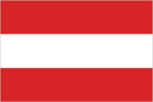
three equal horizontal bands of red (top), white, and red
Location
47 20 N, 13 20 E -- Central Europe, north of Italy Flag ----
Geography
Area
- comparative area
- slightly smaller than Maine
- land area
- 82,730 sq km
- total area
- 83,850 sq km
Climate
temperate; continental, cloudy; cold winters with frequent rain in lowlands and snow in mountains; cool summers with occasional showers
Coastline
0 km (landlocked)
Environment
- current issues
- some forest degradation caused by air and soil pollution; soil pollution results from the use of agricultural chemicals; air pollution results from emissions by coal- and oil-fired power stations and industrial plants and from trucks transiting Austria between northern and southern Europe
- international agreements
- party to - Air Pollution, Air Pollution-Nitrogen Oxides, Air Pollution-Sulphur 85, Air Pollution-Volatile Organic Compounds, Antarctic Treaty, Biodiversity, Climate Change, Endangered Species, Environmental Modification, Hazardous Wastes, Law of the Sea, Nuclear Test Ban, Ozone Layer Protection, Ship Pollution, Tropical Timber 83, Wetlands, Whaling; signed, but not ratified - Air Pollution-Sulphur 94, Antarctic-Environmental Protocol
- natural hazards
- NA
Geographic coordinates
47 20 N, 13 20 E
Geographic note
landlocked; strategic location at the crossroads of central Europe with many easily traversable Alpine passes and valleys; major river is the Danube; population is concentrated on eastern lowlands because of steep slopes, poor soils, and low temperatures elsewhere
International disputes
none
Irrigated land
40 sq km (1989)
Land boundaries
- border countries
- Czech Republic 362 km, Germany 784 km, Hungary 366 km, Italy 430 km, Liechtenstein 37 km, Slovakia 91 km, Slovenia 324 km, Switzerland 164 km
- total
- 2,558 km
Land use
- arable land
- 17%
- forest and woodland
- 39%
- meadows and pastures
- 24%
- other
- 19%
- permanent crops
- 1%
Location
Central Europe, north of Italy
Map references
Europe
Maritime claims
none (landlocked)
Natural resources
iron ore, oil, timber, magnesite, lead, coal, lignite, copper, hydropower
Terrain
- in the west and south mostly mountains (Alps); along the eastern and northern margins mostly flat or gently sloping
- highest point
- Grossglockner 3,797 m
- lowest point
- Neusiedler See 115 m
People and Society
Age structure
0-14 years: 18% (male 720,696; female 685,179) 15-64 years: 67% (male 2,726,122; female 2,659,162) 65 years and over: 15% (male 451,231; female 780,854) (July 1996 est.)
Birth rate
11.19 births/1,000 population (1996 est.)
Death rate
10.43 deaths/1,000 population (1996 est.)
Ethnic divisions
German 99.4%, Croatian 0.3%, Slovene 0.2%, other 0.1%
Infant mortality rate
6.2 deaths/1,000 live births (1996 est.)
Languages
German
Life expectancy at birth
- female
- 79.84 years (1996 est.)
- male
- 73.38 years
- total population
- 76.53 years
Literacy
- age 15 and over can read and write (1974 est.)
- female
- NA%
- male
- NA%
- total population
- 99%
Nationality
- adjective
- Austrian
- noun
- Austrian(s)
Net migration rate
3.34 migrant(s)/1,000 population (1996 est.)
Population
8,023,244 (July 1996 est.)
Population growth rate
0.41% (1996 est.)
Religions
Roman Catholic 85%, Protestant 6%, other 9%
Sex ratio
- all ages
- 0.94 male(s)/female (1996 est.)
- at birth
- 1.05 male(s)/female
- under 15 years
- 1.05 male(s)/female 15-64 years: 1.02 male(s)/female 65 years and over: 0.58 male(s)/female
Total fertility rate
1.49 children born/woman (1996 est.)
Government
Administrative divisions
9 states (bundeslaender, singular - bundesland); Burgenland, Kaernten, Niederoesterreich, Oberoesterreich, Salzburg, Steiermark, Tirol, Vorarlberg, Wien
Capital
Vienna
Constitution
1920; revised 1929 (reinstated 1 May 1945)
Data code
AU
Diplomatic representation in US
- chancery
- 3524 International Court NW, Washington, DC 20008-3035
- chief of mission
- Ambassador Helmut TUERK
- telephone
- [1] (202) 895-6700
Executive branch
- cabinet
- Council of Ministers was chosen by the president on the advice of the chancellor
- chief of state
- President Thomas KLESTIL (since 8 July 1992) was elected for a six-year term by popular vote; election last held 24 May 1992 (next to be held 1998); results of second ballot - Thomas KLESTIL 57%, Rudolf STREICHER 43%
- head of government
- Chancellor Franz VRANITZKY (since 16 June 1986) was chosen by the president from the majority party in the National Council; Vice Chancellor Wolfgang SCHUESSEL (since 22 April 1995) was chosen by the president on the advice of the chancellor
FAX
- [1] (202) 895-6750
- [43] (1) 310-0682
- consulate(s) general
- Chicago, Los Angeles, and New York
Federal Council (Bundesrat)
consists of 63 members representing each of the provinces on the basis of population, but with each province having at least three representatives
Flag
three equal horizontal bands of red (top), white, and red
Independence
12 November 1918 (from Austro-Hungarian Empire)
International organization participation
AfDB, AG (observer), AsDB, Australia Group, BIS, CCC, CE, CEI, CERN, EBRD, ECE, EIB, ESA, EU, FAO, G- 9, IADB, IAEA, IBRD, ICAO, ICC, ICFTU, ICRM, IDA, IEA, IFAD, IFC, IFRCS, ILO, IMF, IMO, Intelsat, Interpol, IOC, IOM, ISO, ITU, MINURSO, MTCR, NACC, NAM (guest), NEA, NSG, OAS (observer), OECD, OSCE, PCA, PFP, UN, UNAMIR, UNCTAD, UNDOF, UNESCO, UNFICYP, UNHCR, UNIDO, UNIKOM, UNMIH, UNMOT, UNOMIG, UNTSO, UPU, WCL, WEU (observer), WFTU, WHO, WIPO, WMO, WToO, WTrO, ZC
Judicial branch
Supreme Judicial Court (Oberster Gerichtshof) for civil and criminal cases; Administrative Court (Verwaltungsgerichtshof) for bureaucratic cases; Constitutional Court (Verfassungsgerichtshof) for constitutional cases
Legal system
civil law system with Roman law origin; judicial review of legislative acts by the Constitutional Court; separate administrative and civil/penal supreme courts; has not accepted compulsory ICJ jurisdiction
Legislative branch
bicameral Federal Assembly (Bundesversammlung)
Name of country
- conventional long form
- Republic of Austria
- conventional short form
- Austria
- local long form
- Republik Oesterreich
- local short form
- Oesterreich
National Council (Nationalrat)
elections last held 17 December 1995 (next to be held Fall 1999); results - SPOE 38.3%, OEVP 28.3%, FPOE 22.1%, Greens 4.6%, LF 5.3%, other 1.4%; seats - (183 total) SPOE 71, OEVP 53, FPOE 40, Greens 9, LF 10
National holiday
National Day, 26 October (1955)
Other political or pressure groups
Federal Chamber of Commerce and Industry; Austrian Trade Union Federation (primarily Socialist); three composite leagues of the Austrian People's Party (OEVP) representing business, labor, and farmers; OEVP-oriented League of Austrian Industrialists; Roman Catholic Church, including its chief lay organization, Catholic Action
Political parties and leaders
Social Democratic Party of Austria (SPOE), Franz VRANITZKY, chairman; Austrian People's Party (OEVP), Wolfgang SCHUESSEL, chairman; Freedom Movement (F, formerly the Freedom Party of Austria or FPOE), Joerg HAIDER, chairman; Communist Party (KPOE), Walter SILBERMAYER, chairman; The Greens, Madeleine PETROVIC; Liberal Forum (LF), Heide SCHMIDT
Suffrage
18 years of age; universal; compulsory for presidential elections
Type of government
federal republic
US diplomatic representation
- chancery
- Boltzmanngasse 16, A-1091, Vienna
- chief of mission
- Ambassador Swanee G. HUNT
- mailing address
- use embassy street address
- telephone
- [43] (1) 313-39
Economy
Agriculture
grains, fruit, potatoes, sugar beets; cattle, pigs, poultry; sawn wood
Budget
- expenditures
- $75.8 billion, including capital expenditures of $NA (1995 est.)
- revenues
- $65 billion
Currency
1 Austrian schilling (S) = 100 groschen
Economic aid
- donor
- ODA, $544 million (1993)
Economic overview
Austria has a well-developed market economy with a sizable - but falling - proportion of nationalized industry, an extensive social system, and a high standard of living. Austria's economy is closely integrated with Germany and other EU members - Austria joined the EU on 1 January 1995. Since the early 1980s, the Austrian economy has experienced stable growth. Following a mild recession in 1993, Austria's economy - driven by strong exports, investment, and private consumption - expanded 2.7% in 1994 and about 2.4% in 1995. The slowdown in 1995 was largely due to an appreciation of the Austrian schilling and its negative effect on exports and tourism. EU membership has had a positive impact on foreign investment and has helped to lower inflation. Despite Austria's generally favorable economic prospects, the government faces a number of economic challenges, especially budget consolidation. Smaller than expected revenues and rising welfare payments caused the budget deficit to climb to 7.1% of GDP in 1995. Austria also faces a growing unemployment problem. Although low by European standards, Austria's unemployment rate has risen gradually during the 1990s as companies restructured to meet competition from the EU single market and Eastern Europe.
Electricity
- capacity
- 17,230,000 kW
- consumption per capita
- 5,824 kWh (1993)
- production
- 50.2 billion kWh
Exchange rates
Austrian schillings (S) per US$1 - 10.314 (January 1996), 10.081 (1995), 11.422 (1994), 11.632 (1993), 10.989 (1992), 11.676 (1991)
Exports
- $45.2 billion (1994)
- commodities
- machinery and equipment, iron and steel, lumber, textiles, paper products, chemicals
- partners
- EU 64.8% (Germany 38.1%, Italy 8.1%), Eastern Europe 11.8%, Japan 1.6%, US 3.5% (1994)
External debt
$28.7 billion (1995 est.)
Fiscal year
calendar year
GDP
purchasing power parity - $152 billion (1995 est.)
GDP composition by sector
- agriculture
- 2%
- industry
- 34%
- services
- 64% (1994)
GDP per capita
$19,000 (1995 est.)
GDP real growth rate
2.4% (1995 est.)
Illicit drugs
transshipment point for Southwest Asian heroin transiting the Balkan route and Eastern Europe
Imports
- $55.3 billion (1994)
- commodities
- petroleum, foodstuffs, machinery and equipment, vehicles, chemicals, textiles and clothing, pharmaceuticals
- partners
- EU 68.4% (Germany 40%, Italy 8.8%), Eastern Europe 6.55%, Japan 4.3%, US 4.4% (1994)
Industrial production growth rate
7.7% (first half 1995)
Industries
food, iron and steel, machines, textiles, chemicals, electrical, paper and pulp, tourism, mining, motor vehicles
Inflation rate (consumer prices)
2.3% (1995 est.)
Labor force
- 3.47 million (1989)
- by occupation
- services 56.4%, industry and crafts 35.4%, agriculture and forestry 8.1%
- note
- an estimated 200,000 Austrians are employed in other European countries; foreign laborers in Austria number 177,840, about 5% of labor force (1988)
Unemployment rate
4.6% (1995 est.)
Communications
Branches
Army (includes Flying Division)
Defense expenditures
exchange rate conversion - $2.1 billion, 1.0% of GDP (1995)
Manpower availability
- males age 15-49
- 2,084,827
- males fit for military service
- 1,741,068
- males reach military age (19) annually
- 45,628 (1996 est.)
Radio broadcast stations
AM 6, FM 21 (repeaters 545), shortwave 0
Radios
NA
Telephone system
- domestic
- highly developed and efficient
- international
- satellite earth stations - 2 Intelsat (1 Atlantic Ocean and 1 Indian Ocean) and 2 Eutelsat
Telephones
3.47 million (1986 est.)
Television broadcast stations
47 (repeaters 870)
Televisions
2,418,584 (1984 est.) Defense
Transportation
Airports
- total
- 55
- with paved runways 1 524 to 2 437 m
- 1
- with paved runways 2 438 to 3 047 m
- 5
- with paved runways 914 to 1 523 m
- 3
- with paved runways over 3 047 m
- 1
- with paved runways under 914 m
- 41
- with unpaved runways 914 to 1 523 m
- 4 (1995 est.)
Heliports
1 (1995 est.)
Highways
- paved
- 22,000 km (including 1,800 km of expressways)
- total
- 108,000 km
- unpaved
- 86,000 km (1992 est.)
Merchant marine
- ships by type
- bulk 1, cargo 23, combination bulk 2, container 1, refrigerated cargo 2 (1995 est.)
- total
- 29 ships (1,000 GRT or over) totaling 88,617 GRT/122,475 DWT
Pipelines
crude oil 554 km; petroleum products 171 km; natural gas 2,611 km
Ports
Linz, Vienna
Railways
- narrow gauge
- 355 km 1.000-m and 0.760-m gauge (86 km electrified) (1995)
- standard gauge
- 5,269 km 1.435-m gauge (3,263 km electrified)
- total
- 5,624 km
Waterways
446 km