1992 Edition
CIA World Factbook 1992 (Project Gutenberg)
Geography
Climate
generally arid to semiarid; temperate in south and east; tropical in north
Coastline
25,760 km
Comparative area
slightly smaller than the US
Contiguous zone
12 nm
Continental shelf
200 m (depth) or to depth of exploitation
Disputes
territorial claim in Antarctica (Australian Antarctic Territory)
Environment
subject to severe droughts and floods; cyclones along coast; limited freshwater availability; irrigated soil degradation; regular, tropical, invigorating, sea breeze known as the doctor occurs along west coast in summer; desertification
Exclusive fishing zone
200 nm
Land area
7,617,930 km2; includes Macquarie Island
Land boundaries
none
Land use
arable land 6%; permanent crops NEGL%; meadows and pastures 58%; forest and woodland 14%; other 22%; includes irrigated NEGL%
Natural resources
bauxite, coal, iron ore, copper, tin, silver, uranium, nickel, tungsten, mineral sands, lead, zinc, diamonds, natural gas, crude oil
Note
world's smallest continent but sixth-largest country
Terrain
mostly low plateau with deserts; fertile plain in southeast
Territorial sea
12 nm
Total area
7,686,850 km2
People and Society
Birth rate
15 births/1,000 population (1992)
Death rate
7 deaths/1,000 population (1992)
Ethnic divisions
Caucasian 95%, Asian 4%, Aboriginal and other 1%
Infant mortality rate
8 deaths/1,000 live births (1992)
Labor force
8,630,000 (September 1991); finance and services 33.8%, public and community services 22.3%, wholesale and retail trade 20.1%, manufacturing and industry 16.2%, agriculture 6.1% (1987)
Languages
English, native languages
Life expectancy at birth
74 years male, 80 years female (1992)
Literacy
100% (male 100%, female 100%) age 15 and over can read and write (1980 est.)
Nationality
noun - Australian(s); adjective - Australian
Net migration rate
7 migrants/1,000 population (1992)
Organized labor
40% of labor force (November 1991)
Population
17,576,354 (July 1992), growth rate 1.4% (1992)
Religions
Anglican 26.1%, Roman Catholic 26.0%, other Christian 24.3%
Total fertility rate
1.8 children born/woman (1992)
Government
Administrative divisions
6 states and 2 territories*; Australian Capital Territory*, New South Wales, Northern Territory*, Queensland, South Australia, Tasmania, Victoria, Western Australia
Capital
Canberra
Chief of State
Queen ELIZABETH II (since February 1952), represented by Governor General William George HAYDEN (since 16 February 1989)
Communists
4,000 members (est.)
Constitution
9 July 1900, effective 1 January 1901
Dependent areas
Ashmore and Cartier Islands, Christmas Island, Cocos (Keeling) Islands, Coral Sea Islands, Heard Island and McDonald Islands, Norfolk Island
Diplomatic representation
Ambassador Michael J. COOK; Chancery at 1601 Massachusetts Avenue NW, Washington, DC 20036; telephone (202) 797-3000; there are Australian Consulates General in Chicago, Honolulu, Houston, Los Angeles, New York, Pago Pago (American Samoa), and San Francisco US: Ambassador Melvin F. SEMBLER; Moonah Place, Yarralumla, Canberra, Australian Capital Territory 2600 (mailing address is APO AP 96549); telephone [61] (6) 270-5000; FAX [61] (6) 270-5970; there are US Consulates General in Melbourne, Perth, and Sydney, and a Consulate in Brisbane
Executive branch
British monarch, governor general, prime minister, deputy prime minister, Cabinet
Flag
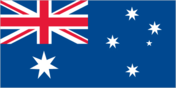
blue with the flag of the UK in the upper hoist-side quadrant and a large seven-pointed star in the lower hoist-side quadrant; the remaining half is a representation of the Southern Cross constellation in white with one small five-pointed star and four, larger, seven-pointed stars
Head of Government
Prime Minister Paul John KEATING (since 20 December 1991); Deputy Prime Minister Brian HOWE (since 4 June 1991)
House of Representatives
last held 24 March 1990 (next to be held by NA November 1993); results - Labor 39.7%, Liberal-National 43%, Australian Democrats and independents 11.1%; seats - (148 total) Labor 78, Liberal-National 69, independent 1
Independence
1 January 1901 (federation of UK colonies)
Judicial branch
High Court
Legal system
based on English common law; accepts compulsory ICJ jurisdiction, with reservations
Legislative branch
bicameral Federal Parliament consists of an upper house or Senate and a lower house or House of Representatives
Long-form name
Commonwealth of Australia
Member of
AfDB, AG (observer), ANZUS, APEC, AsDB, Australia Group, BIS, C, CCC, COCOM, CP, EBRD, ESCAP, FAO, GATT, G-8, IAEA, IBRD, ICAO, ICC, ICFTU, IDA, IEA, IFAD, IFC, ILO, IMF, IMO, INMARSAT, INTELSAT, INTERPOL, IOC, IOM, ISO, ITU, LORCS, MTCR, NAM (guest), NEA, NSG, OECD, PCA, SPC, SPF, UN, UNCTAD, UNESCO, UNFICYP, UNHCR, UNIIMOG, UNTAG, UNTSO, UPU, WFTU, WHO, WIPO, WMO, WTO, ZC
National holiday
Australia Day, 26 January
Other political or pressure groups
Australian Democratic Labor Party (anti-Communist Labor Party splinter group); Peace and Nuclear Disarmament Action (Nuclear Disarmament Party splinter group)
Political parties and leaders
government: Australian Labor Party, Paul John KEATING opposition: Liberal Party, John HEWSON; National Party, Timothy FISCHER; Australian Democratic Party, John COULTER
Senate
last held 11 July 1987 (next to be held by NA July 1993); results - Labor 43%, Liberal-National 42%, Australian Democrats 8%, independents 2%; seats - (76 total) Labor 32, Liberal-National 34, Australian Democrats 7, independents 3
Suffrage
universal and compulsory at age 18
Type
federal parliamentary state
Economy
Agriculture
accounts for 5% of GNP and 37% of export revenues; world's largest exporter of beef and wool, second-largest for mutton, and among top wheat exporters; major crops - wheat, barley, sugarcane, fruit; livestock - cattle, sheep, poultry
Budget
revenues $76.9 billion; expenditures $75.4 billion, including capital expenditures of NA (FY91)
Currency
Australian dollar (plural - dollars); 1 Australian dollar ($A) = 100 cents
Economic aid
donor - ODA and OOF commitments (1970-89), $10.4 billion
Electricity
40,000,000 kW capacity; 155,000 million kWh produced, 8,960 kWh per capita (1991)
Exchange rates
Australian dollars ($A) per US$1 - 1.3360 (January 1992), 1.2836 (1991), 1.2618 (1989), 1.2752 (1988), 1.4267 (1987)
Exports
$41.7 billion (f.o.b., FY91) commodities: metals, minerals, coal, wool, cereals, meat, manufacturers partners: Japan 26%, US 11%, NZ 6%, South Korea 4%, Singapore 4%, UK, Taiwan, Hong Kong
External debt
$130.4 billion (June 1991)
Fiscal year
1 July - 30 June
GDP
purchasing power equivalent - $280.8 billion, per capita $16,200; real growth rate --0.6% (1991 est.)
Illicit drugs
Tasmania is one of the world's major suppliers of licit opiate products; government maintains strict controls over areas of opium poppy cultivation and output of poppy straw concentrate
Imports
$37.8 billion (f.o.b., FY91) commodities: manufactured raw materials, capital equipment, consumer goods partners: US 24%, Japan 19%, UK 6%, FRG 7%, NZ 4% (1990)
Industrial production
growth rate --0.9% (1991); accounts for 32% of GDP
Industries
mining, industrial and transportation equipment, food processing, chemicals, steel, motor vehicles
Inflation rate (consumer prices)
3.3% (September 1991)
Overview
Australia has a prosperous Western-style capitalist economy, with a per capita GDP comparable to levels in industrialized West European countries. Rich in natural resources, Australia is a major exporter of agricultural products, minerals, metals, and fossil fuels. Of the top 25 exports, 21 are primary products, so that, as happened during 1983-84, a downturn in world commodity prices can have a big impact on the economy. The government is pushing for increased exports of manufactured goods, but competition in international markets continues to be severe.
Unemployment rate
10.5% (November 1991)
Communications
Airports
481 total, 440 usable; 237 with permanent-surface runways, 1 with runway over 3,659 m; 20 with runways 2,440-3,659 m; 268 with runways 1,220-2,439 m
Civil air
about 150 major transport aircraft
Highways
837,872 km total; 243,750 km paved, 228,396 km gravel, crushed stone, or stabilized soil surface, 365,726 km unimproved earth
Inland waterways
8,368 km; mainly by small, shallow-draft craft
Merchant marine
85 ships (1,000 GRT or over) totaling 2,324,803 GRT/3,504,385 DWT; includes 2 short-sea passenger, 8 cargo, 8 container, 11 roll-on/roll-off, 1 vehicle carrier, 17 petroleum tanker, 2 chemical tanker, 4 liquefied gas, 1 combination ore/oil, 30 bulk, 1 combination bulk
Pipelines
crude oil 2,500 km; petroleum products 500 km; natural gas 5,600 km
Ports
Adelaide, Brisbane, Cairns, Darwin, Devonport, Fremantle, Geelong, Hobart, Launceston, Mackay, Melbourne, Sydney, Townsville
Railroads
40,478 km total; 7,970 km 1.600-meter gauge, 16,201 km 1.435-meter standard gauge, 16,307 km 1.067-meter gauge; 183 km dual gauge; 1,130 km electrified; government owned (except for a few hundred kilometers of privately owned track) (1985)
Telecommunications
good international and domestic service; 8.7 million telephones; broadcast stations - 258 AM, 67 FM, 134 TV; submarine cables to New Zealand, Papua New Guinea, and Indonesia; domestic satellite service; satellite stations - 4 Indian Ocean INTELSAT, 6 Pacific Ocean INTELSAT earth stations
Military and Security
Branches
Australian Army, Royal Australian Navy, Royal Australian Air Force
Defense expenditures
exchange rate conversion - $7.5 billion, 2.4% of GDP (FY92 budget)
Manpower availability
males 15-49, 4,769,005; 4,153,060 fit for military service; 138,117 reach military age (17) annually