2022 Edition
CIA World Factbook 2022 (factbook.json @ 61dadec0c9c9)
Introduction
Background
In 1816, the United Provinces of the Rio Plata declared their independence from Spain. After Bolivia, Paraguay, and Uruguay went their separate ways, the area that remained became Argentina. The country's population and culture were heavily shaped by immigrants from throughout Europe, with Italy and Spain providing the largest percentage of newcomers from 1860 to 1930. Up until about the mid-20th century, much of Argentina's history was dominated by periods of internal political unrest and conflict between civilian and military factions. After World War II, an era of populism under former President Juan Domingo PERON - the founder of the Peronist political movement - and direct and indirect military interference in subsequent governments was followed by a military junta that took power in 1976. Democracy returned in 1983 after a failed bid to seize the Falkland Islands (Islas Malvinas) by force, and has persisted despite numerous challenges, the most formidable of which was a severe economic crisis in 2001-02 that led to violent public protests and the successive resignations of several presidents. The years 2003-15 saw Peronist rule by Nestor KIRCHNER (2003-07) and his spouse Cristina FERNANDEZ DE KIRCHNER (2007-15), who oversaw several years of strong economic growth (2003-11) followed by a gradual deterioration in the government’s fiscal situation and eventual economic stagnation and isolation. Argentina underwent a brief period of economic reform and international reintegration under Mauricio MACRI (2015-19), but a recession in 2018-19 and frustration with MACRI’s economic policies ushered in a new Peronist government in 2019 led by President Alberto FERNANDEZ and Vice President FERNANDEZ DE KIRCHNER. Presidential elections will take place next in 2023.
Geography
Area
- land
- 2,736,690 sq km
- total
- 2,780,400 sq km
- water
- 43,710 sq km
Area - comparative
slightly less than three-tenths the size of the US
Climate
mostly temperate; arid in southeast; subantarctic in southwest
Coastline
4,989 km
Elevation
- highest point
- Cerro Aconcagua (located in the northwestern corner of the province of Mendoza; highest point in South America) 6,962 m
- lowest point
- Laguna del Carbon (located between Puerto San Julian and Comandante Luis Piedra Buena in the province of Santa Cruz) -105 m
- mean elevation
- 595 m
Geographic coordinates
34 00 S, 64 00 W
Geography - note
note 1: second-largest country in South America (after Brazil); strategic location relative to sea lanes between the South Atlantic and the South Pacific Oceans (Strait of Magellan, Beagle Channel, Drake Passage); diverse geophysical landscapes range from tropical climates in the north to tundra in the far south; Cerro Aconcagua is the Western Hemisphere's tallest mountain, while Laguna del Carbon is the lowest point in the Western Hemisphere; shares Iguazu Falls, the world's largest waterfalls system, with Brazilnote 2: southeast Bolivia and northwest Argentina seem to be the original development site for peanuts
Irrigated land
23,600 sq km (2012)
Land boundaries
- border countries
- Bolivia 942 km; Brazil 1,263 km; Chile 6,691 km; Paraguay 2,531 km; Uruguay 541 km
- total
- 11,968 km
Land use
- agricultural land
- 53.9% (2018 est.)
- agricultural land: arable land
- arable land: 13.9% (2018 est.)
- agricultural land: permanent crops
- permanent crops: 0.4% (2018 est.)
- agricultural land: permanent pasture
- permanent pasture: 39.6% (2018 est.)
- forest
- 10.7% (2018 est.)
- other
- 35.4% (2018 est.)
Location
Southern South America, bordering the South Atlantic Ocean, between Chile and Uruguay
Major aquifers
Guarani Aquifer System
Major lakes (area sq km)
- fresh water lake(s)
- Lago Buenos Aires (shared with Chile) - 2,240 sq km; Lago Argentino - 1,410 sq km; Lago Viedma - 1,090 sq km; Lago San Martin (shared with Chile) - 1,010 sq km; Lago Colhue Huapi - 800 sq km; Lago Fagnano (shared with Chile) - 590 sq km; Lago Nahuel Huapi - 550 sq km
- salt water lake(s)
- Laguna Mar Chiquita - 1,850 sq km;
Major rivers (by length in km)
Rio de la Plata/Parana river mouth (shared with Brazil [s], Paraguay, and Uruguay) - 4,880 km; Paraguay (shared with Brazil [s], and Paraguay [m]) - 2,549 km; Uruguay (shared with Brazil [s] and Uruguay [m]) - 1,610 kmnote – [s] after country name indicates river source; [m] after country name indicates river mouth
Major watersheds (area sq km)
Atlantic Ocean drainage: Paraná (2,582,704 sq km)
Map references
South America
Maritime claims
- contiguous zone
- 24 nm
- continental shelf
- 200 nm or to the edge of the continental margin
- exclusive economic zone
- 200 nm
- territorial sea
- 12 nm
Natural hazards
San Miguel de Tucuman and Mendoza areas in the Andes subject to earthquakes; pamperos are violent windstorms that can strike the pampas and northeast; heavy flooding in some areasvolcanism: volcanic activity in the Andes Mountains along the Chilean border; Copahue (2,997 m) last erupted in 2000; other historically active volcanoes include Llullaillaco, Maipo, Planchon-Peteroa, San Jose, Tromen, Tupungatito, and Viedma
Natural resources
fertile plains of the pampas, lead, zinc, tin, copper, iron ore, manganese, petroleum, uranium, arable land
Population distribution
one-third of the population lives in Buenos Aires; pockets of agglomeration occur throughout the northern and central parts of the country; Patagonia to the south remains sparsely populated
Terrain
rich plains of the Pampas in northern half, flat to rolling plateau of Patagonia in south, rugged Andes along western border
People and Society
Age structure
- 0-14 years
- 24.02% (male 5,629,188/female 5,294,723)
- 15-24 years
- 15.19% (male 3,539,021/female 3,367,321)
- 25-54 years
- 39.6% (male 9,005,758/female 9,002,931)
- 55-64 years
- 9.07% (male 2,000,536/female 2,122,699)
- 65 years and over
- 12.13% (male 2,331,679/female 3,185,262) (2020 est.)
Alcohol consumption per capita
- beer
- 3.62 liters of pure alcohol (2019 est.)
- other alcohols
- 0.72 liters of pure alcohol (2019 est.)
- spirits
- 0.72 liters of pure alcohol (2019 est.)
- total
- 7.95 liters of pure alcohol (2019 est.)
- wine
- 2.88 liters of pure alcohol (2019 est.)
Birth rate
15.58 births/1,000 population (2022 est.)
Children under the age of 5 years underweight
1.7% (2018/19)
Contraceptive prevalence rate
70.1% (2019/20)
Current health expenditure
9.5% of GDP (2019)
Death rate
7.32 deaths/1,000 population (2022 est.)
Demographic profile
Argentina's population continues to grow but at a slower rate because of its steadily declining birth rate. Argentina's fertility decline began earlier than in the rest of Latin America, occurring most rapidly between the early 20th century and the 1950s, and then becoming more gradual. Life expectancy has been improving, most notably among the young and the poor. While the population under age 15 is shrinking, the youth cohort - ages 15-24 - is the largest in Argentina's history and will continue to bolster the working-age population. If this large working-age population is well-educated and gainfully employed, Argentina is likely to experience an economic boost and possibly higher per capita savings and investment. Although literacy and primary school enrollment are nearly universal, grade repetition is problematic and secondary school completion is low. Both of these issues vary widely by region and socioeconomic group. Argentina has been primarily a country of immigration for most of its history, welcoming European immigrants (often providing needed low-skilled labor) after its independence in the 19th century and attracting especially large numbers from Spain and Italy. More than 7 million European immigrants are estimated to have arrived in Argentina between 1880 and 1930, when it adopted a more restrictive immigration policy. European immigration also began to wane in the 1930s because of the global depression. The inflow rebounded temporarily following WWII and resumed its decline in the 1950s when Argentina's military dictators tightened immigration rules and European economies rebounded. Regional migration increased, however, supplying low-skilled workers escaping economic and political instability in their home countries. As of 2015, immigrants made up almost 5% of Argentina's population, the largest share in South America. Migration from neighboring countries accounted for approximately 80% of Argentina's immigrant population in 2015. The first waves of highly skilled Argentine emigrant workers headed mainly to the United States and Spain in the 1960s and 1970s, driven by economic decline and repressive military dictatorships. The 2008 European economic crisis drove the return migration of some Argentinean and other Latin American nationals, as well as the immigration of Europeans to South America, where Argentina was a key recipient. In 2015, Argentina received the highest number of legal migrants in Latin America and the Caribbean. The majority of its migrant inflow came from Paraguay and Bolivia.
Dependency ratios
- elderly dependency ratio
- 18.2
- potential support ratio
- 5.5 (2021 est.)
- total dependency ratio
- 54.3
- youth dependency ratio
- 36
Drinking water source
- improved: rural
- rural: NA
- improved: total
- total: NA
- improved: urban
- urban: 99.8% of population
- unimproved: rural
- rural: NA
- unimproved: total
- total: (2020 est.) NA
- unimproved: urban
- urban: 0.2% of population
Education expenditures
5% of GDP (2020 est.)
Ethnic groups
European (mostly Spanish and Italian descent) and Mestizo (mixed European and Amerindian ancestry) 97.2%, Amerindian 2.4%, African descent 0.4% (2010 est.)
HIV/AIDS - adult prevalence rate
0.4% (2021 est.)
Hospital bed density
5 beds/1,000 population (2017)
Infant mortality rate
- female
- 8.28 deaths/1,000 live births (2022 est.)
- male
- 10.35 deaths/1,000 live births
- total
- 9.35 deaths/1,000 live births
Languages
- Languages
- Spanish (official), Italian, English, German, French, indigenous (Quechua, Guarani, Mapudungun)
- major-language sample(s)
- La Libreta Informativa del Mundo, la fuente indispensable de información básica. (Spanish)The World Factbook, the indispensable source for basic information.
Life expectancy at birth
- female
- 81.59 years (2022 est.)
- male
- 75.23 years
- total population
- 78.31 years
Literacy
- definition
- age 15 and over can read and write
- female
- 99.1% (2018)
- male
- 98.9%
- total population
- 99%
Major infectious diseases
note: widespread ongoing transmission of a respiratory illness caused by the novel coronavirus (COVID-19) is occurring throughout Argentina; as of 9 December 2022, Argentina has reported a total of 9,739,856 cases of COVID-19 or 21,550.36 cumulative cases of COVID-19 per 100,000 population with a total of 130,034 cumulative deaths or 287.7 cumulative deaths per 100,000 population; as of 8 December 2022, 91% of the population has received at least one dose of COVID-19 vaccine
Major urban areas - population
15.490 million BUENOS AIRES (capital), 1.612 million Cordoba, 1.594 million Rosario, 1.226 million Mendoza, 1.027 million San Miguel de Tucuman, 914,000 La Plata (2023)
Maternal mortality ratio
39 deaths/100,000 live births (2017 est.)
Median age
- female
- 33.6 years (2020 est.)
- male
- 31.1 years
- total
- 32.4 years
Nationality
- adjective
- Argentine
- noun
- Argentine(s)
Net migration rate
-0.08 migrant(s)/1,000 population (2022 est.)
Obesity - adult prevalence rate
28.3% (2016)
Physicians density
4.06 physicians/1,000 population (2020)
Population
46,245,668 (2022 est.)
Population distribution
one-third of the population lives in Buenos Aires; pockets of agglomeration occur throughout the northern and central parts of the country; Patagonia to the south remains sparsely populated
Population growth rate
0.82% (2022 est.)
Religions
Roman Catholic 62.9%, Evangelical 15.3% (Pentecostal 13%, other Evangelical 2.3%), Jehovah's Witness and Church of Jesus Christ 1.4%, other 1.2% (includes Muslim, Jewish), none 18.9% (includes agnostic and atheist), unspecified 0.3% (2019 est.)
Sanitation facility access
- improved: rural
- rural: NA
- improved: total
- total: NA
- improved: urban
- urban: 100% of population
- unimproved: rural
- rural: NA
- unimproved: total
- total: (2020 est.) NA
School life expectancy (primary to tertiary education)
- female
- 20 years (2020)
- male
- 17 years
- total
- 18 years
Sex ratio
- 0-14 years
- 1.06 male(s)/female
- 15-24 years
- 1.06 male(s)/female
- 25-54 years
- 1 male(s)/female
- 55-64 years
- 0.94 male(s)/female
- 65 years and over
- 0.57 male(s)/female
- at birth
- 1.07 male(s)/female
- total population
- 0.98 male(s)/female (2022 est.)
Tobacco use
- female
- 19.6% (2020 est.)
- male
- 29.4% (2020 est.)
- total
- 24.5% (2020 est.)
Total fertility rate
2.18 children born/woman (2022 est.)
Urbanization
- rate of urbanization
- 0.97% annual rate of change (2020-25 est.)
- urban population
- 92.5% of total population (2023)
Youth unemployment rate (ages 15-24)
- female
- 26.7% (2021 est.)
- male
- 20.8%
- total
- 23.2%
Government
Administrative divisions
- 23 provinces (provincias, singular - provincia) and 1 autonomous city*; Buenos Aires, Catamarca, Chaco, Chubut, Ciudad Autonoma de Buenos Aires*, Cordoba, Corrientes, Entre Rios, Formosa, Jujuy, La Pampa, La Rioja, Mendoza, Misiones, Neuquen, Rio Negro, Salta, San Juan, San Luis, Santa Cruz, Santa Fe, Santiago del Estero, Tierra del Fuego - Antartida e Islas del Atlantico Sur (Tierra del Fuego - Antarctica and the South Atlantic Islands), Tucuman
- note
- note: the US does not recognize any claims to Antarctica
Capital
- etymology
- the name translates as "fair winds" in Spanish and derives from the original designation of the settlement that would become the present-day city, "Santa Maria del Buen Aire" (Saint Mary of the Fair Winds)
- geographic coordinates
- 34 36 S, 58 22 W
- name
- Buenos Aires
- time difference
- UTC-3 (2 hours ahead of Washington, DC, during Standard Time)
Citizenship
- citizenship by birth
- yes
- citizenship by descent only
- yes
- dual citizenship recognized
- yes
- residency requirement for naturalization
- 2 years
Constitution
- amendments
- a declaration of proposed amendments requires two-thirds majority vote by both houses of the National Congress followed by approval by an ad hoc, multi-member constitutional convention; amended several times, last significant amendment in 1994
- history
- several previous; latest effective 11 May 1853
Country name
- conventional long form
- Argentine Republic
- conventional short form
- Argentina
- etymology
- originally the area was referred to as Tierra Argentina, i.e., "Land beside the Silvery River" or "silvery land," which referred to the massive estuary in the east of the country, the Rio de la Plata (River of Silver); over time the name shortened to simply Argentina or "silvery"
- local long form
- Republica Argentina
- local short form
- Argentina
Diplomatic representation from the US
- chief of mission
- Ambassador Marc Robert STANLEY (since 24 January 2022)
- email address and website
- buenosaires-acs@state.govhttps://ar.usembassy.gov/
- embassy
- Avenida Colombia 4300, (C1425GMN) Buenos Aires
- FAX
- [54] (11) 5777-4240
- mailing address
- 3130 Buenos Aires Place, Washington DC 20521-3130
- telephone
- [54] (11) 5777-4533
Diplomatic representation in the US
- chancery
- 1600 New Hampshire Avenue NW, Washington, DC 20009
- chief of mission
- Ambassador Jorge Martin Arturo ARGUELLO (since 6 February 2020)
- consulate(s) general
- Atlanta, Chicago, Houston, Los Angeles, Miami, New York, Washington, DC
- email address and website
- eeeuu@mrecic.gov.arhttps://eeeuu.cancilleria.gob.ar/en
- FAX
- [1] (202) 332-3171
- telephone
- [1] (202) 238-6400
Executive branch
- cabinet
- Cabinet appointed by the president
- chief of state
- President Alberto Angel FERNANDEZ (since 10 December 2019); Vice President Cristina FERNANDEZ DE KIRCHNER (since 10 December 2019); note - the president is both chief of state and head of government
- election results
- 2019: Alberto Angel FERNANDEZ elected president; percent of vote - Alberto Angel FERNANDEZ (TODOS) 48.1%, Mauricio MACRI (PRO) 40.4%, Roberto LAVAGNA (independent) 6.2%, other 5.3%2015: Mauricio MACRI elected president in second round; percent of vote in first round - Daniel SCIOLI (PJ) 37.1%, Mauricio MACRI (PRO) 34.2%, Sergio MASSA (FR/PJ) 21.4%, other 7.3%; percent of vote in second round - Mauricio MACRI (PRO) 51.4%, Daniel SCIOLI (PJ) 48.6%
- elections/appointments
- president and vice president directly elected on the same ballot by qualified majority vote (to win, a candidate must receive at least 45% of votes or 40% of votes and a 10-point lead over the second place candidate; if neither occurs, a second round is held ); the president serves a 4-year term (eligible for a second consecutive term); election last held on 27 October 2019 (next to be held in October 2023)
- head of government
- President Alberto Angel FERNANDEZ (since 10 December 2019); Vice President Cristina FERNANDEZ DE KIRCHNER (since 10 December 2019)
Flag description
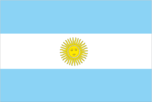
three equal horizontal bands of sky blue (top), white, and sky blue; centered in the white band is a radiant yellow sun with a human face (delineated in brown) known as the Sun of May; the colors represent the clear skies and snow of the Andes; the sun symbol commemorates the appearance of the sun through cloudy skies on 25 May 1810 during the first mass demonstration in favor of independence; the sun features are those of Inti, the Inca god of the sun
Government type
presidential republic
Independence
9 July 1816 (from Spain)
International law organization participation
has not submitted an ICJ jurisdiction declaration; accepts ICCt jurisdiction
International organization participation
AfDB (nonregional member), Australia Group, BCIE, BIS, CAN (associate), CD, CELAC, FAO, FATF, G-15, G-20, G-24, G-77, IADB, IAEA, IBRD, ICAO, ICC (national committees), ICCt, ICRM, IDA, IFAD, IFC, IFRCS, IHO, ILO, IMF, IMO, IMSO, Interpol, IOC, IOM, IPU, ISO, ITSO, ITU, ITUC (NGOs), LAES, LAIA, Mercosur, MIGA, MINURSO, MINUSTAH, NAM (observer), NSG, OAS, OPANAL, OPCW, Paris Club (associate), PCA, PROSUR, SICA (observer), UN, UNASUR, UNCTAD, UNESCO, UNFICYP, UNHCR, UNHRC, UNIDO, Union Latina (observer), UNTSO, UNWTO, UPU, Wassenaar Arrangement, WCO, WFTU (NGOs), WHO, WIPO, WMO, WTO, ZC
Judicial branch
- highest court(s)
- Supreme Court or Corte Suprema (consists of the court president, vice president, 2 judges, 1 vacancy)
- judge selection and term of office
- judges nominated by the president and approved by the Senate; ministers can serve until mandatory retirement at age 75; extensions beyond 75 require renomination by the president and approval by the Senate
- subordinate courts
- federal level appellate, district, and territorial courts; provincial level supreme, appellate, and first instance courts
Legal system
civil law system based on West European legal systems; note - in mid-2015, Argentina adopted a new civil code, replacing the old one in force since 1871
Legislative branch
- description
- bicameral National Congress or Congreso Nacional consists of:Senate or Senado (72 seats; members directly elected on a provincial basis with 2 seats awarded to the party with the most votes and 1 seat to the party with the second highest number of votes; members serve 6-year terms with one-third of the membership renewed every 2 years)Chamber of Deputies or Cámara de Diputados (257 seats; members directly elected in multi-seat constituencies by party-list proportional representation vote using the D'Hondt method; members serve 4-year terms with one-half of the membership renewed every 2 years)
- election results
- Senate - percent of vote by bloc or party - NA; seats by bloc or party - FdT 35, JxC 33, other 4; composition (as of February 2022) men 41, women 31, percent of women 43.1% Chamber of Deputies - percent of vote by bloc or party - NA; seats by bloc or party - FdT 118, JxC 116, FIT-U 4, other: 19; composition (as of February 2022) - men 142, women 115, percent of women 44.7%; note - total National Congress percent of women 44.4%
- elections
- Senate - last held on 14 November 2021 (next to be held 29 October 2023)Chamber of Deputies - last held on 14 November 2021 (next to be held 29 October 2023)
National anthem
- lyrics/music
- Vicente LOPEZ y PLANES/Jose Blas PARERA
- name
- "Himno Nacional Argentino" (Argentine National Anthem)
- note
- note: adopted 1813; Vicente LOPEZ was inspired to write the anthem after watching a play about the 1810 May Revolution against Spain
National heritage
- selected World Heritage Site locales
- Los Glaciares National Park (n); Jesuit Missions of the Guaranis (c); Iguazú National Park (n); Cueva de las Manos (c); Valdés Península (n); Ischigualasto/Talampaya National Parks (n); Jesuit Block and Estancias of Córdoba (c); Quebrada de Humahuaca (c); Qhapaq Ñan/Andean Road System (c)
- total World Heritage Sites
- 11 (6 cultural, 5 natural)
National holiday
Revolution Day (May Revolution Day), 25 May (1810)
National symbol(s)
Sun of May (a sun-with-face symbol); national colors: sky blue, white
Political parties and leaders
Avanza Libertad or AL [Jose Luis ESPERT]Civic Coalition ARI or CC-ARI [Elisa CARRIO, Maximiliano FERRARO]Federal Consensus or CF [Roberto LAVAGNA, Juan Manuel URTUBEY]Frente Civico por Santiago (Civic Front for Santiago) [Gerardo ZAMORA]Frente de Izquierda (Workers' Left Front) or FIT-U [Nicolas DEL CANO, Miriam BREGMAN] (coalition of leftist parties in lower house; includes PTS, PO, and MST) Frente de la Concordia Misionero (Front for the Renewal of Social Concord) or FRCS [Carlos Eduardo ROVIRA]Frente de Todos (Everyone's Front) or FdT [Alberto FERNANDEZ] (includes FR, La Campora, and PJ); note - ruling coalition since 2019; includes several national and provincial Peronist political partiesFrente Renovador (Renewal Front) or FR [Sergio MASSA, Pablo MIROLO]Generacion por un Encuentro Nacional (Generation for a National Encounter) or GEN [Margarita STOLBIZER]Hacemos por Cordoba (We do for Cordoba) or HC [Juan SCHIARETTI]Juntos por el Cambio (Together for Change) or JxC [Horacio Rodríguez LARRETA] (includes CC-ARI, PRO, and UCR); note - primary opposition coalition since 2019Juntos Somos Rio Negro (Together We Are Rio Negro) or JSRN [Alberto WERETILNECK] Justicialist Party or PJ [Alberto Angel FERNANDEZ]La Campora [Maximo KIRCHNER]La Libertad Avanza or LLA [Javier MILEI]Movimiento Popular Neuquino (Neuquen People's Movement) or MPN [Omar GUTIERREZ]Partido Socialista or PS [Monica Haydee FEIN]Propuesta Republicana or PRO [Mauricio MACRI]Radical Civic Union or UCR [Gerardo MORALES]Socialist Workers' Party or PTS [Nicolas DEL CANO]Unidad Federal (coalition of provencial parties in the lower house; includes FRCS and JSRN)Workers' Party or PO [Gabriel SOLANO]Workers' Socialist Movement or MST [Alejandro BODART]Vamos con Vos (Let's Go with You) or VcV [Florencio RANDAZZO]
Suffrage
18-70 years of age; universal and compulsory; 16-17 years of age - optional for national elections
Economy
Agricultural products
maize, soybeans, wheat, sugar cane, milk, barley, sunflower seed, beef, grapes, potatoes
Budget
- expenditures
- 158.6 billion (2017 est.)
- revenues
- 120.6 billion (2017 est.)
Budget surplus (+) or deficit (-)
-6% (of GDP) (2017 est.)
Credit ratings
- Fitch rating
- CCC (2020)
- Moody's rating
- Ca (2020)
- note
- note: The year refers to the year in which the current credit rating was first obtained.
- Standard & Poors rating
- CCC+ (2020)
Current account balance
- Current account balance 2018
- -$27.049 billion (2018 est.)
- Current account balance 2019
- -$3.997 billion (2019 est.)
Debt - external
- Debt - external 2018
- $261.949 billion (2018 est.)
- Debt - external 2019
- $278.524 billion (2019 est.)
Economic overview
Argentina benefits from rich natural resources, a highly literate population, an export-oriented agricultural sector, and a diversified industrial base. Although one of the world's wealthiest countries 100 years ago, Argentina suffered during most of the 20th century from recurring economic crises, persistent fiscal and current account deficits, high inflation, mounting external debt, and capital flight. Cristina FERNANDEZ DE KIRCHNER succeeded her husband as president in late 2007, and in 2008 the rapid economic growth of previous years slowed sharply as government policies held back exports and the world economy fell into recession. In 2010 the economy rebounded strongly, but slowed in late 2011 even as the government continued to rely on expansionary fiscal and monetary policies, which kept inflation in the double digits. In order to deal with these problems, the government expanded state intervention in the economy: it nationalized the oil company YPF from Spain's Repsol, expanded measures to restrict imports, and further tightened currency controls in an effort to bolster foreign reserves and stem capital flight. Between 2011 and 2013, Central Bank foreign reserves dropped $21.3 billion from a high of $52.7 billion. In July 2014, Argentina and China agreed on an $11 billion currency swap; the Argentine Central Bank has received the equivalent of $3.2 billion in Chinese yuan, which it counts as international reserves. With the election of President Mauricio MACRI in November 2015, Argentina began a historic political and economic transformation, as his administration took steps to liberalize the Argentine economy, lifting capital controls, floating the peso, removing export controls on some commodities, cutting some energy subsidies, and reforming the country’s official statistics. Argentina negotiated debt payments with holdout bond creditors, continued working with the IMF to shore up its finances, and returned to international capital markets in April 2016. In 2017, Argentina’s economy emerged from recession with GDP growth of nearly 3.0%. The government passed important pension, tax, and fiscal reforms. And after years of international isolation, Argentina took on several international leadership roles, including hosting the World Economic Forum on Latin America and the World Trade Organization Ministerial Conference, and is set to assume the presidency of the G-20 in 2018.
Exchange rates
- Currency
- Argentine pesos (ARS) per US dollar -
- Exchange rates 2013
- 8.08 (2013 est.)
- Exchange rates 2014
- 9.23 (2014 est.)
- Exchange rates 2018
- 37.23499 (2018 est.)
- Exchange rates 2019
- 59.96559 (2019 est.)
- Exchange rates 2020
- 82.034 (2020 est.)
Exports
- Exports 2018
- $77.07 billion (2018 est.)
- Exports 2019
- $79.29 billion (2019 est.)
- Exports 2020
- $64.18 billion (2020 est.)
- note
- note: Data are in current year dollars and do not include illicit exports or re-exports.
Exports - commodities
soybean products, corn, delivery trucks, wheat, frozen meat, gold (2019)
Exports - partners
Brazil 16%, China 11%, United States 7%, Chile 5% (2019)
Fiscal year
calendar year
GDP - composition, by end use
- exports of goods and services
- 11.2% (2017 est.)
- government consumption
- 18.2% (2017 est.)
- household consumption
- 65.9% (2017 est.)
- imports of goods and services
- -13.8% (2017 est.)
- investment in fixed capital
- 14.8% (2017 est.)
- investment in inventories
- 3.7% (2017 est.)
GDP - composition, by sector of origin
- agriculture
- 10.8% (2017 est.)
- industry
- 28.1% (2017 est.)
- services
- 61.1% (2017 est.)
GDP (official exchange rate)
$447.467 billion (2019 est.)
Gini Index coefficient - distribution of family income
- Gini Index coefficient - distribution of family income 2009
- 45.8 (2009)
- Gini Index coefficient - distribution of family income 2018
- 41.4 (2018 est.)
Household income or consumption by percentage share
- highest 10%
- 31% (2017 est.)
- lowest 10%
- 1.8%
Imports
- Imports 2018
- $86.78 billion (2018 est.) note: data are in current year dollars
- Imports 2019
- $66.28 billion (2019 est.) note: data are in current year dollars
- Imports 2020
- $52.14 billion (2020 est.) note: data are in current year dollars
Imports - commodities
cars, refined petroleum, vehicle parts, natural gas, soybeans (2019)
Imports - partners
Brazil 21%, China 18%, US 14%, Germany 6% (2019)
Industrial production growth rate
- 2.7% (2017 est.)
- note
- note: based on private sector estimates
Industries
food processing, motor vehicles, consumer durables, textiles, chemicals and petrochemicals, printing, metallurgy, steel
Inflation rate (consumer prices)
- Inflation rate (consumer prices) 2016
- 26.5% (2016 est.)
- Inflation rate (consumer prices) 2017
- 25.7% (2017 est.)
- note
- note: data are derived from private estimates
Labor force
- 18 million (2017 est.)
- note
- note: urban areas only
Labor force - by occupation
- agriculture
- 5.3%
- industry
- 28.6%
- services
- 66.1% (2017 est.)
Population below poverty line
35.5% (2019 est.)
Public debt
- Public debt 2016
- 55% of GDP (2016 est.)
- Public debt 2017
- 57.6% of GDP (2017 est.)
Real GDP (purchasing power parity)
- note
- note: data are in 2017 dollars
- Real GDP (purchasing power parity) 2018
- $1,012,670,000,000 (2018 est.)
- Real GDP (purchasing power parity) 2019
- $991.52 billion (2019 est.)
- Real GDP (purchasing power parity) 2020
- $893.31 billion (2020 est.)
Real GDP growth rate
- Real GDP growth rate 2017
- 2.83% (2017 est.)
- Real GDP growth rate 2018
- -2.53% (2018 est.)
- Real GDP growth rate 2019
- -2.03% (2019 est.)
Real GDP per capita
- note
- note: data are in 2017 dollars
- Real GDP per capita 2018
- $22,800 (2018 est.)
- Real GDP per capita 2019
- $22,100 (2019 est.)
- Real GDP per capita 2020
- $19,700 (2020 est.)
Reserves of foreign exchange and gold
- Reserves of foreign exchange and gold 31 December 2016
- $38.43 billion (31 December 2016 est.)
- Reserves of foreign exchange and gold 31 December 2017
- $55.33 billion (31 December 2017 est.)
Taxes and other revenues
18.9% (of GDP) (2017 est.)
Unemployment rate
- Unemployment rate 2018
- 9.18% (2018 est.)
- Unemployment rate 2019
- 9.84% (2019 est.)
Youth unemployment rate (ages 15-24)
- female
- 26.7% (2021 est.)
- male
- 20.8%
- total
- 23.2%
Energy
Carbon dioxide emissions
- from coal and metallurgical coke
- 2.122 million metric tonnes of CO2 (2019 est.)
- from consumed natural gas
- 96.875 million metric tonnes of CO2 (2019 est.)
- from petroleum and other liquids
- 94.208 million metric tonnes of CO2 (2019 est.)
- total emissions
- 193.205 million metric tonnes of CO2 (2019 est.)
Coal
- consumption
- 1.55 million metric tons (2020 est.)
- exports
- 4,000 metric tons (2020 est.)
- imports
- 990,000 metric tons (2020 est.)
- production
- 829,000 metric tons (2020 est.)
- proven reserves
- 500 million metric tons (2019 est.)
Electricity
- consumption
- 121,563,940,000 kWh (2020 est.)
- exports
- 261 million kWh (2020 est.)
- imports
- 7.802 billion kWh (2020 est.)
- installed generating capacity
- 44.731 million kW (2020 est.)
- transmission/distribution losses
- 20.74 billion kWh (2020 est.)
Electricity access
- electrification - rural areas
- 85% (2020)
- electrification - total population
- 99% (2020)
- electrification - urban areas
- 99% (2020)
Electricity generation sources
- biomass and waste
- 1.5% of total installed capacity (2020 est.)
- fossil fuels
- 65.8% of total installed capacity (2020 est.)
- geothermal
- 0% of total installed capacity (2020 est.)
- hydroelectricity
- 17.6% of total installed capacity (2020 est.)
- nuclear
- 7.3% of total installed capacity (2020 est.)
- solar
- 1% of total installed capacity (2020 est.)
- tide and wave
- 0% of total installed capacity (2020 est.)
- wind
- 6.8% of total installed capacity (2020 est.)
Energy consumption per capita
- Total energy consumption per capita 2019
- 79.083 million Btu/person (2019 est.)
Natural gas
- consumption
- 49,476,585,000 cubic meters (2019 est.)
- exports
- 691.241 million cubic meters (2019 est.)
- imports
- 6,865,323,000 cubic meters (2019 est.)
- production
- 41,194,148,000 cubic meters (2020 est.)
- proven reserves
- 396.464 billion cubic meters (2021 est.)
Petroleum
- crude oil and lease condensate exports
- 59,100 bbl/day (2018 est.)
- crude oil and lease condensate imports
- 11,400 bbl/day (2018 est.)
- crude oil estimated reserves
- 2,482,700,000 barrels (2021 est.)
- refined petroleum consumption
- 680,000 bbl/day (2019 est.)
- total petroleum production
- 690,200 bbl/day (2021 est.)
Refined petroleum products - exports
58,360 bbl/day (2015 est.)
Refined petroleum products - imports
121,400 bbl/day (2015 est.)
Refined petroleum products - production
669,800 bbl/day (2015 est.)
Communications
Broadband - fixed subscriptions
- subscriptions per 100 inhabitants
- 21 (2020 est.)
- total
- 9,571,562 (2020 est.)
Broadcast media
government owns a TV station and radio network; more than two dozen TV stations and hundreds of privately owned radio stations; high rate of cable TV subscription usage (2022)
Internet country code
.ar
Internet users
- percent of population
- 86% (2020 est.)
- total
- 39,024,016 (2020 est.)
Telecommunication systems
- domestic
- roughly 16 per 100 fixed-line and 121 per 100 mobile-cellular; microwave radio relay, fiber-optic cable, and a domestic satellite system with 40 earth stations serve the trunk network (2020)
- general assessment
- Argentina’s ongoing problem with hyperinflation continues to distort the telecom market’s performance, which shows strong growth in revenue but only modest gains in subscriber numbers each year; the fixed broadband segment has penetration levels only slightly higher than the fixed-line teledensity; nearly a quarter of the country’s broadband connections are via DSL, although fiber is starting claim an increasing share of that market as networks expand across most of the main cities; mobile broadband continues to be the preferred platform for internet access, supported by high mobile penetration levels and nationwide LTE coverage; the first 5G service was launched in February 2021 using refarmed LTE frequencies; the anticipated 5G spectrum auctions should drive even stronger uptake in mobile broadband services; while the various fixed, mobile, and cable operators push to expand and enhance their services, the government is also making an active contribution towards boosting broadband connectivity around the country; its national connectivity plan ‘Plan Conectar’, launched in September 2020, provides funding for a range of programs to increase coverage; in August 2021, the telecom regulator announced the release funding to help operators accelerate the rollout of their broadband infrastructure and services (2021)
- international
- country code - 54; landing points for the UNISUR, Bicentenario, Atlantis-2, SAm-1, and SAC, Tannat, Malbec and ARBR submarine cable systems that provide links to Europe, Africa, South and Central America, and US; satellite earth stations - 112 (2019)
- note
- note: the COVID-19 pandemic continues to have a significant impact on production and supply chains globally; since 2020, some aspects of the telecom sector have experienced a downturn, particularly in mobile device production; progress toward 5G implementation has resumed, as well as upgrades to infrastructure; consumer spending on telecom services has increased due to the surge in demand for capacity and bandwidth; the crucial nature of telecom services as a tool for work and school from home is still evident, and the spike in this area has seen growth opportunities for development of new tools and increased services
Telephones - fixed lines
- subscriptions per 100 inhabitants
- 16 (2020 est.)
- total subscriptions
- 7,356,165 (2020 est.)
Telephones - mobile cellular
- subscriptions per 100 inhabitants
- 121 (2020 est.)
- total subscriptions
- 54,763,900 (2020 est.)
Transportation
Airports
- total
- 916 (2021)
Airports - with paved runways
- 1,524 to 2,437 m
- 65
- 2,438 to 3,047 m
- 29
- 914 to 1,523 m
- 53
- over 3,047 m
- 4
- total
- 161
- under 914 m
- 10 (2021)
Airports - with unpaved runways
- 1,524 to 2,437 m
- 43
- 2,438 to 3,047 m
- 1
- 914 to 1,523 m
- 484
- over 3,047 m
- 1
- total
- 977
- under 914 m
- 448 (2021)
Civil aircraft registration country code prefix
LV
Heliports
2 (2021)
Merchant marine
- by type
- container ship 1,bulk carrier 1 general cargo 8, oil tanker 33, other 159 (2021)
- total
- 202
National air transport system
- annual freight traffic on registered air carriers
- 311.57 million (2018) mt-km
- annual passenger traffic on registered air carriers
- 18,081,937 (2018)
- inventory of registered aircraft operated by air carriers
- 107
- number of registered air carriers
- 6 (2020)
Pipelines
29,930 km gas, 41 km liquid petroleum gas, 6,248 km oil, 3,631 km refined products (2013)
Ports and terminals
- container port(s) (TEUs)
- Buenos Aires (1,485,328) (2019)
- LNG terminal(s) (import)
- Bahia Blanca
- major seaport(s)
- Bahia Blanca, Buenos Aires, La Plata, Punta Colorada, Ushuaia
- river port(s)
- Arroyo Seco, Rosario, San Lorenzo-San Martin (Parana)
Railways
- broad gauge
- 26,391 km (2014) 1.676-m gauge (149 km electrified)
- narrow gauge
- 7,523.3 km (2014) 1.000-m gauge
- note
- 258 km 0.750-mm gauge
- standard gauge
- 2,745.1 km (2014) 1.435-m gauge (41.1 km electrified)
- total
- 36,917.4 km (2014)
Roadways
- paved
- 117,616 km (2017)
- total
- 281,290 km (2017)
- unpaved
- 163,674 km (2017)
Transportation - note
Argentina operates one PC 5 or 6 class light icebreakernote - PC indicates a Polar Class vessel: PC 5 - year-round operation in medium first-year ice which may include old ice inclusions (ice thickness up to 70-120 cm); PC 6 - summer/autumn operation in medium first-year ice which may include old ice inclusions (ice thickness up to 30-70 cm)
Waterways
11,000 km (2012)
Military and Security
Military - note
the Army and Navy were both created in 1810 during the Argentine War of Independence, while the Air Force was established in 1945; the military coups d'état in 1930, 1943, 1955, 1962, 1966, and 1976; the 1976 coup, aka the "National Reorganization Process," marked the beginning of the so-called "Dirty War," a period of state-sponsored terrorism that saw the deaths or disappearances of thousands of Argentinians; the defeat in the 1983 Falklands War led to the downfall of the military juntaArgentina and Chile have a joint peacekeeping force known as the Combined Southern Cross Peacekeeping Force (FPC), designed to be made available to the UN; the FPC is made up of two battalions, one from each country, a command and service company, an air component (a squadron of Argentine and Chilean helicopters), a naval component, and a combined logistics support unitArgentina has Major Non-NATO Ally (MNNA) status with the US; MNNA is a designation under US law that provides foreign partners with certain benefits in the areas of defense trade and security cooperation; while MNNA status provides military and economic privileges, it does not entail any security commitments (2022)
Military and security forces
Armed Forces of the Argentine Republic (Fuerzas Armadas de la República Argentina): Argentine Army (Ejercito Argentino, EA), Navy of the Argentine Republic (Armada Republica, ARA; includes naval aviation and naval infantry), Argentine Air Force (Fuerza Aerea Argentina, FAA); Ministry of Security: Gendarmería Nacional Argentina (National Gendarmerie), Coast Guard (Prefectura Naval) (2022)
Military and security service personnel strengths
approximately 82,000 active duty personnel (50,000 Army; 18,000 Navy, including about 3,500 marines); 14,000 Air Force); estimated 20,000 Gendarmerie (2022)
Military deployments
250 Cyprus (UNFICYP) (May 2022)
Military equipment inventories and acquisitions
the inventory of Argentina's armed forces is a mix of domestically-produced and mostly older imported weapons, largely from Europe and the US; since 2010, France and the US are the leading suppliers of equipment; Argentina has an indigenous defense industry that produces air, land, and sea systems (2022)
Military expenditures
- Military Expenditures 2017
- 0.9% of GDP (2017) (approximately $5.95 billion)
- Military Expenditures 2018
- 0.8% of GDP (2018) (approximately $5.3 billion)
- Military Expenditures 2019
- 0.7% of GDP (2019) (approximately $5 billion)
- Military Expenditures 2020
- 0.8% of GDP (2020)
- Military Expenditures 2021
- 0.8% of GDP (2021 est.)
Military service age and obligation
- 18-24 years of age for voluntary military service for men and women; conscription suspended in 1995; citizens can still be drafted in times of crisis, national emergency, or war, or if the Defense Ministry is unable to fill all vacancies to keep the military functional (2022)
- note
- note - as of 2021, women comprised over 21% of the active duty military
Transnational Issues
Disputes - international
Argentina-Bolivia: Contraband smuggling, human trafficking, and illegal narcotic trafficking are problems in the porous areas of the border with BoliviaArgentina-Brazil: Uncontested dispute between Brazil and Uruguay over Braziliera/Brasiliera Island in the Quarai/Cuareim River leaves the tripoint with Argentina in question.Argentina-Chile: The joint boundary commission, established by Chile and Argentina in 2001 has yet to map and demarcate the delimited boundary in the inhospitable Andean Southern Ice Field (Campo de Hielo Sur).Argentina-Paraguay: None identifiedArgentina-Uruguay: In 2010, the ICJ ruled in favor of Uruguay's operation of two paper mills on the Uruguay River, which forms the border with Argentina; the two countries formed a joint pollution monitoring regime. Isla de Martín Garcia situated in the Rio de la Plata estuary is wholly within Uruguayan territorial waters but up to its low tide mark, the island is Argentinian territory. The island is accorded unrestricted access rights.Argentina-United Kingdom: Argentina continues to assert its claims to the UK-administered Falkland Islands (Islas Malvinas), South Georgia, and the South Sandwich Islands in its constitution, forcibly occupying the Falklands in 1982, but in 1995 agreed to no longer seek settlement by force; UK continues to reject Argentine requests for sovereignty talks.
Illicit drugs
counterfeiting, drug trafficking, and other smuggling offenses along the northern border; some money laundering organizations in the Tri-Border Area may have links to the terrorist organization Hizballah; a large producer of chemical precursors
Refugees and internally displaced persons
- refugees (country of origin)
- 170,517 (Venezuela) (economic and political crisis; includes Venezuelans who have claimed asylum, are recognized as refugees, or have received alternative legal stay) (2021)
Terrorism
Terrorist group(s)
- Hizballah
- note
- note: details about the history, aims, leadership, organization, areas of operation, tactics, targets, weapons, size, and sources of support of the group(s) appear(s) in Appendix-T
Environment
Air pollutants
- carbon dioxide emissions
- 201.35 megatons (2016 est.)
- methane emissions
- 120.66 megatons (2020 est.)
- particulate matter emissions
- 11.83 micrograms per cubic meter (2016 est.)
Climate
mostly temperate; arid in southeast; subantarctic in southwest
Environment - current issues
environmental problems (urban and rural) typical of an industrializing economy such as deforestation, soil degradation (erosion, salinization), desertification, air pollution, and water pollution
Environment - international agreements
- party to
- Antarctic-Environmental Protection, Antarctic-Marine Living Resources, Antarctic Seals, Antarctic Treaty, Biodiversity, Climate Change, Climate Change-Kyoto Protocol, Climate Change-Paris Agreement, Comprehensive Nuclear Test Ban, Desertification, Endangered Species, Environmental Modification, Hazardous Wastes, Law of the Sea, Marine Dumping-London Convention, Nuclear Test Ban, Ozone Layer Protection, Ship Pollution, Wetlands, Whaling
- signed, but not ratified
- Marine Dumping-London Protocol, Marine Life Conservation
Land use
- agricultural land
- 53.9% (2018 est.)
- agricultural land: arable land
- arable land: 13.9% (2018 est.)
- agricultural land: permanent crops
- permanent crops: 0.4% (2018 est.)
- agricultural land: permanent pasture
- permanent pasture: 39.6% (2018 est.)
- forest
- 10.7% (2018 est.)
- other
- 35.4% (2018 est.)
Major aquifers
Guarani Aquifer System
Major infectious diseases
note: widespread ongoing transmission of a respiratory illness caused by the novel coronavirus (COVID-19) is occurring throughout Argentina; as of 9 December 2022, Argentina has reported a total of 9,739,856 cases of COVID-19 or 21,550.36 cumulative cases of COVID-19 per 100,000 population with a total of 130,034 cumulative deaths or 287.7 cumulative deaths per 100,000 population; as of 8 December 2022, 91% of the population has received at least one dose of COVID-19 vaccine
Major lakes (area sq km)
- fresh water lake(s)
- Lago Buenos Aires (shared with Chile) - 2,240 sq km; Lago Argentino - 1,410 sq km; Lago Viedma - 1,090 sq km; Lago San Martin (shared with Chile) - 1,010 sq km; Lago Colhue Huapi - 800 sq km; Lago Fagnano (shared with Chile) - 590 sq km; Lago Nahuel Huapi - 550 sq km
- salt water lake(s)
- Laguna Mar Chiquita - 1,850 sq km;
Major rivers (by length in km)
Rio de la Plata/Parana river mouth (shared with Brazil [s], Paraguay, and Uruguay) - 4,880 km; Paraguay (shared with Brazil [s], and Paraguay [m]) - 2,549 km; Uruguay (shared with Brazil [s] and Uruguay [m]) - 1,610 kmnote – [s] after country name indicates river source; [m] after country name indicates river mouth
Major watersheds (area sq km)
Atlantic Ocean drainage: Paraná (2,582,704 sq km)
Revenue from coal
- coal revenues
- 0% of GDP (2018 est.)
Revenue from forest resources
- forest revenues
- 0.09% of GDP (2018 est.)
Total renewable water resources
876.24 billion cubic meters (2017 est.)
Total water withdrawal
- agricultural
- 27.93 billion cubic meters (2017 est.)
- industrial
- 4 billion cubic meters (2017 est.)
- municipal
- 5.85 billion cubic meters (2017 est.)
Urbanization
- rate of urbanization
- 0.97% annual rate of change (2020-25 est.)
- urban population
- 92.5% of total population (2023)
Waste and recycling
- municipal solid waste generated annually
- 17,910,550 tons (2014 est.)
- municipal solid waste recycled annually
- 1,074,633 tons (2010 est.)
- percent of municipal solid waste recycled
- 6% (2010 est.)