2010 Edition
CIA World Factbook 2010 (Project Gutenberg)
Introduction
Background
In 1816, the United Provinces of the Rio Plata declared their independence from Spain. After Bolivia, Paraguay, and Uruguay went their separate ways, the area that remained became Argentina. The country's population and culture were heavily shaped by immigrants from throughout Europe, but most particularly Italy and Spain, which provided the largest percentage of newcomers from 1860 to 1930. Up until about the mid-20th century, much of Argentina's history was dominated by periods of internal political conflict between Federalists and Unitarians and between civilian and military factions. After World War II, an era of Peronist populism and direct and indirect military interference in subsequent governments was followed by a military junta that took power in 1976. Democracy returned in 1983 after a failed bid to seize the Falkland (Malvinas) Islands by force, and has persisted despite numerous challenges, the most formidable of which was a severe economic crisis in 2001-02 that led to violent public protests and the successive resignations of several presidents.
Geography
Area
- land
- 2,736,690 sq km
- total
- 2,780,400 sq km
- water
- 43,710 sq km
Area - comparative
slightly less than three-tenths the size of the US
Climate
mostly temperate; arid in southeast; subantarctic in southwest
Coastline
4,989 km
Elevation extremes
- highest point
- Cerro Aconcagua 6,960 m (located in the northwestern corner of the province of Mendoza)
- lowest point
- Laguna del Carbon -105 m (located between Puerto San Julian and Comandante Luis Piedra Buena in the province of Santa Cruz)
Environment - current issues
environmental problems (urban and rural) typical of an industrializing economy such as deforestation, soil degradation, desertification, air pollution, and water pollution note: Argentina is a world leader in setting voluntary greenhouse gas targets
Environment - international agreements
- party to
- Antarctic-Environmental Protocol, Antarctic-Marine Living Resources, Antarctic Seals, Antarctic Treaty, Biodiversity, Climate Change, Climate Change-Kyoto Protocol, Desertification, Endangered Species, Environmental Modification, Hazardous Wastes, Law of the Sea, Marine Dumping, Ozone Layer Protection, Ship Pollution, Wetlands, Whaling signed, but not ratified: Marine Life Conservation
Freshwater withdrawal (domestic/industrial/agricultural)
- per capita
- 753 cu m/yr (2000)
- total
- 29.19 cu km/yr (17%/9%/74%)
Geographic coordinates
34 00 S, 64 00 W
Geography - note
second-largest country in South America (after Brazil); strategic location relative to sea lanes between the South Atlantic and the South Pacific Oceans (Strait of Magellan, Beagle Channel, Drake Passage); diverse geophysical landscapes range from tropical climates in the north to tundra in the far south; Cerro Aconcagua is the Western Hemisphere's tallest mountain, while Laguna del Carbon is the lowest point in the Western Hemisphere
Irrigated land
15,500 sq km (2003)
Land boundaries
- border countries
- Bolivia 832 km, Brazil 1,261 km, Chile 5,308 km, Paraguay 1,880 km, Uruguay 580 km
- total
- 9,861 km
Land use
- arable land
- 10.03%
- other
- 89.61% (2005)
- permanent crops
- 0.36%
Location
Southern South America, bordering the South Atlantic Ocean, between Chile and Uruguay
Map references
South America
Maritime claims
- contiguous zone
- 24 nm
- continental shelf
- 200 nm or to the edge of the continental margin
- exclusive economic zone
- 200 nm
- territorial sea
- 12 nm
Natural hazards
- San Miguel de Tucuman and Mendoza areas in the Andes subject to earthquakes; pamperos are violent windstorms that can strike the pampas and northeast; heavy flooding in some areas
- volcanism
- Argentina experiences volcanic activity in the Andes Mountains along the Chilean border; Copahue (elev. 2,997 m, 9,833 ft) last erupted in 2000; other historically active volcanoes include Llullaillaco, Maipo, Planchon-Peteroa, San Jose, Tromen, Tupungatito, and Viedma
Natural resources
fertile plains of the pampas, lead, zinc, tin, copper, iron ore, manganese, petroleum, uranium
Terrain
rich plains of the Pampas in northern half, flat to rolling plateau of Patagonia in south, rugged Andes along western border
Total renewable water resources
814 cu km (2000)
People and Society
Age structure
0-14 years: 25.6% (male 5,369,477/female 5,122,260) 15-64 years: 63.5% (male 12,961,725/female 13,029,265) 65 years and over: 10.8% (male 1,819,057/female 2,611,800) (2010 est.)
Birth rate
17.75 births/1,000 population (2010 est.)
Death rate
7.39 deaths/1,000 population (July 2010 est.)
Education expenditures
4.9% of GDP (2007)
Ethnic groups
white (mostly Spanish and Italian) 97%, mestizo (mixed white and Amerindian ancestry), Amerindian, or other non-white groups 3%
HIV/AIDS - adult prevalence rate
0.5% (2007 est.)
HIV/AIDS - deaths
7,000 (2007 est.)
HIV/AIDS - people living with HIV/AIDS
120,000 (2007 est.)
Infant mortality rate
- female
- 9.75 deaths/1,000 live births (2010 est.)
- male
- 12.4 deaths/1,000 live births
- total
- 11.11 deaths/1,000 live births
Languages
Spanish (official), Italian, English, German, French
Life expectancy at birth
- female
- 80.17 years (2010 est.)
- male
- 73.52 years
- total population
- 76.76 years
Literacy
- definition: age 15 and over can read and write
- female
- 97.2% (2001 census)
- male
- 97.2%
- total population
- 97.2%
Major infectious diseases
- degree of risk
- intermediate
- food or waterborne diseases
- bacterial diarrhea, hepatitis A
- water contact disease
- leptospirosis (2009)
Median age
- female
- 31.3 years (2010 est.)
- male
- 29.2 years
- total
- 30.3 years
Nationality
- adjective
- Argentine
- noun
- Argentine(s)
Net migration rate
0 migrant(s)/1,000 population (2010 est.)
Population
41,343,201 (July 2010 est.)
Population growth rate
1.036% (2010 est.)
Religions
nominally Roman Catholic 92% (less than 20% practicing), Protestant 2%, Jewish 2%, other 4%
School life expectancy (primary to tertiary education)
- female
- 17 years (2007)
- male
- 15 years
- total
- 16 years
Sex ratio
- at birth
- 1.052 male(s)/female under 15 years: 1.05 male(s)/female 15-64 years: 1 male(s)/female 65 years and over: 0.7 male(s)/female
- total population
- 0.97 male(s)/female (2010 est.)
Total fertility rate
2.33 children born/woman (2010 est.)
Urbanization
- rate of urbanization
- 1.2% annual rate of change (2005-10 est.)
- urban population
- 92% of total population (2008)
Government
Administrative divisions
23 provinces (provincias, singular - provincia) and 1 autonomous city* (distrito federal); Buenos Aires, Buenos Aires Capital Federal*, Catamarca, Chaco, Chubut, Cordoba, Corrientes, Entre Rios, Formosa, Jujuy, La Pampa, La Rioja, Mendoza, Misiones, Neuquen, Rio Negro, Salta, San Juan, San Luis, Santa Cruz, Santa Fe, Santiago del Estero, Tierra del Fuego - Antartida e Islas del Atlantico Sur (Tierra del Fuego), Tucuman note: the US does not recognize any claims to Antarctica
Capital
- daylight saving time
- none scheduled for 2010
- geographic coordinates
- 34 36 S, 58 40 W
- name
- Buenos Aires
- time difference
- UTC-3 (3 hours ahead of Washington, DC during Standard Time)
Constitution
1 May 1853; amended many times starting in 1860
Country name
- conventional long form
- Argentine Republic
- conventional short form
- Argentina
- local long form
- Republica Argentina
- local short form
- Argentina
Diplomatic representation from the US
- address
- US Embassy Buenos Aires, Unit 4334, APO AA 34034
- chief of mission
- Ambassador Vilma MARTINEZ
- embassy
- Avenida Colombia 4300, C1425GMN Buenos Aires
- FAX
- [54] (11) 5777-4240
- mailing address
- international mail: use embassy street address; APO
- telephone
- [54] (11) 5777-4533
Diplomatic representation in the US
- chancery
- 1600 New Hampshire Avenue NW, Washington, DC 20009
- chief of mission
- Ambassador (vacant)
- consulate(s) general
- Atlanta, Chicago, Houston, Los Angeles, Miami, New York
- FAX
- [1] (202) 332-3171
- telephone
- [1] (202) 238-6400
Executive branch
- cabinet
- Cabinet appointed by the president (For more information visit the World Leaders website )
- chief of state
- President Cristina FERNANDEZ DE KIRCHNER (since 10 December 2007); Vice President Julio COBOS (since 10 December 2007); note - the president is both the chief of state and head of government
- election results
- Cristina FERNANDEZ DE KIRCHNER elected president; percent of vote - Cristina FERNANDEZ DE KIRCHNER 45%, Elisa CARRIO 23%, Roberto LAVAGNA 17%, Alberto Rodriguez SAA 8%
- elections
- president and vice president elected on the same ticket by popular vote for four-year terms (eligible for a second term); election last held on 28 October 2007 (next election to be held in 2011)
- head of government
- President Cristina FERNANDEZ DE KIRCHNER (since 10 December 2007); Vice President Julio COBOS (since 10 December 2007)
Flag description
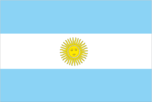
three equal horizontal bands of light blue (top), white, and light blue; centered in the white band is a radiant yellow sun with a human face known as the Sun of May; the colors represent the clear skies and snow of the Andes; the sun symbol commemorates the appearance of the sun through cloudy skies on 25 May 1810 during the first mass demonstration in favor of independence; the sun features are those of Inti, the Inca god of the sun
Government type
republic
Independence
9 July 1816 (from Spain)
International organization participation
AfDB (nonregional member), Australia Group, BCIE, BIS, CAN (associate), FAO, FATF, G-15, G-20, G-24, G-77, IADB, IAEA, IBRD, ICAO, ICC, ICCt, ICRM, IDA, IFAD, IFC, IFRCS, IHO, ILO, IMF, IMO, IMSO, Interpol, IOC, IOM, IPU, ISO, ITSO, ITU, ITUC, LAES, LAIA, Mercosur, MIGA, MINURSO, MINUSTAH, NAM (observer), NSG, OAS, OPANAL, OPCW, Paris Club (associate), PCA, RG, SICA (observer), UN, UNASUR, UNCTAD, UNESCO, UNFICYP, UNHCR, UNIDO, Union Latina (observer), UNTSO, UNWTO, UPU, WCO, WFTU, WHO, WIPO, WMO, WTO, ZC
Judicial branch
Supreme Court or Corte Suprema (the Supreme Court judges are appointed by the president with approval of the Senate) note: the Supreme Court has seven judges; the Argentine Congress in 2006 passed a bill to gradually reduce the number of Supreme Court judges to five
Legal system
mixture of US and West European legal systems; has not accepted compulsory ICJ jurisdiction
Legislative branch
- bicameral National Congress or Congreso Nacional consists of the Senate (72 seats; members are elected by direct vote; presently one-third of the members elected every two years to serve six-year terms) and the Chamber of Deputies (257 seats; members are elected by direct vote; one-half of the members elected every two years to serve four-year terms)
- election results
- Senate - percent of vote by bloc or party - NA; seats by bloc or party - FpV 8, ACyS 14, PJ disidente 2; Chamber of Deputies - percent of vote by bloc or party - NA; seats by bloc or party - FpV 45, ACyS 42, PRO 20, PJ disidente 12, other 8; note - as of 13 January 2009, the composition of the entire legislature is as
- elections
- Senate - last held on 28 June 2009 (next to be held in 2011); Chamber of Deputies - last held on 28 June 2009 (next to be held in 2011)
- follows
- Senate - seats by bloc or party - FpV 36, ACyS 23, PJ disidente 9, other 4; Chamber of Deputies - seats by bloc or party - FpV 113, ACyS 77, PRO 26, PJ disidente 17, other 24
National anthem
- lyrics/music
- Vicente LOPEZ y PLANES/Jose Blas PARERA note: adopted 1813; Vicente LOPEZ was inspired to write the anthem after watching a play about the 1810 May Revolution against Spain
- name
- "Himno Nacional Argentino" (Argentine National Anthem)
National holiday
Revolution Day, 25 May (1810)
Political parties and leaders
Civic and Social Accord or ACyS (a broad center-left alliance-including the CC, UCR, and Socialist parties-created ahead of the 2009 legislative elections); Civic Coalition or CC (a broad coalition loosely affiliated with Elisa CARRIO); Dissident Peronists or PJ Disidente (a sector of the Justicialist Party opposed to the Kirchners); Front for Victory or FpV (a broad coalition, including elements of the UCR and numerous provincial parties) [Cristina FERNANDEZ DE KIRCHNER]; Interbloque Federal or IF (a broad coalition of approximately 12 parties including PRO); Justicialist Party or PJ [Daniel SCIOLI]; Radical Civic Union or UCR [Ernesto SANZ]; Republican Proposal or PRO [Mauricio MACRI] (including Federal Recreate Movement or RECREAR [Esteban BULLRICH]; Socialist Party or PS [Ruben GIUSTINIANI]; Union For All [Patricia BULLRICH] (associated with the Civic Coalition); numerous provincial parties
Political pressure groups and leaders
- Argentine Association of Pharmaceutical Labs (CILFA); Argentine Industrial Union (manufacturers' association); Argentine Rural Confederation or CRA (small to medium landowners' association); Argentine Rural Society (large landowners' association); Central of Argentine Workers or CTA (a radical union for employed and unemployed workers); General Confederation of Labor or CGT (Peronist-leaning umbrella labor organization); White and Blue CGT (dissident CGT labor confederation); Roman Catholic Church
- other
- business organizations; Peronist-dominated labor movement; Piquetero groups (popular protest organizations that can be either pro or anti-government); students
Suffrage
18 years of age; universal and compulsory
Economy
Agriculture - products
sunflower seeds, lemons, soybeans, grapes, corn, tobacco, peanuts, tea, wheat; livestock
Central bank discount rate
NA%
Commercial bank prime lending rate
15.66% (31 December 2009 est.) 19.47% (31 December 2008 est.)
Current account balance
$6.976 billion (2010 est.) $11.29 billion (2009 est.)
Debt - external
$128.6 billion (31 December 2010 est.) $118.4 billion (31 December 2009 est.)
Distribution of family income - Gini index
45.7 (2009)
Economy - overview
Argentina benefits from rich natural resources, a highly literate population, an export-oriented agricultural sector, and a diversified industrial base. Although one of the world's wealthiest countries 100 years ago, Argentina suffered during most of the 20th century from recurring economic crises, persistent fiscal and current account deficits, high inflation, mounting external debt, and capital flight. A severe depression, growing public and external indebtedness, and a bank run culminated in 2001 in the most serious economic, social, and political crisis in the country's turbulent history. Interim President Adolfo RODRIGUEZ SAA declared a default - the largest in history - on the government's foreign debt in December of that year, and abruptly resigned only a few days after taking office. His successor, Eduardo DUHALDE, announced an end to the peso's decade-long 1-to-1 peg to the US dollar in early 2002. The economy bottomed out that year, with real GDP 18% smaller than in 1998 and almost 60% of Argentines under the poverty line. Real GDP rebounded to grow by an average 8.5% annually over the subsequent six years, taking advantage of previously idled industrial capacity and labor, an audacious debt restructuring and reduced debt burden, excellent international financial conditions, and expansionary monetary and fiscal policies. Inflation also increased, however, during the administration of President Nestor KIRCHNER, which responded with price restraints on businesses, as well as export taxes and restraints, and beginning in early 2007, with understating inflation data. Cristina FERNANDEZ DE KIRCHNER succeeded her husband as President in late 2007, and the rapid economic growth of previous years began to slow sharply the following year as government policies held back exports and the world economy fell into recession. The economy has rebounded from the 2009 recession, but the government's continued reliance on expansionary fiscal and monetary policies risks exacerbating already high inflation, which remains under-reported by official statistics.
Electricity - consumption
99.21 billion kWh (2007 est.)
Electricity - exports
2.628 billion kWh (2007 est.)
Electricity - imports
10.28 billion kWh (2007 est.)
Electricity - production
109.5 billion kWh (2007 est.)
Exchange rates
Argentine pesos (ARS) per US dollar - 3.8983 (2010), 3.7101 (2009), 3.1636 (2008), 3.1105 (2007), 3.0543 (2006)
Exports
$68.01 billion (2010 est.) $55.67 billion (2009 est.)
Exports - commodities
soybeans and derivatives, petroleum and gas, vehicles, corn, wheat
Exports - partners
Brazil 18.78%, China 9.26%, Chile 7.11%, US 6.38% (2009)
GDP - composition by sector
- agriculture
- 8.5%
- industry
- 31.6%
- services
- 59.8% (2010 est.)
GDP - per capita (PPP)
$14,700 (2010 est.) $13,700 (2009 est.) $14,100 (2008 est.) note: data are in 2010 US dollars
GDP - real growth rate
7.5% (2010 est.) -3% (2009 est.) 5% (2008 est.)
GDP (official exchange rate)
$351 billion (2010 est.)
GDP (purchasing power parity)
$596 billion (2010 est.) $554.5 billion (2009 est.) $571.6 billion (2008 est.) note: data are in 2010 US dollars
Household income or consumption by percentage share
lowest 10%: 1.2% highest 10%: 32.6% (2009)
Imports
$52.61 billion (2010 est.) $37.14 billion (2009 est.)
Imports - commodities
machinery, motor vehicles, petroleum and natural gas, organic chemicals, plastics
Imports - partners
Brazil 31.12%, US 13.69%, China 10.26%, Germany 4.69% (2009)
Industrial production growth rate
6.7% (2010 est.)
Industries
food processing, motor vehicles, consumer durables, textiles, chemicals and petrochemicals, printing, metallurgy, steel
Inflation rate (consumer prices)
22% (2010 est.) 16% (2009 est.)
Investment (gross fixed)
22% of GDP (2010 est.)
Labor force
16.62 million note: urban areas only (2010 est.)
Labor force - by occupation
- agriculture
- 5%
- industry
- 23%
- services
- 72% (2009 est.)
Market value of publicly traded shares
$48.93 billion (31 December 2009) $52.31 billion (31 December 2008) $86.68 billion (31 December 2007)
Natural gas - consumption
43.14 billion cu m (2009 est.)
Natural gas - exports
890 million cu m (2008 est.)
Natural gas - imports
2.66 billion cu m (2009 est.)
Natural gas - production
41.36 billion cu m (2009 est.)
Natural gas - proved reserves
398.4 billion cu m (1 January 2010 est.)
Oil - consumption
622,000 bbl/day (2009 est.)
Oil - exports
314,400 bbl/day (2007 est.)
Oil - imports
52,290 bbl/day (2007 est.)
Oil - production
796,300 bbl/day (2009 est.)
Oil - proved reserves
2.386 billion bbl (1 January 2010 est.)
Population below poverty line
30% (January-June 2010)
Public debt
50.3% of GDP (2010 est.) 48.6% of GDP (2009 est.)
Reserves of foreign exchange and gold
$53.61 billion (31 December 2010 est.) $48.03 billion (31 December 2009 est.)
Stock of broad money
$112.9 billion (31 December 2010 est.) $85.18 billion (31 December 2009 est.)
Stock of direct foreign investment - abroad
$30.16 billion (31 December 2010 est.) $29.46 billion (31 December 2009 est.)
Stock of direct foreign investment - at home
$86.8 billion (31 December 2010 est.) $80.1 billion (31 December 2009 est.)
Stock of domestic credit
$113.9 billion (31 December 2010 est.) $84.92 billion (31 December 2009 est.)
Stock of narrow money
$41.66 billion (31 December 2010 est) $35.33 billion (31 December 2009 est)
Unemployment rate
7.9% (2010 est.) 8.7% (2009 est.) note: based on official data, which may understate unemployment
Communications
Broadcast media
government owns a TV station and a radio network; more than 2 dozen TV stations and hundreds of privately-owned radio stations; high rate of cable TV subscription usage (2007)
Internet country code
.ar
Internet hosts
6.025 million (2010)
Internet users
13.694 million (2009)
Telephone system
- domestic
- microwave radio relay, fiber-optic cable, and a domestic satellite system with 40 earth stations serve the trunk network; fixed-line teledensity is increasing gradually and mobile-cellular subscribership is increasing rapidly; broadband Internet services are gaining ground
- general assessment
- the "Telecommunications Liberalization Plan of 1998" opened the telecommunications market to competition and foreign investment encouraging the growth of modern telecommunications technology; fiber-optic cable trunk lines are being installed between all major cities; major networks are entirely digital and the availability of telephone service is improving
- international
- country code - 54; landing point for the Atlantis-2, UNISUR, South America-1, and South American Crossing/Latin American Nautilus submarine cable systems that provide links to Europe, Africa, South and Central America, and US; satellite earth stations - 112; 2 international gateways near Buenos Aires (2009)
Telephones - main lines in use
9.764 million (2009)
Telephones - mobile cellular
51.891 million (2009)
Transportation
Airports
1,141 (2010)
Airports - with paved runways
- total
- 156 over 3,047 m: 4 2,438 to 3,047 m: 27 1,524 to 2,437 m: 65 914 to 1,523 m: 51 under 914 m: 9 (2010)
Airports - with unpaved runways
- total
- 985 over 3,047 m: 1 2,438 to 3,047 m: 1 1,524 to 2,437 m: 43 914 to 1,523 m: 530 under 914 m: 410 (2010)
Heliports
2 (2010)
Merchant marine
- by type
- bulk carrier 3, cargo 7, chemical tanker 4, container 1, passenger/cargo 3, petroleum tanker 23, refrigerated cargo 2
- foreign-owned
- 12 (Brazil 1, Chile 6, Spain 3, UK 2)
- registered in other countries
- 17 (Liberia 3, Panama 7, Paraguay 5, Uruguay 2) (2010)
- total
- 43
Pipelines
gas 28,248 km; liquid petroleum gas 41 km; oil 5,977 km; refined products 3,636 km (2009)
Ports and terminals
Arroyo Seco, Bahia Blanca, Buenos Aires, La Plata, Punta Colorada, Rosario, San Lorenzo-San Martin
Railways
- broad gauge
- 27,301 km 1.676-m gauge (94 km electrified)
- narrow gauge
- 1,328 km 1.000-m gauge (2008)
- standard gauge
- 2,780 km 1.435-m gauge (26 km electrified)
- total
- 31,409 km
Roadways
- paved
- 69,412 km (includes 734 km of expressways)
- total
- 231,374 km
- unpaved
- 161,962 km (2004)
Waterways
11,000 km (2007)
Military and Security
Manpower available for military service
males age 16-49: 9,934,765 females age 16-49: 9,868,008 (2010 est.)
Manpower fit for military service
males age 16-49: 8,366,206 females age 16-49: 8,344,321 (2010 est.)
Manpower reaching militarily significant age annually
- female
- 323,953 (2010 est.)
- male
- 340,570
Military - note
the Argentine military is a well-organized force constrained by the country's prolonged economic hardship; the country has recently experienced a strong recovery, and the military is implementing a modernization plan aimed at making the ground forces lighter and more responsive (2008)
Military branches
Argentine Army (Ejercito Argentino), Navy of the Argentine Republic (Armada Republica; includes naval aviation and naval infantry), Argentine Air Force (Fuerza Aerea Argentina, FAA) (2011)
Military expenditures
0.8% of GDP (2009)
Military service age and obligation
18-24 years of age for voluntary military service (18-21 requires parental permission); no conscription (2001)
Transnational Issues
Disputes - international
Argentina continues to assert its claims to the UK-administered Falkland Islands (Islas Malvinas), South Georgia, and the South Sandwich Islands in its constitution, forcibly occupying the Falklands in 1982, but in 1995 agreed no longer to seek settlement by force; territorial claim in Antarctica partially overlaps UK and Chilean claims; unruly region at convergence of Argentina-Brazil-Paraguay borders is locus of money laundering, smuggling, arms and illegal narcotics trafficking, and fundraising for extremist organizations; uncontested dispute between Brazil and Uruguay over Braziliera/Brasiliera Island in the Quarai/Cuareim River leaves the tripoint with Argentina in question; in 2006, Argentina went to the ICJ to protest, on environmental grounds, the construction of two pulp mills in Uruguay on the Uruguay River, which forms the boundary; both parties presented their pleadings in 2007 with Argentina's reply in January and Uruguay's rejoinder in July 2008; the joint boundary commission, established by Chile and Argentina in 2001 has yet to map and demarcate the delimited boundary in the inhospitable Andean Southern Ice Field (Campo de Hielo Sur)
Illicit drugs
a transshipment country for cocaine headed for Europe, heroin headed for the US, and ephedrine and pseudoephedrine headed for Mexico; some money-laundering activity, especially in the Tri-Border Area; law enforcement corruption; a source for precursor chemicals; increasing domestic consumption of drugs in urban centers, especially cocaine base and synthetic drugs (2008) page last updated on January 19, 2011 ======================================================================