2004 Edition
CIA World Factbook 2004 (Project Gutenberg)
Introduction
Background
Following independence from Spain in 1816, Argentina experienced periods of internal political conflict between conservatives and liberals and between civilian and military factions. After World War II, a long period of Peronist authoritarian rule and interference in subsequent governments was followed by a military junta that took power in 1976. Democracy returned in 1983, and numerous elections since then have underscored Argentina's progress in democratic consolidation.
Geography
Area
- land
- 2,736,690 sq km
- total
- 2,766,890 sq km
- water
- 30,200 sq km
Area - comparative
slightly less than three-tenths the size of the US
Climate
mostly temperate; arid in southeast; subantarctic in southwest
Coastline
4,989 km
Elevation extremes
- Julian and Comandante Luis Piedra Buena in the province of Santa Cruz)
- corner of the province of Mendoza)
- highest point
- Cerro Aconcagua 6,960 m (located in the northwestern
- lowest point
- Laguna del Carbon -105 m (located between Puerto San
Environment - current issues
- environmental problems (urban and rural) typical of an industrializing economy such as deforestation, soil degradation, desertification, air pollution, and water pollution
- gas targets
- note
- Argentina is a world leader in setting voluntary greenhouse
Environment - international agreements
- Resources, Antarctic Seals, Antarctic Treaty, Biodiversity, Climate Change, Climate Change-Kyoto Protocol, Desertification, Endangered Species, Environmental Modification, Hazardous Wastes, Law of the Sea, Marine Dumping, Ozone Layer Protection, Ship Pollution, Wetlands, Whaling
- party to
- Antarctic-Environmental Protocol, Antarctic-Marine Living
- signed, but not ratified
- Marine Life Conservation
Geographic coordinates
34 00 S, 64 00 W
Geography - note
second-largest country in South America (after Brazil); strategic location relative to sea lanes between the South Atlantic and the South Pacific Oceans (Strait of Magellan, Beagle Channel, Drake Passage); Cerro Aconcagua is South America's tallest mountain, while Laguna del Carbon is the lowest point in the Western Hemisphere
Irrigated land
15,610 sq km (1998 est.)
Land boundaries
- Paraguay 1,880 km, Uruguay 579 km
- border countries
- Bolivia 832 km, Brazil 1,224 km, Chile 5,150 km,
- total
- 9,665 km
Land use
- arable land
- 12.31%
- other
- 87.21% (2001)
- permanent crops
- 0.48%
Location
Southern South America, bordering the South Atlantic Ocean, between Chile and Uruguay
Map references
South America
Maritime claims
- contiguous zone
- 24 nm
- continental shelf
- 200 nm or to the edge of the continental margin
- exclusive economic zone
- 200 nm
- territorial sea
- 12 nm
Natural hazards
San Miguel de Tucuman and Mendoza areas in the Andes subject to earthquakes; pamperos are violent windstorms that can strike the pampas and northeast; heavy flooding
Natural resources
fertile plains of the pampas, lead, zinc, tin, copper, iron ore, manganese, petroleum, uranium
Terrain
rich plains of the Pampas in northern half, flat to rolling plateau of Patagonia in south, rugged Andes along western border
People and Society
Age structure
0-14 years: 25.9% (male 5,179,236; female 4,947,234) 15-64 years: 63.6% (male 12,452,566; female 12,457,451) 65 years and over: 10.5% (male 1,685,371; female 2,422,895) (2004 est.)
Birth rate
17.19 births/1,000 population (2004 est.)
Death rate
7.57 deaths/1,000 population (2004 est.)
Ethnic groups
white (mostly Spanish and Italian) 97%, mestizo, Amerindian, or other nonwhite groups 3%
HIV/AIDS - adult prevalence rate
0.7% (2001 est.)
HIV/AIDS - deaths
1,500 (2001 est.)
HIV/AIDS - people living with HIV/AIDS
130,000 (2001 est.)
Infant mortality rate
- female
- 13.63 deaths/1,000 live births (2004 est.)
- male
- 17.6 deaths/1,000 live births
- total
- 15.66 deaths/1,000 live births
Languages
Spanish (official), English, Italian, German, French
Life expectancy at birth
- female
- 79.65 years (2004 est.)
- male
- 71.95 years
- total population
- 75.7 years
Literacy
- definition
- age 15 and over can read and write
- female
- 97.1% (2003 est.)
- male
- 97.1%
- total population
- 97.1%
Median age
- female
- 30.1 years (2004 est.)
- male
- 28.3 years
- total
- 29.2 years
Nationality
- adjective
- Argentine
- noun
- Argentine(s)
Net migration rate
0.61 migrant(s)/1,000 population (2004 est.)
Population
39,144,753 (July 2004 est.)
Population growth rate
1.02% (2004 est.)
Religions
nominally Roman Catholic 92% (less than 20% practicing), Protestant 2%, Jewish 2%, other 4%
Sex ratio
- 15-64 years: 1 male(s)/female 65 years and over: 0.7 male(s)/female
- at birth
- 1.05 male(s)/female
- total population
- 0.97 male(s)/female (2004 est.)
- under 15 years
- 1.05 male(s)/female
Total fertility rate
2.24 children born/woman (2004 est.)
Government
Administrative divisions
- 23 provinces (provincias, singular - provincia), and 1 autonomous city* (distrito federal); Buenos Aires, Buenos Aires Capital Federal*, Catamarca, Chaco, Chubut, Cordoba, Corrientes, Entre Rios, Formosa, Jujuy, La Pampa, La Rioja, Mendoza, Misiones, Neuquen, Rio Negro, Salta, San Juan, San Luis, Santa Cruz, Santa Fe, Santiago del Estero, Tierra del Fuego - Antartida e Islas del Atlantico Sur, Tucuman
- note
- the US does not recognize any claims to Antarctica
Capital
Buenos Aires
Constitution
1 May 1853; revised August 1994
Country name
- conventional long form
- Argentine Republic
- conventional short form
- Argentina
- local long form
- Republica Argentina
- local short form
- Argentina
Diplomatic representation from the US
- FAX: [54] (11) 5777-4240
- address
- Unit 4334, APO AA 34034
- chief of mission
- Ambassador Lino GUTIERREZ
- embassy
- Avenida Colombia 4300, C1425GMN Buenos Aires
- mailing address
- international mail: use street address; APO
- telephone
- [54] (11) 5777-4533
Diplomatic representation in the US
- New York FAX: [1] (202) 332-3171
- chancery
- 1600 New Hampshire Avenue NW, Washington, DC 20009
- chief of mission
- Ambassador Jose Octavio BORDON
- consulate(s) general
- Atlanta, Chicago, Houston, Los Angeles, Miami,
- telephone
- [1] (202) 238-6400
Executive branch
- President Daniel SCIOLI (since 25 May 2003); note - the president is both the chief of state and head of government
- Vice President Daniel SCIOLI (since 25 May 2003); note - the president is both the chief of state and head of government
- 2003: Carlos Saul MENEM 24.3%, Nestor KIRCHNER 22%, Ricardo Lopez MURPHY 16.4%, Adolfo Rodriguez SAA 14.4%, Elisa CARRIO 14.2%, other 8.7%; the subsequent runoff election slated for 25 May 2003 was awarded to KIRCHNER by default after MENEM withdrew his candidacy on the eve of the election
- by popular vote for four-year terms; the last election held was the presidential primary election of 27 April 2003 (next election to be held NA 2007)
- cabinet
- Cabinet appointed by the president
- chief of state
- President Nestor KIRCHNER (since 25 May 2003); Vice
- election results
- results of the presidential primary of 27 April
- elections
- president and vice president elected on the same ticket
- head of government
- President Nestor KIRCHNER (since 25 May 2003);
Flag description
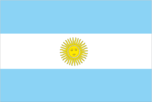
three equal horizontal bands of light blue (top), white, and light blue; centered in the white band is a radiant yellow sun with a human face known as the Sun of May
Government type
republic
Independence
9 July 1816 (from Spain)
International organization participation
AfDB, Australia Group, BCIE, BIS, FAO, G-6, G-15, G-24, G-77, IADB, IAEA, IBRD, ICAO, ICC, ICCt, ICFTU, ICRM, IDA, IFAD, IFC, IFRCS, IHO, ILO, IMF, IMO, Interpol, IOC, IOM, ISO, ITU, LAES, LAIA, Mercosur, MIGA, MINURSO, MINUSTAH, NSG, OAS, OPANAL, OPCW, PCA, RG, UN, UN Security Council (temporary), UNCTAD, UNESCO, UNFICYP, UNHCR, UNIDO, UNMIK, UNMOVIC, UNTSO, UPU, WCL, WCO, WFTU, WHO, WIPO, WMO, WToO, WTO, ZC
Judicial branch
Supreme Court or Corte Suprema (the nine Supreme Court judges are appointed by the president with approval by the Senate)
Legal system
mixture of US and West European legal systems; has not accepted compulsory ICJ jurisdiction
Legislative branch
- bicameral National Congress or Congreso Nacional consists of the Senate (72 seats; members are elected by direct vote; presently one-third of the members elected every two years to a six-year term) and the Chamber of Deputies (257 seats; members are elected by direct vote; one-half of the members elected every two years to a four-year term)
- seats by bloc or party - PJ 41, UCR 16, provincial parties 15; Chamber of Deputies - percent of vote by bloc or party - NA; seats by bloc or party - PJ 133, UCR 46, IF 23, ARI 11, Socialist 6, other/provincial parties 38
- 2nd half of 2003 (next to be held NA 2005); Chamber of Deputies - last held intermittently by province during the 2nd half of 2003 (next to be held NA 2005)
- election results
- Senate - percent of vote by bloc or party - NA;
- elections
- Senate - last held intermittently by province during the
National holiday
Revolution Day, 25 May (1810)
Political parties and leaders
Action for the Republic or AR [Domingo CAVALLO]; Alternative for a Republic of Equals or ARI [Elisa CARRIO]; Front for a Country in Solidarity or Frepaso (a four-party coalition) [Dario Pedro ALESSANDRO]; Interbloque Federal or IF (a broad coalition of approximately 12 parties including RECREAR) [leader NA]; Justicialist Party or PJ [leader NA] (Peronist umbrella political organization); Radical Civic Union or UCR [Angel ROZAS]; Federal Recreate Movement or RECREAR [Ricardo LOPEZ MURPHY]; Socialist Party or PS [Ruben GIUSTINIANI]; Union For All [Patricia BULLRICH]; several provincial parties
Political pressure groups and leaders
Argentine Association of Pharmaceutical Labs (CILFA); Argentine Industrial Union (manufacturers' association); Argentine Rural Society (large landowners' association); business organizations; General Confederation of Labor or CGT (Peronist-leaning umbrella labor organization); Central of Argentine Workers or CTA (a radical union for employed and unemployed workers); Peronist-dominated labor movement; Roman Catholic Church; students
Suffrage
18 years of age; universal and compulsory
Economy
Agriculture - products
sunflower seeds, lemons, soybeans, grapes, corn, tobacco, peanuts, tea, wheat; livestock
Budget
- (2003 est.)
- expenditures
- $26 billion, including capital expenditures of NA
- revenues
- $26.62 billion
Currency
Argentine peso (ARS)
Currency code
ARS
Current account balance
$7.855 billion (2003)
Debt - external
$145.6 billion (2003 est.)
Economic aid - recipient
$10 billion (2001 est.)
Economy - overview
Argentina benefits from rich natural resources, a highly literate population, an export-oriented agricultural sector, and a diversified industrial base. Over the past decade, however, the country has suffered recurring economic problems of inflation, external debt, capital flight, and budget deficits. Growth in 2000 was a negative 0.8%, as both domestic and foreign investors remained skeptical of the government's ability to pay debts and maintain the peso's fixed exchange rate with the US dollar. The economic situation worsened in 2001 with the widening of spreads on Argentine bonds, massive withdrawals from the banks, and a further decline in consumer and investor confidence. Government efforts to achieve a "zero deficit," to stabilize the banking system, and to restore economic growth proved inadequate in the face of the mounting economic problems. The peso's peg to the dollar was abandoned in January 2002, and the peso was floated in February; the exchange rate plunged and inflation picked up rapidly, but by mid-2002 the economy had stabilized, albeit at a lower level. Strong demand for the peso compelled the Central Bank to intervene in foreign exchange markets to curb its appreciation in 2003. Led by record exports, the economy began to recover with output up 8% in 2003, unemployment falling, and inflation reduced to under 4% at year-end.
Electricity - consumption
92.12 billion kWh (2001)
Electricity - exports
5.662 billion kWh (2001)
Electricity - imports
7.417 billion kWh (2001)
Electricity - production
97.17 billion kWh (2001)
Exchange rates
Argentine pesos per US dollar - 2.9003 (2003), 3.0633 (2002), 0.9995 (2001), 0.9995 (2000), 0.9995 (1999)
Exports
$29.57 billion f.o.b. (2003 est.)
Exports - commodities
edible oils, fuels and energy, cereals, feed, motor vehicles
Exports - partners
Brazil 15.8%, Chile 12%, US 10.6%, China 8.4%, Spain 4.7% (2003)
Fiscal year
calendar year
GDP
purchasing power parity - $435.5 billion (2003 est.)
GDP - composition by sector
- agriculture
- 11.1%
- industry
- 34.8%
- services
- 54.1% (2003 est.)
GDP - per capita
purchasing power parity - $11,200 (2003 est.)
GDP - real growth rate
8.7% (2003 est.)
Household income or consumption by percentage share
- highest 10%
- NA
- lowest 10%
- NA
Imports
$13.27 billion f.o.b. (2003 est.)
Imports - commodities
machinery and equipment, motor vehicles, chemicals, metal manufactures, plastics
Imports - partners
Brazil 34%, US 16.4%, Germany 5.6%, China 5.2% (2003) Reserves of foreign exchange & gold: $14.16 billion (2003)
Industrial production growth rate
16.2% (2003 est.)
Industries
food processing, motor vehicles, consumer durables, textiles, chemicals and petrochemicals, printing, metallurgy, steel
Inflation rate (consumer prices)
13.4% (2003)
Investment (gross fixed)
15.1% of GDP (2003)
Labor force
14.92 million (2003)
Labor force - by occupation
agriculture NA, industry NA, services NA
Natural gas - consumption
31.1 billion cu m (2001 est.)
Natural gas - exports
6.05 billion cu m (2001 est.)
Natural gas - imports
0 cu m (2001 est.)
Natural gas - production
37.15 billion cu m (2001 est.)
Natural gas - proved reserves
768 billion cu m (1 January 2002)
Oil - consumption
486,000 bbl/day (2001 est.)
Oil - exports
NA (2001)
Oil - imports
NA (2001)
Oil - production
828,600 bbl/day (2001 est.)
Oil - proved reserves
2.927 billion bbl (1 January 2002)
Population below poverty line
51.7% (May 2003)
Public debt
65.7% of GDP (2003 est.)
Unemployment rate
17.3% (2003)
Communications
Internet country code
.ar
Internet hosts
742,358 (2003)
Internet Service Providers (ISPs)
33 (2000)
Internet users
4.1 million (2002)
Radio broadcast stations
AM 260 (including 10 inactive stations), FM NA (probably more than 1,000, mostly unlicensed), shortwave 6 (1998)
Radios
24.3 million (1997)
Telephone system
- competition and foreign investment with the "Telecommunications Liberalization Plan of 1998," Argentina encouraged the growth of modern telecommunication technology; fiber-optic cable trunk lines are being installed between all major cities; the major networks are entirely digital and the availability of telephone service is being improved; however, telephone density is presently minimal, and making telephone service universally available will take time
- satellite system with 40 earth stations serve the trunk network; more than 110,000 pay telephones are installed and mobile telephone use is rapidly expanding
- Intelsat (Atlantic Ocean); Atlantis II and Unisur submarine cables; two international gateways near Buenos Aires (1999)
- domestic
- microwave radio relay, fiber-optic cable, and a domestic
- general assessment
- by opening the telecommunications market to
- international
- country code - 54; satellite earth stations - 8
Telephones - main lines in use
8,009,400 (2002)
Telephones - mobile cellular
6.5 million (2002)
Television broadcast stations
42 (plus 444 repeaters) (1997)
Televisions
7.95 million (1997)
Transportation
Airports
1,335 (2003 est.)
Airports - with paved runways
- 2,438 to 3,047 m: 26 1,524 to 2,437 m: 62 914 to 1,523 m: 44
- over 3,047 m
- 4
- total
- 144
- under 914 m
- 8 (2004 est.)
Airports - with unpaved runways
- 2,438 to 3,047 m: 2 1,524 to 2,437 m: 50 914 to 1,523 m: 569
- over 3,047 m
- 2
- total
- 1,190
- under 914 m
- 567 (2004 est.)
Highways
- paved
- 63,348 km (including 734 km of expressways)
- total
- 215,471 km
- unpaved
- 152,123 km (1999)
Merchant marine
- refrigerated cargo 2, roll on/roll off 1, short-sea/passenger 1, specialized tanker 1
- by type
- cargo 9, petroleum tanker 9, rail car carrier 1,
- foreign-owned
- Uruguay 1
- registered in other countries
- 26 (2004 est.)
- total
- 45 ships (1,000 GRT or over) 149,007 GRT/212,620 DWT
Pipelines
gas 27,166 km; liquid petroleum gas 41 km; oil 3,668 km; refined products 2,945 km; unknown (oil/water) 13 km (2004)
Ports and harbors
Bahia Blanca, Buenos Aires, Comodoro Rivadavia, Concepcion del Uruguay, La Plata, Mar del Plata, Necochea, Rio Gallegos, Rosario, Santa Fe, Ushuaia
Railways
- broad gauge
- 20,594 km 1.676-m gauge (141 km electrified)
- narrow gauge
- 10,375 km 1.000-m gauge; 237 km 0.750-m gauge (2003)
- standard gauge
- 2,885 km 1.435-m gauge (26 km electrified)
- total
- 34,091 km (167 km electrified)
Waterways
11,000 km (2004)
Military and Security
Military branches
Argentine Army, Navy of the Argentine Republic (includes Naval Aviation and Marines), Argentine Air Force (Fuerza Aerea Argentina, FAA)
Military expenditures - dollar figure
$4.3 billion (FY99)
Military expenditures - percent of GDP
1.3% (FY00)
Military manpower - availability
- males age 15-49
- 9,901,352 (2004 est.)
Military manpower - fit for military service
- males age 15-49
- 8,042,304 (2004 est.)
Military manpower - military age and obligation
18 years of age for voluntary military service; no conscription (2001)
Military manpower - reaching military age annually
- males
- 327,738 (2004 est.)
Transnational Issues
Disputes - international
UK continues to reject sovereignty talks requested by Argentina, whose constitution still claims UK-administered Falkland Islands (Islas Malvinas) and South Georgia and the South Sandwich Islands, but in 1995 ceded the right to settle the dispute by force; Beagle Channel islands dispute resolved through Papal mediation in 1984, but armed incidents persist since 1992 oil discovery; territorial claim in Antarctica partially overlaps UK and Chilean claims (see Antarctic disputes); unruly region at convergence of Argentina-Brazil-Paraguay borders is locus of money laundering, smuggling, arms and drug trafficking, and fundraising for extremist organizations; uncontested dispute between Brazil and Uruguay over Braziliera Island in the Quarai/Cuareim River leaves the tripoint with Argentina in question
Illicit drugs
used as a transshipment country for cocaine headed for Europe and the US; some money-laundering activity, especially in the Tri-Border Area; domestic consumption of drugs in urban centers is increasing This page was last updated on 10 February, 2005 @Armenia