2002 Edition
CIA World Factbook 2002 (Project Gutenberg)
Introduction
Background
Following independence from Spain in 1816, Argentina experienced periods of internal political conflict between conservatives and liberals and between civilian and military factions. After World War II, a long period of Peronist authoritarian rule and interference in subsequent governments was followed by a military junta that took power in 1976. Democracy returned in 1983, and numerous elections since then have underscored Argentina's progress in democratic consolidation.
Geography
Area
total: 2,766,890 sq km land: 2,736,690 sq km water: 30,200 sq km
Area - comparative
slightly less than three-tenths the size of the US
Coastline
4,989 km
Elevation extremes
lowest point: Salinas Chicas -40 m (located on Peninsula Valdes) highest point: Cerro Aconcagua 6,960 m
Environment - current issues
environmental problems (urban and rural) typical of an industrializing economy such as deforestation, soil degradation, desertification, air pollution, and water pollution note: Argentina is a world leader in setting voluntary greenhouse gas targets
Environment - international agreements
party to: Antarctic-Environmental Protocol, Antarctic-Marine Living Resources, Antarctic Seals, Antarctic Treaty, Biodiversity, Climate Change, Climate Change-Kyoto Protocol, Desertification, Endangered Species, Environmental Modification, Hazardous Wastes, Law of the Sea, Marine Dumping, Nuclear Test Ban, Ozone Layer Protection, Ship Pollution, Wetlands, Whaling signed, but not ratified: Marine Life Conservation
Geographic coordinates
34 00 S, 64 00 W
Irrigated land
15,610 sq km (1998 est.)
Land boundaries
total: 9,665 km border countries: Bolivia 832 km, Brazil 1,224 km, Chile 5,150 km, Paraguay 1,880 km, Uruguay 579 km
Land use
arable land: 9% permanent crops: 1% other: 90% (1998 est.)
Location
Southern South America, bordering the South Atlantic Ocean, between Chile and Uruguay
Map references
South America
Maritime claims
12 NM exclusive economic zone: Climate: mostly temperate; arid in southeast; subantarctic in southwest
Natural hazards
San Miguel de Tucuman and Mendoza areas in the Andes subject to earthquakes; pamperos are violent windstorms that can strike the Pampas and northeast; heavy flooding
Natural resources
fertile plains of the Pampas, lead, zinc, tin, copper, iron ore, manganese, petroleum, uranium
Terrain
rich plains of the Pampas in northern half, flat to rolling plateau of Patagonia in south, rugged Andes along western border
People and Society
Age structure
0-14 years: 26.3% (male 5,090,046; female 4,854,761) 15-64 years: 63.2% (male 11,968,135; female 11,937,709) 65 years and over: 10.5% (male 1,636,332; female 2,325,834) (2002 est.)
Birth rate
18.23 births/1,000 population (2002 est.)
Death rate
7.57 deaths/1,000 population (2002 est.)
Ethnic groups
white (mostly Spanish and Italian) 97%, mestizo, Amerindian, or other nonwhite groups 3%
HIV/AIDS - adult prevalence rate
0.69% (1999 est.)
HIV/AIDS - deaths
1,800 (1999 est.)
HIV/AIDS - people living with HIV/AIDS
130,000 (1999 est.)
Infant mortality rate
17.2 deaths/1,000 live births (2002 est.)
Languages
Spanish (official), English, Italian, German, French
Life expectancy at birth
79.03 years (2002 est.) male: Total fertility rate: 2.41 children born/woman (2002 est.)
Literacy
definition: age 15 and over can read and write total population: 96.2% male: 96.2% female: 96.2% (1995 est.)
Nationality
noun: Argentine(s) adjective: Argentine
Net migration rate
0.63 migrant(s)/1,000 population (2002 est.)
Population
37,812,817 (July 2002 est.)
Population growth rate
1.13% (2002 est.)
Religions
nominally Roman Catholic 92% (less than 20% practicing), Protestant 2%, Jewish 2%, other 4%
Sex ratio
at birth: 1.05 male(s)/female under 15 years: 1.05 male(s)/female 15-64 years: 1 male(s)/female 65 years and over: 0.7 male(s)/female total population: 0.98 male(s)/female (2002 est.)
Government
Administrative divisions
23 provinces (provincias, singular - provincia), and 1 autonomous city* (distrito federal); Buenos Aires, Buenos Aires Capital Federal*, Catamarca, Chaco, Chubut, Cordoba, Corrientes, Entre Rios, Formosa, Jujuy, La Pampa, La Rioja, Mendoza, Misiones, Neuquen, Rio Negro, Salta, San Juan, San Luis, Santa Cruz, Santa Fe, Santiago del Estero, Tierra del Fuego - Antartida e Islas del Atlantico Sur, Tucuman note: Independence: 9 July 1816 (from Spain)
Capital
Buenos Aires
Constitution
1 May 1853; revised August 1994
Country name
Argentine Republic conventional short form: Government type: republic
Diplomatic representation from the US
chief of mission: Ambassador James D. WALSH embassy: Avenida Colombia 4300, C1425GMN Buenos Aires mailing address: international mail: use street address; APO address: Unit 4334, APO AA 34034 telephone: [54] (11) 5777-4533 FAX: [54] (11) 5511-4240
Diplomatic representation in the US
chief of mission: Ambassador Diego Ramiro GUELAR chancery: 1600 New Hampshire Avenue NW, Washington, DC 20009 consulate(s) general: Atlanta, Chicago, Houston, Los Angeles, Miami, New York FAX: [1] (202) 332-3171 telephone: [1] (202) 238-6400
Executive branch
chief of state: President Eduardo Alberto DUHALDE (since 2 January 2002); note - selected by National Congress in aftermath of resignation of former President DE LA RUA on 20 December 2001 and resignations of others who briefly held the office following DE LA RUA's departure; Vice President Carlos "Chacho" ALVAREZ resigned 6 October 2000 and the post remains vacant; note - the president is both the chief of state and head of government head of government: President Eduardo Alberto DUHALDE (since 2 January 2002); note - selected by National Congress in aftermath of resignation of former President DE LA RUA on 20 December 2001 and resignations of others who briefly held the office following DE LA RUA's departure; Vice President Carlos "Chacho" ALVAREZ resigned 6 October 2000 and the post remains vacant; note - the president is both the chief of state and head of government cabinet: Cabinet appointed by the president election results: Fernando DE LA RUA elected president; percent of vote - 48.5% ; Vice President Carlos "Chacho" ALVAREZ resigned 6 October 2000 and a replacement was not named; DE LA RUA resigned 20 December 2001; following a series of interim presidents, Eduardo Alberto DUHALDE was selected president by the National Congress on 1 January 2002 elections: for four-year terms; election last held 24 October 1999 (next to be held NA October 2003)
Flag description
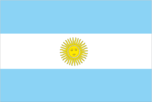
three equal horizontal bands of light blue (top), white, and light blue; centered in the white band is a radiant yellow sun with a human face known as the Sun of May
International organization participation
AfDB, Australia Group, BCIE, BIS, CCC, ECLAC, FAO, G-6, G-15, G-19, G-24, G-77, IADB, IAEA, IBRD, ICAO, ICC, ICFTU, ICRM, IDA, IFAD, IFC, IFRCS, IHO, ILO, IMF, IMO, Interpol, IOC, IOM, ISO, ITU, LAES, LAIA, Mercosur, MINURSO, MIPONUH, MTCR, NSG, OAS, OPANAL, OPCW, PCA, RG, UN, UNCTAD, UNESCO, UNFICYP, UNHCR, UNIDO, UNIKOM, UNMEE, UNMIBH, UNMIK, UNMOP, UNMOVIC, UNTSO, UNU, UPU, WCL, WFTU, WHO, WIPO, WMO, WToO, WTrO, ZC
Judicial branch
Supreme Court or Corte Suprema (the nine Supreme Court judges are appointed by the president with approval by the Senate)
Legal system
mixture of US and West European legal systems; has not accepted compulsory ICJ jurisdiction
Legislative branch
bicameral National Congress or Congreso Nacional consists of the Senate (72 seats; formerly, three members appointed by each of the provincial legislatures; presently transitioning to one-third of the members being elected every two years to six-year terms) and the Chamber of Deputies (257 seats; one-half of the members elected every two years to four-year terms) election results: Senate - percent of vote by bloc or party - NA%; seats by bloc or party - Justicialist (Peronist) 40, UCR 24, provincial parties 6, Frepaso 1, ARI 1; Chamber of Deputies - percent of vote by bloc or party - NA%; seats by bloc or party - Justicialist (Peronist) 113, UCR 74, provincial parties 27, Frepaso 17, ARI 17, AR 9 elections: Senate - last held 14 October 2001 (next to be held NA October 2003); Chamber of Deputies - last held 14 October 2001 (next to be held NA October 2003)
National holiday
Revolution Day, 25 May (1810)
Political parties and leaders
Action for the Republic or AR [Domingo CAVALLO]; Alternative for a Republic of Equals or ARI [Elisa CARRIO]; Front for a Country in Solidarity or Frepaso (a four-party coalition) [Dario Pedro ALESSANDRO]; Justicialist Party or PJ [Carlos Saul MENEM] (Peronist umbrella political organization); Radical Civic Union or UCR [Angel ROZAS]; several provincial parties
Political pressure groups and leaders
Argentine Association of Pharmaceutical Labs (CILFA); Argentine Industrial Union (manufacturers' association); Argentine Rural Society (large landowners' association); business organizations; General Confederation of Labor or CGT (Peronist-leaning umbrella labor organization); Peronist-dominated labor movement; Roman Catholic Church; students
Suffrage
18 years of age; universal and mandatory
Economy
Agriculture - products
sunflower seeds, lemons, soybeans, grapes, corn, tobacco, peanuts, tea, wheat; livestock
Budget
revenues: $44 billion expenditures: $48 billion, including capital expenditures of $NA (2000 est.)
Currency
Argentine peso (ARS)
Currency code
ARS
Debt - external
$155 billion (2001 est.)
Economic aid - recipient
$10 billion (2001 est.)
Electricity - consumption
80.806 billion kWh (2000)
Electricity - exports
3.7 billion kWh (2000)
Electricity - imports
7.5 billion kWh (2000)
Electricity - production
82.802 billion kWh (2000)
Electricity - production by source
fossil fuel: 51.81% hydro: 40.67% other: 0.29% (2000) nuclear: 7.23%
Exchange rates
Argentine pesos per US dollar - 1.33325 (January 2002), 1.000 (1997-2001); note - fixed rate pegged to the US dollar was abandoned in January 2002; peso now floats
Exports
$26.5 billion (f.o.b., 2000 est.)
Exports - commodities
edible oils, fuels and energy, cereals, feed, motor vehicles
Exports - partners
Brazil 26.5%, US 11.8%, Chile 10.6%, Spain 3.5% (2000)
Fiscal year
calendar year
GDP
purchasing power parity - $453 billion (2001 est.)
GDP - composition by sector
agriculture: 6% industry: 28% services: 66% (2001 est.)
GDP - per capita
purchasing power parity - $12,000 (2001 est.)
GDP - real growth rate
-4.6% (2001 est.)
Household income or consumption by percentage share
lowest 10%: NA% highest 10%: NA%
Imports
$23.8 billion (f.o.b., 2000 est.)
Imports - commodities
machinery and equipment, motor vehicles, chemicals, metal manufactures, plastics
Imports - partners
Brazil 25.1%, US 18.7%, Germany 5%, China 4.6% (2000)
Industrial production growth rate
1% (2000 est.)
Industries
food processing, motor vehicles, consumer durables, textiles, chemicals and petrochemicals, printing, metallurgy, steel
Inflation rate (consumer prices)
4% (2001 est.)
Labor force
15 million (1999)
Labor force - by occupation
agriculture NA%, industry NA%, services NA%
Population below poverty line
37% (2001 est.)
Unemployment rate
25% (yearend 2001)
Communications
Internet country code
.ar
Internet Service Providers (ISPs)
33 (2000)
Internet users
3.88 million (2001)
Radio broadcast stations
AM 260 (including 10 inactive stations), FM NA (probably more than 1,000, mostly unlicensed), shortwave 6 (1998)
Radios
24.3 million (1997)
Telephone system
general assessment: by opening the telecommunications market to competition and foreign investment with the "Telecommunications Liberalization Plan of 1998", Argentina encouraged the growth of modern telecommunication technology; fiber-optic cable trunk lines are being installed between all major cities; the major networks are entirely digital and the availability of telephone service is being improved; however, telephone density is presently minimal, and making telephone service universally available will take some time domestic: microwave radio relay, fiber-optic cable, and a domestic satellite system with 40 earth stations serve the trunk network; more than 110,000 pay telephones are installed and mobile telephone use is rapidly expanding international: Unisur submarine cables; two international gateways near Buenos Aires (1999)
Telephones - main lines in use
7.5 million (1998)
Telephones - mobile cellular
3 million (December 1999)
Television broadcast stations
42 (plus 444 repeaters) (1997)
Televisions
7.95 million (1997)
Transportation
Airports
1,369 (2001)
Airports - with paved runways
total: 144 over 3,047 m: 4 2,438 to 3,047 m: 26 1,524 to 2,437 m: 60 914 to 1,523 m: 45 under 914 m: 9 (2001)
Airports - with unpaved runways
2 1,524 to 2,437 m: Military Argentina
Highways
total: 215,434 km paved: 63,553 km (including 734 km of expressways) unpaved: 151,881 km (1998 est.)
Merchant marine
total: 24 ships (1,000 GRT or over) totaling 147,505 GRT/222,500 DWT ships by type: cargo 9, petroleum tanker 10, railcar carrier 1, refrigerated cargo 2, roll on/roll off 1, short-sea passenger 1, includes some foreign-owned ships registered here as a flag of convenience: United Arab Emirates 1, Uruguay 1 (2002 est.)
Military branches
Argentine Army, Navy of the Argentine Republic (includes naval aviation and Marines), Coast Guard, Argentine Air Force, National Gendarmerie, National Aeronautical Police Force
Military expenditures - dollar figure
$4.3 billion (FY99)
Military expenditures - percent of GDP
1.3% (FY00)
Military manpower - availability
males age 15-49: 9,521,633 (2002 est.)
Military manpower - fit for military service
males age 15-49: 7,721,219 (2002 est.)
Military manpower - military age
20 years of age (2002 est.)
Military manpower - reaching military age annually
males: 335,085 (2002 est.)
Pipelines
crude oil 4,090 km; petroleum products 2,900 km; natural gas 9,918 km
Ports and harbors
Bahia Blanca, Buenos Aires, Comodoro Rivadavia, Concepcion del Uruguay, La Plata, Mar del Plata, Necochea, Rio Gallegos, Rosario, Santa Fe, Ushuaia
Railways
total: 33,744 km (167 km electrified) broad gauge: 20,594 km 1.676-m gauge (141 km electrified) standard gauge: 2,739 km 1.435-m gauge (26 km electrified) narrow gauge: 10,154 km 1.000-m gauge; 257 km 0.750-m gauge (2000 est.)
Waterways
10,950 km
Transnational Issues
Disputes - international
claims UK-administered Falkland Islands (Islas Malvinas); claims UK-administered South Georgia and the South Sandwich Islands; territorial claim in Antarctica partially overlaps British and Chilean claims
Illicit drugs
used as a transshipment country for cocaine headed for Europe and the US; increasing use as a money-laundering center; domestic consumption of drugs in urban centers is increasing This page was last updated on 1 January 2002 Australia