1991 Edition
CIA World Factbook 1991 (Project Gutenberg)
Geography
Climate
mostly temperate; arid in southeast; subantarctic in southwest
Coastline
4,989 km
Comparative area
slightly more than four times the size of Texas
Disputes
short section of the boundary with Uruguay is in dispute; short section of the boundary with Chile is indefinite; claims British-administered Falkland Islands (Islas Malvinas); claims British-administered South Georgia and the South Sandwich Islands; territorial claim in Antarctica
Environment
Tucuman and Mendoza areas in Andes subject to earthquakes; pamperos are violent windstorms that can strike Pampas and northeast; irrigated soil degradation; desertification; air and water pollution in Buenos Aires
Land boundaries
9,665 km total; Bolivia 832 km, Brazil 1,224 km, Chile 5,150 km, Paraguay 1,880 km, Uruguay 579 km
Land use
arable land 9%; permanent crops 4%; meadows and pastures 52%; forest and woodland 22%; other 13%; includes irrigated 1%
Maritime claims
Continental shelf: 200 m (depth) or to depth of exploitation; Territorial sea: 200 nm (overflight and navigation permitted beyond 12 nm)
Natural resources
fertile plains of the pampas, lead, zinc, tin, copper, iron ore, manganese, crude oil, uranium
Note
second-largest country in South America (after Brazil); strategic location relative to sea lanes between South Atlantic and South Pacific Oceans (Strait of Magellan, Beagle Channel, Drake Passage)
Terrain
rich plains of the Pampas in northern half, flat to rolling plateau of Patagonia in south, rugged Andes along western border
Total area
2,766,890 km2; land area: 2,736,690 km2
People and Society
Birth rate
20 births/1,000 population (1991)
Death rate
9 deaths/1,000 population (1991)
Ethnic divisions
white 85%; mestizo, Indian, or other nonwhite groups 15%
Infant mortality rate
31 deaths/1,000 live births (1991)
Labor force
10,900,000; agriculture 12%, industry 31%, services 57% (1985 est.)
Language
Spanish (official), English, Italian, German, French
Life expectancy at birth
68 years male, 74 years female (1991)
Literacy
95% (male 96%, female 95%) age 15 and over can read and write (1990 est.)
Nationality
noun--Argentine(s); adjective--Argentine
Net migration rate
NEGL migrants/1,000 population (1991)
Organized labor
3,000,000; 28% of labor force
Population
32,663,983 (July 1991), growth rate 1.1% (1991)
Religion
nominally Roman Catholic 90% (less than 20% practicing), Protestant 2%, Jewish 2%, other 6%
Total fertility rate
2.7 children born/woman (1991)
Government
Administrative divisions
22 provinces (provincias, singular--provincia), 1 national territory* (territorio nacional), and 1 district** (distrito); Buenos Aires, Catamarca, Chaco, Chubut, Cordoba, Corrientes, Distrito Federal**, Entre Rios, Formosa, Jujuy, La Pampa, La Rioja, Mendoza, Misiones, Neuquen, Rio Negro, Salta, San Juan, San Luis, Santa Cruz, Santa Fe, Santiago del Estero, Tierra del Fuego, Antartida e Islas del Atlantico Sur*, Tucuman; note--the national territory is in the process of becoming a province; the US does not recognize claims to Antarctica
Capital
Buenos Aires (tentative plans to move to Viedma by 1990 indefinitely postponed)
Communists
some 70,000 members in various party organizations, including a small nucleus of activists
Constitution
1 May 1853
Diplomatic representation
Ambassador Ortiz de ROZAS; Chancery at 1600 New Hampshire Avenue NW, Washington DC 20009; telephone (202) 939-6400 through 6403; there are Argentine Consulates General in Houston, Miami, New Orleans, New York, San Francisco, and San Juan (Puerto Rico), and Consulates in Baltimore, Chicago, and Los Angeles; US--Ambassador Terence A. TODMAN; Embassy at 4300 Colombia, 1425 Buenos Aires (mailing address is APO Miami 34034); telephone [54] (1) 774-7611 or 8811, 9911
Elections
President--last held 14 May 1989 (next to be held May 1995); results--Carlos Saul MENEM was elected; Chamber of Deputies--last held 14 May 1989 (next to be held October 1991); results--JP 47%, UCR 30%, UCD 7%, other 16%; seats--(254 total); JP 122, UCR 93, UCD 11, other 28
Executive branch
president, vice president, Cabinet
Flag
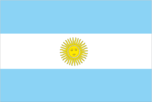
three equal horizontal bands of light blue (top), white, and light blue; centered in the white band is a radiant yellow sun with a human face known as the Sun of May
Independence
9 July 1816 (from Spain)
Judicial branch
Supreme Court (Corte Suprema)
Leaders
Chief of State and Head of Government--President Carlos Saul MENEM (since 8 July 1989); Vice President Eduardo DUHALDE (since 8 July 1989)
Legal system
mixture of US and West European legal systems; has not accepted compulsory ICJ jurisdiction
Legislative branch
bicameral National Congress (Congreso Nacional) consists of an upper chamber or Senate (Senado) and a lower chamber or Chamber of Deputies (Camara de Diputados)
Long-form name
Argentine Republic
Member of
AfDB, AG (observer), CCC, ECLAC, FAO, G-6, G-11, G-19, G-24, G-77, GATT, IADB, IAEA, IBRD, ICAO, ICC, ICFTU, IDA, IFAD, IFC, ILO, IMF, IMO, INMARSAT, INTELSAT, INTERPOL, IOC, IOM, ISO, ITU, LAES, LAIA, LORCS, NAM, OAS, PCA, RG, UN, UNAVEM, UNCTAD, UNESCO, UNHCR, UNIDO, UNIIMOG, UNTSO, UPU, WCL, WFTU, WHO, WIPO, WMO, WTO
National holiday
Revolution Day, 25 May (1810)
Other political or pressure groups
Peronist-dominated labor movement, General Confederation of Labor (Peronist-leaning umbrella labor organization), Argentine Industrial Union (manufacturers' association), Argentine Rural Society (large landowners' association), business organizations, students, the Roman Catholic Church, the Armed Forces
Political parties and leaders
Justicialist Party (JP), Carlos Saul MENEM, Peronist umbrella political organization; Radical Civic Union (UCR), Raul ALFONSIN, moderately left of center; Union of the Democratic Center (UCD), Alvaro ALSOGARAY, conservative party; Intransigent Party (PI), Dr. Oscar ALENDE, leftist party; several provincial parties
Suffrage
universal at age 18
Type
republic
Economy
Agriculture
accounts for 15% of GNP (including fishing); produces abundant food for both domestic consumption and exports; among world's top five exporters of grain and beef; principal crops--wheat, corn, sorghum, soybeans, sugar beets; 1987 fish catch estimated at 500,000 tons
Budget
revenues $12.2 billion; expenditures $17.3 billion, including capital expenditures of $2.8 billion (1989)
Currency
austral (plural--australes); 1 austral (2) = 100 centavos
Economic aid
US commitments, including Ex-Im (FY70-89), $1.0 billion; Western (non-US) countries, ODA and OOF bilateral commitments (1970-88), $4.0 billion; Communist countries (1970-89), $718 million
Electricity
16,749,000 kW capacity; 45,580 million kWh produced, 1,410 kWh per capita (1990)
Exchange rates
australes (2) per US$1--9,900 (April 1991), 4,707 (1990), 423 (1989), 8.7526 (1988), 2.1443 (1987), 0.9430 (1986), 0.6018 (1985)
Exports
$12.4 billion (f.o.b., 1990); commodities--meat, wheat, corn, oilseed, hides, wool; partners--US 12%, USSR, Italy, Brazil, Japan, Netherlands
External debt
$60 billion (December 1990)
Fiscal year
calendar year
GNP
$82.7 billion, per capita $2,560; real growth rate - 3.5% (1990 est.)
Imports
$4.1 billion (c.i.f., 1990); commodities--machinery and equipment, chemicals, metals, fuels and lubricants, agricultural products; partners--US 22%, Brazil, FRG, Bolivia, Japan, Italy, Netherlands
Industrial production
growth rate 5% (1991 est.); accounts for 30% of GDP
Industries
food processing, motor vehicles, consumer durables, textiles, chemicals and petrochemicals, printing, metallurgy, steel
Inflation rate (consumer prices)
1,350% (1990)
Overview
Argentina is rich in natural resources and has a highly literate population, an export-oriented agricultural sector, and a diversified industrial base. Nevertheless, following decades of mismanagement and statist policies, the economy has encountered major problems in recent years, leading to escalating inflation and a recession in 1988-90. A widening public-sector deficit and a multidigit inflation rate have dominated the economy over the past three years; retail prices rose nearly 5,000% in 1989 and another 1,345% in 1990. Since 1978, Argentina's external debt has nearly doubled to $60 billion, creating severe debt-servicing difficulties and hurting the country's creditworthiness with international lenders.
Unemployment rate
8.6% (May 1990)
Communications
Airports
1,763 total, 1,575 usable; 135 with permanent-surface runways; 1 with runways over 3,659 m; 31 with runways 2,440-3,659 m; 336 with runways 1,220-2,439 m
Civil air
54 major transport aircraft
Highways
208,350 km total; 47,550 km paved, 39,500 km gravel, 101,000 km improved earth, 20,300 km unimproved earth
Inland waterways
11,000 km navigable
Merchant marine
129 ships (1,000 GRT or over) totaling 1,663,884 GRT/2,689,645 DWT; includes 42 cargo, 7 refrigerated cargo, 6 container, 1 railcar carrier, 47 petroleum, oils, and lubricants (POL) tanker, 4 chemical tanker, 4 liquefied gas, 18 bulk; additionally, 2 naval tankers and 1 military transport are sometimes used commercially
Pipelines
4,090 km crude oil; 2,900 km refined products; 9,918 km natural gas
Ports
Bahia Blanca, Buenos Aires, Necochea, Rio Gallegos, Rosario, Santa Fe
Railroads
34,172 km total (includes 169 km electrified); includes a mixture of 1.435-meter standard gauge, 1.676-meter broad gauge, 1.000-meter gauge, and 0.750-meter gauge
Telecommunications
extensive modern system; 2,650,000 telephones (12,000 public telephones); radio relay widely used; stations--171 AM, no FM, 231 TV, 13 shortwave; 2 Atlantic Ocean INTELSAT earth stations; domestic satellite network has 40 stations
Military and Security
Branches
Argentine Army, Navy of the Argentine Republic, Argentine Air Force, National Gendarmerie, Argentine Naval Prefecture (Coast Guard only), National Aeronautical Police Force
Defense expenditures
$700 million, 1% of GNP (1990) _%_
Manpower availability
males 15-49, 7,992,140; 6,478,730 fit for military service; 285,047 reach military age (20) annually