1993 Edition
CIA World Factbook 1993 (Project Gutenberg)
Geography
Area
total area: 440 km2 land area: 440 km2 comparative area: slightly less than 2.5 times the size of Washington, DC note: includes Redonda
Climate
tropical marine; little seasonal temperature variation
Coastline
153 km
Environment
subject to hurricanes and tropical storms (July to October); insufficient freshwater resources; deeply indented coastline provides many natural harbors
International disputes
none
Irrigated land
NA km2
Land boundaries
0 km
Land use
arable land: 18% permanent crops: 0% meadows and pastures: 7% forest and woodland: 16% other: 59%
Location
in the eastern Caribbean Sea, about 420 km east-southeast of Puerto Rico
Map references
Central America and the Caribbean, Standard Time Zones of the World
Maritime claims
contiguous zone: 24 nm exclusive economic zone: 200 nm territorial sea: 12 nm
Natural resources
negligible; pleasant climate fosters tourism
Terrain
mostly low-lying limestone and coral islands with some higher volcanic areas
People and Society
Birth rate
17.51 births/1,000 population (1993 est.)
Death rate
5.5 deaths/1,000 population (1993 est.)
Ethnic divisions
black African, British, Portuguese, Lebanese, Syrian
Infant mortality rate
19.2 deaths/1,000 live births (1993 est.)
Labor force
30,000 by occupation: commerce and services 82%, agriculture 11%, industry 7% (1983)
Languages
English (official), local dialects
Life expectancy at birth
total population: 72.83 years male: 70.81 years female: 74.95 years (1993 est.)
Literacy
age 15 and over having completed 5 or more years of schooling (1960) total population: 89% male: 90% female: 88%
Nationality
noun: Antiguan(s), Barbudan(s) adjective: Antiguan, Barbudan
Net migration rate
-6.96 migrant(s)/1,000 population (1993 est.)
Population
64,406 (July 1993 est.)
Population growth rate
0.51% (1993 est.)
Religions
Anglican (predominant), other Protestant sects, some Roman Catholic
Total fertility rate
1.67 children born/woman (1993 est.)
Government
Administrative divisions
6 parishes and 2 dependencies*; Barbuda*, Redonda*, Saint George, Saint, John, Saint Mary, Saint Paul, Saint Peter, Saint Philip
Capital
Saint John's
Chief of State
Queen ELIZABETH II (since 6 February 1952), represented by Governor General Sir Wilfred Ebenezer JACOBS (since 1 November 1981, previously Governor since 1976)
Constitution
1 November 1981
Digraph
AC
Diplomatic representation in US
chief of mission: Ambassador Patrick Albert LEWIS
Executive branch
British monarch, governor general, prime minister, Cabinet
FAX
(809) 462-3516
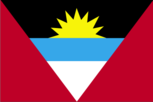
Flag
red with an inverted isosceles triangle based on the top edge of the flag; the triangle contains three horizontal bands of black (top), light blue, and white with a yellow rising sun in the black band
Head of Government
Prime Minister Vere Cornwall BIRD, Sr. (since NA 1976); Deputy Prime Minister Lester BIRD (since NA)
House of Representatives
last held 9 March 1989 (next to be held NA 1994); results - percent of vote by party NA; seats - (17 total) ALP 15, UPP 1, independent 1
Independence
1 November 1981 (from UK)
Judicial branch
Eastern Caribbean Supreme Court
Legal system
based on English common law
Legislative branch
bicameral Parliament consists of an upper house or Senate and a lower house or House of Representatives
Member of
ACP, C, CARICOM, CDB, ECLAC, FAO, G-77, GATT, IBRD, ICAO, ICFTU, IFAD, IFC, ILO, IMF, IMO, INTERPOL, IOC, ITU, NAM (observer), OAS, OECS, OPANAL, UN, UNCTAD, UNESCO, WCL, WHO, WMO
Names
conventional long form: none conventional short form: Antigua and Barbuda
National holiday
Independence Day, 1 November (1981)
Other political or pressure groups
United Progressive Party (UPP), headed by Baldwin SPENCER, a coalition of three opposition political parties - the United National Democratic Party (UNDP); the Antigua Caribbean Liberation Movement (ACLM); and the Progressive Labor Movement (PLM); Antigua Trades and Labor Union (ATLU), headed by Noel THOMAS
Political parties and leaders
Antigua Labor Party (ALP), Vere Cornwall BIRD, Sr., Lester BIRD; United Progressive Party (UPP), Baldwin SPENCER
Suffrage
18 years of age; universal
Type
parliamentary democracy
US diplomatic representation
chief of mission: the US Ambassador to Barbados is accredited to Antigua and Barbuda, and, in his absence, the Embassy is headed by Charge d'Affaires Bryant J. SALTER embassy: Queen Elizabeth Highway, Saint John's mailing address: FPO AA 34054-0001 telephone: (809) 462-3505 or 3506
Economy
Agriculture
accounts for 4% of GDP; expanding output of cotton, fruits, vegetables, and livestock; other crops - bananas, coconuts, cucumbers, mangoes, sugarcane; not self-sufficient in food
Budget
revenues $105 million; expenditures $161 million, including capital expenditures of $56 million (1992)
Currency
1 EC dollar (EC$) = 100 cents
Economic aid
US commitments, $10 million (1985-88); Western (non-US) countries, ODA and OOF bilateral commitments (1970-89), $50 million
Electricity
52,100 kW capacity; 95 million kWh produced, 1,482 kWh per capita (1992)
Exchange rates
East Caribbean dollars (EC$) per US$1 - 2.70 (fixed rate since 1976)
Exports
$32 million (f.o.b., 1991) commodities: petroleum products 48%, manufactures 23%, food and live animals 4%, machinery and transport equipment 17% partners: OECS 26%, Barbados 15%, Guyana 4%, Trinidad and Tobago 2%, US 0.3%
External debt
$250 million (1990 est.)
Fiscal year
1 April - 31 March
Imports
$317.5 million (c.i.f., 1991) commodities: food and live animals, machinery and transport equipment, manufactures, chemicals, oil partners: US 27%, UK 16%, Canada 4%, OECS 3%, other 50%
Industrial production
growth rate 3% (1989 est.); accounts for 5% of GDP
Industries
tourism, construction, light manufacturing (clothing, alcohol, household appliances)
Inflation rate (consumer prices)
6.5% (1991 est.)
National product
GDP - exchange rate conversion - $424 million (1991 est.)
National product per capita
$6,600 (1991 est.)
National product real growth rate
1.4% (1991 est.)
Overview
The economy is primarily service oriented, with tourism the most important determinant of economic performance. During the period 1987-90, real GDP expanded at an annual average rate of about 6%. Tourism makes a direct contribution to GDP of about 13% and also affects growth in other sectors - particularly in construction, communications, and public utilities. Although Antigua and Barbuda is one of the few areas in the Caribbean experiencing a labor shortage in some sectors of the economy, it has been hurt in 1991-92 by a downturn in tourism caused by the Persian Gulf war and the US recession.
Unemployment rate
5% (1988 est.)
Communications
Airports
total: 3 usable: 3 with permanent-surface runways: 2 with runways 3,659 m: with runways 2,440-3,659 m: 1 with runways 1,220-2,439 m:
Highways
240 km
Merchant marine
149 ships (1,000 GRT or over) totaling 529,202 GRT/778,506 DWT; includes 96 cargo, 3 refrigerated cargo, 21 container, 5 roll-on/roll-off cargo, 1 multifunction large-load carrier, 2 oil tanker, 19 chemical tanker, 2 bulk; note - a flag of convenience registry
Ports
Saint John's
Railroads
64 km 0.760-meter narrow gauge and 13 km 0.610-meter gauge used almost exclusively for handling sugarcane
Telecommunications
good automatic telephone system; 6,700 telephones; tropospheric scatter links with Saba and Guadeloupe; broadcast stations - 4 AM, 2 FM, 2 TV, 2 shortwave; 1 coaxial submarine cable; 1 Atlantic Ocean INTELSAT earth station
Military and Security
Branches
Royal Antigua and Barbuda Defense Force, Royal Antigua and Barbuda Police Force (including the Coast Guard)
Defense expenditures
exchange rate conversion - $1.4 million, 1% of GDP (FY90/91)
Manpower availability
NA