1990 Edition
CIA World Factbook 1990 (Project Gutenberg)
Geography
Climate
tropical marine; little seasonal temperature variation
Coastline
153 km
Comparative area
slightly less than 2.5 times the size of Washington, DC
Contiguous zone
24 nm;
Environment
subject to hurricanes and tropical storms (July to October); insufficient freshwater resources; deeply indented coastline provides many natural harbors
Extended economic zone
200 nm;
Land boundaries
none
Land use
18% arable land; 0% permanent crops; 7% meadows and pastures; 16% forest and woodland; 59% other
Natural resources
negligible; pleasant climate fosters tourism
Note
420 km east-southeast of Puerto Rico
Terrain
mostly low-lying limestone and coral islands with some higher volcanic areas
Territorial sea
12 nm
Total area
440 km2; land area: 440 km2; includes Redonda
People and Society
Birth rate
18 births/1,000 population (1990)
Death rate
6 deaths/1,000 population (1990)
Ethnic divisions
almost entirely of black African origin; some of British, Portuguese, Lebanese, and Syrian origin
Infant mortality rate
23 deaths/1,000 live births (1990)
Labor force
30,000; 82% commerce and services, 11% agriculture, 7% industry (1983)
Language
English (official), local dialects
Life expectancy at birth
70 years male, 74 years female (1990)
Literacy
90% (est.)
Nationality
noun--Antiguan(s); adjective--Antiguan
Net migration rate
- 10 migrants/1,000 population (1990)
Organized labor
Antigua and Barbuda Public Service Association (ABPSA), membership 500; Antigua Trades and Labor Union (ATLU), 10,000 members; Antigua Workers Union (AWU), 10,000 members (1986 est.)
Population
63,726 (July 1990), growth rate 0.3% (1990)
Religion
Anglican (predominant), other Protestant sects, some Roman Catholic
Total fertility rate
1.7 children born/woman (1990)
Government
Administrative divisions
6 parishes and 2 dependencies*; Barbuda*, Redonda*, Saint George, Saint John, Saint Mary, Saint Paul, Saint Peter, Saint Philip
Capital
Saint John's
Communists
negligible
Constitution
1 November 1981
Diplomatic representation
Ambassador Edmund Hawkins LAKE; Chancery at Suite 2H, 3400 International Drive NW, Washington DC 20008; telephone (202) 362-5211 or 5166, 5122, 5225; there is an Antiguan Consulate in Miami; US--the US Ambassador to Barbados is accredited to Antigua and Barbuda, and in his absence, the Embassy is headed by Charge d'Affaires Roger R. GAMBLE; Embassy at Queen Elizabeth Highway, Saint John's (mailing address is FPO Miami 34054); telephone (809) 462-3505 or 3506
Elections
House of Representatives--last held 9 March 1989 (next to be held 1994); results--percentage of vote by party NA; seats--(17 total) ALP 15, UNDP 1, independent 1
Executive branch
British monarch, governor general, prime minister, deputy prime minister, Cabinet
Flag
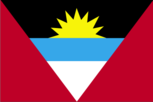
red with an inverted isosceles triangle based on the top edge of the flag; the triangle contains three horizontal bands of black (top), light blue, and white with a yellow rising sun in the black band
Independence
1 November 1981 (from UK)
Judicial branch
Eastern Caribbean Supreme Court
Leaders
Chief of State--Queen ELIZABETH II (since 6 February 1952), represented by Governor General Sir Wilfred Ebenezer JACOBS (since 1 November 1981, previously Governor since 1976); Head of Government--Prime Minister Vere Cornwall BIRD, Sr. (since NA 1976); Deputy Prime Minister Lester BIRD (since NA 1976)
Legal system
based on English common law
Legislative branch
bicameral Parliament consists of an upper house or Senate and a lower house or House of Representatives
Long-form name
none
Member of
ACP, CARICOM, Commonwealth, FAO, G-77, IBRD, ICAO, ILO, IMF, ISO, OAS, UN, UNESCO, WHO, WMO
National holiday
Independence Day, 1 November (1981)
Other political or pressure groups
Antigua Caribbean Liberation Movement (ACLM), a small leftist nationalist group led by Leonard (Tim) Hector; Antigua Trades and Labor Union (ATLU), headed by Noel Thomas
Political parties and leaders
Antigua Labor Party (ALP), Vere C. Bird, Sr., Lester Bird; United National Democratic Party (UNDP), Dr. Ivor Heath
Suffrage
universal at age 18
Type
parliamentary democracy
Economy
Agriculture
accounts for 4% of GDP; expanding output of cotton, fruits, vegetables, and livestock sector; other crops--bananas, coconuts, cucumbers, mangoes; not self-sufficient in food
Aid
Western (non-US) countries, ODA and OOF bilateral commitments (1970-87), $40 million
Budget
revenues $77 million; expenditures $81 million, including capital expenditures of $13 million (1988 est.)
Currency
East Caribbean dollar (plural--dollars); 1 EC dollar (EC$) = 100 cents
Electricity
49,000 kW capacity; 90 million kWh produced, 1,410 kWh per capita (1989)
Exchange rates
East Caribbean dollars (EC$) per US$1--2.70 (fixed rate since 1976)
Exports
$30.4 million (f.o.b., 1988 est.); commodities--petroleum products 46%, manufactures 29%, food and live animals 14%, machinery and transport equipment 11%; partners--Trinidad and Tobago 40%, Barbados 8%, US 0.3%
External debt
$245.4 million (1987)
Fiscal year
1 April-31 March
GDP
$353.5 million, per capita $5,550; real growth rate 6.2% (1989 est.)
Imports
$302.1 million (c.i.f., 1988 est.); commodities--food and live animals, machinery and transport equipment, manufactures, chemicals, oil; partners--US 27%, UK 14%, CARICOM 7%, Canada 4%, other 48%
Industrial production
growth rate 10% (1987)
Industries
tourism, construction, light manufacturing (clothing, alcohol, household appliances)
Inflation rate (consumer prices)
7.1% (1988 est.)
Overview
The economy is primarily service oriented, with tourism the most important determinant of economic performance. During the period 1983-87, real GDP expanded at an annual average rate of 8%. Tourism's contribution to GDP, as measured by value added in hotels and restaurants, rose from about 14% in 1983 to 17% in 1987, and stimulated growth in other sectors--particularly in construction, communications, and public utilities. During the same period the combined share of agriculture and manufacturing declined from 12% to less than 10%. Antigua and Barbuda is one of the few areas in the Caribbean experiencing a labor shortage in some sectors of the economy.
Unemployment rate
5.0% (1988 est.)
Communications
Airports
3 total, 3 usable; 2 with permanent-surface runways; 1 with runways 2,440-3,659 m; 2 with runways less than 2,440 m
Civil air
10 major transport aircraft
Highways
240 km
Merchant marine
80 ships (1,000 GRT or over) totaling 307,315 GRT/501,552 DWT; includes 50 cargo, 4 refrigerated cargo, 8 container, 8 roll-on/roll-off cargo, 2 petroleum, oils, and lubricants (POL) tanker, 5 chemical tanker, 2 liquefied gas, 1 short-sea passenger; note--a flag of convenience registry
Ports
St. John's
Railroads
64 km 0.760-meter narrow gauge and 13 km 0.610-meter gauge used almost exclusively for handling sugarcane
Telecommunications
good automatic telephone system; 6,700 telephones; tropospheric scatter links with Saba and Guadeloupe; stations--4 AM, 2 FM, 2 TV, 2 shortwave; 1 coaxial submarine cable; 1 Atlantic Ocean INTELSAT earth station
Military and Security
Branches
Royal Antigua and Barbuda Defense Force, Royal Antigua and Barbuda Police Force (includes the Coast Guard)
Defense expenditures
NA
Military manpower
NA