2002 Edition
CIA World Factbook 2002 (Project Gutenberg)
Introduction
Background
Civil war has been the norm in Angola since independence from Portugal in 1975. A 1994 peace accord between the government and the National Union for the Total Independence of Angola (UNITA) provided for the integration of former UNITA insurgents into the government and armed forces. A national unity government was installed in April of 1997, but serious fighting resumed in late 1998, rendering hundreds of thousands of people homeless. Up to 1.5 million lives may have been lost in fighting over the past quarter century. The death of Jonas SAVIMBI and a cease fire with UNITA may bode well for the country.
Geography
Area
total: 1,246,700 sq km water: 0 sq km land: 1,246,700 sq km
Area - comparative
slightly less than twice the size of Texas
Coastline
1,600 km
Elevation extremes
lowest point: Atlantic Ocean 0 m highest point: Morro de Moco 2,620 m
Environment - current issues
overuse of pastures and subsequent soil erosion attributable to population pressures; desertification; deforestation of tropical rain forest, in response to both international demand for tropical timber and to domestic use as fuel, resulting in loss of biodiversity; soil erosion contributing to water pollution and siltation of rivers and dams; inadequate supplies of potable water
Environment - international agreements
party to: Biodiversity, Climate Change, Desertification, Law of the Sea, Ozone Layer Protection, Ship Pollution signed, but not ratified: none of the selected agreements
Geographic coordinates
12 30 S, 18 30 E
Geography - note
Cabinda is separated from rest of country by the Democratic Republic of the Congo
Irrigated land
750 sq km (1998 est.)
Land boundaries
total: 5,198 km border countries: Democratic Republic of the Congo 2,511 km (of which 225 km is the boundary of discontiguous Cabinda Province), Republic of the Congo 201 km, Namibia 1,376 km, Zambia 1,110 km
Land use
arable land: 2% permanent crops: 1% other: 97% (1998 est.)
Location
Southern Africa, bordering the South Atlantic Ocean, between Namibia and Democratic Republic of the Congo
Map references
Africa
Maritime claims
200 NM territorial sea: Climate: semiarid in south and along coast to Luanda; north has cool, dry season (May to October) and hot, rainy season (November to April)
Natural hazards
locally heavy rainfall causes periodic flooding on the plateau
Natural resources
petroleum, diamonds, iron ore, phosphates, copper, feldspar, gold, bauxite, uranium
Terrain
narrow coastal plain rises abruptly to vast interior plateau
People and Society
Age structure
0-14 years: 43.3% (male 2,318,326; female 2,272,726) 15-64 years: 53.9% (male 2,904,595; female 2,806,430) 65 years and over: 2.8% (male 131,316; female 159,778) (2002 est.)
Birth rate
46.18 births/1,000 population (2002 est.)
Death rate
24.35 deaths/1,000 population (2002 est.)
Ethnic groups
Ovimbundu 37%, Kimbundu 25%, Bakongo 13%, mestico (mixed European and Native African) 2%, European 1%, other 22%
HIV/AIDS - adult prevalence rate
2.78% (1999 est.)
HIV/AIDS - deaths
15,000 (1999 est.)
HIV/AIDS - people living with HIV/AIDS
160,000 (1999 est.)
Infant mortality rate
191.66 deaths/1,000 live births (2002 est.)
Languages
Portuguese (official), Bantu and other African languages
Life expectancy at birth
40.18 years (2002 est.) male: Total fertility rate: 6.43 children born/woman (2002 est.)
Literacy
definition: age 15 and over can read and write total population: 42% male: 56% female: 28% (1998 est.)
Nationality
noun: Angolan(s) adjective: Angolan
Net migration rate
0 migrant(s)/1,000 population (2002 est.)
Population
10,593,171 (July 2002 est.)
Population growth rate
2.18% (2002 est.)
Religions
indigenous beliefs 47%, Roman Catholic 38%, Protestant 15% (1998 est.)
Sex ratio
at birth: 1.05 male(s)/female under 15 years: 1.02 male(s)/female 15-64 years: 1.03 male(s)/female 65 years and over: 0.82 male(s)/female total population: 1.02 male(s)/female (2002 est.)
Government
Administrative divisions
18 provinces (provincias, singular - provincia); Bengo, Benguela, Bie, Cabinda, Cuando Cubango, Cuanza Norte, Cuanza Sul, Cunene, Huambo, Huila, Luanda, Lunda Norte, Lunda Sul, Malanje, Moxico, Namibe, Uige, Zaire
Capital
Luanda
Constitution
11 November 1975; revised 7 January 1978, 11 August 1980, 6 March 1991, and 26 August 1992
Council of Ministers appointed by the president elections
DOS SANTOS originally elected (in 1979) without opposition under a one-party system and stood for reelection in Angola's first multiparty elections 29-30 September 1992 (next to be held NA) election results: DOS SANTOS 49.6%, Jonas SAVIMBI 40.1%, making a run-off election necessary; the run-off was not held and SAVIMBI's National Union for the Total Independence of Angola (UNITA) repudiated the results of the first election; the civil war resumed
Country name
Republic of Angola conventional short form: local long form: Republica de Angola
Diplomatic representation from the US
chief of mission: Ambassador Christopher William DELL embassy: number international mail: State, Washington, DC 20521-2550 telephone: [244] (2) 445-481, 447-028, 446-224, 445-727 FAX: [244] (2) 446-924
Diplomatic representation in the US
chief of mission: Ambassador Josefina Perpetua Pitra DIAKIDI FAX: [1] (202) 785-1258 consulate(s) general: New York telephone: [1] (202) 785-1156 chancery: 2100 16th Street NW, Washington, DC 20009
Executive branch
chief of state: President Jose Eduardo DOS SANTOS (since 21 September 1979); note - the president is both chief of state and head of government head of government: President Jose Eduardo DOS SANTOS (since 21 September 1979); note - the president is both chief of state and head of government
Flag description
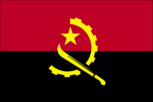
two equal horizontal bands of red (top) and black with a centered yellow emblem consisting of a five-pointed star within half a cogwheel crossed by a machete (in the style of a hammer and sickle)
Government type
republic, nominally a multiparty democracy with a strong presidential system
Independence
11 November 1975 (from Portugal)
International organization participation
ACP, AfDB, CCC, CEEAC, ECA, FAO, G-77, IAEA, IBRD, ICAO, ICFTU, ICRM, IDA, IFAD, IFC, IFRCS, ILO, IMF, IMO, Interpol, IOC, IOM, ITU, NAM, OAS (observer), OAU, SADC, UN, UNCTAD, UNESCO, UNIDO, UPU, WFTU, WHO, WIPO, WMO, WToO, WTrO
Judicial branch
Supreme Court or Tribunal da Relacao (judges are appointed by the president)
Legal system
based on Portuguese civil law system and customary law; recently modified to accommodate political pluralism and increased use of free markets
Legislative branch
unicameral National Assembly or Assembleia Nacional (220 seats; members elected by proportional vote to serve four-year terms) elections: last held 29-30 September 1992 (next to be held NA) election results: percent of vote by party - MPLA 54%, UNITA 34%, others 12%; seats by party - MPLA 129, UNITA 70, PRS 6, FNLA 5, PLD 3, others 7
National holiday
Independence Day, 11 November (1975)
Political parties and leaders
Liberal Democratic Party or PLD [Analia de Victoria PEREIRA]; National Front for the Liberation of Angola or FNLA [disputed leadership: Lucas NGONDA, Holden ROBERTO]; National Union for the Total Independence of Angola or UNITA [Jonas SAVIMBI], largest opposition party has engaged in years of armed resistance; Popular Movement for the Liberation of Angola or MPLA [Jose Eduardo DOS SANTOS], ruling party in power since 1975; Social Renewal Party or PRS [disputed leadership: Eduardo KUANGANA, Antonio MUACHICUNGO]; UNITA-Renovada [Eugenio NGOLO "Manuvakola"] note: won a few seats and have little influence in the National Assembly
Political pressure groups and leaders
Front for the Liberation of the Enclave of Cabinda or FLEC [N'zita Henriques TIAGO; Antonio Bento BEMBE] note: FLEC is waging a small-scale, highly factionalized, armed struggle for the independence of Cabinda Province
Suffrage
18 years of age; universal
Economy
Agriculture - products
bananas, sugarcane, coffee, sisal, corn, cotton, manioc (tapioca), tobacco, vegetables, plantains; livestock; forest products; fish
Budget
revenues: $928 million expenditures: $2.5 billion, including capital expenditures of $963 million (1992 est.)
Currency
kwanza (AOA)
Currency code
AOA
Debt - external
$10.4 billion (2001 est.)
Economic aid - recipient
$383.5 million (1999)
Electricity - consumption
1.107 billion kWh (2000)
Electricity - exports
0 kWh (2000)
Electricity - imports
0 kWh (2000)
Electricity - production
1.19 billion kWh (2000)
Electricity - production by source
fossil fuel: 40.34% hydro: 59.66% other: 0% (2000) nuclear: 0%
Exchange rates
kwanza per US dollar - 32.8716 (January 2002), 22.058 (2001), 10.041 (2000), 2.791 (1999), 0.393 (1998), 0.229 (1997); note - in December 1999 the kwanza was revalued with six zeroes dropped off the old value
Exports
$7 billion (f.o.b., 2001 est.)
Exports - commodities
crude oil 90%, diamonds, refined petroleum products, gas, coffee, sisal, fish and fish products, timber, cotton
Exports - partners
US 44.5%, EU 17.3%, China 22.7%, South Korea 8.1% (2000)
Fiscal year
calendar year
GDP
purchasing power parity - $13.3 billion (2001 est.)
GDP - composition by sector
agriculture: 6% industry: 70% services: 24% (2000 est.)
GDP - per capita
purchasing power parity - $1,330 (2001 est.)
GDP - real growth rate
5.4% (2001 est.)
Household income or consumption by percentage share
lowest 10%: NA% highest 10%: NA%
Imports
$2.7 billion (f.o.b., 2001 est.)
Imports - commodities
machinery and electrical equipment, vehicles and spare parts; medicines, food, textiles, military goods
Imports - partners
EU 47.4%, South Korea 16%, South Africa 15.9%, US 11.3%, Brazil 5.5% (2000)
Industrial production growth rate
NA%
Industries
petroleum; diamonds, iron ore, phosphates, feldspar, bauxite, uranium, and gold; cement; basic metal products; fish processing; food processing; brewing; tobacco products; sugar; textiles
Inflation rate (consumer prices)
110% (2001 est.)
Labor force
5 million (1997 est.)
Labor force - by occupation
agriculture 85%, industry and services 15% (1997 est.)
Population below poverty line
NA%
Unemployment rate
extensive unemployment and underemployment affecting more than half the population (2001 est.)
Communications
Internet country code
.ao
Internet Service Providers (ISPs)
1 (2000)
Internet users
30,000 (2001)
Radio broadcast stations
AM 36, FM 7, shortwave 9 (2000)
Radios
815,000 (2000)
Telephone system
general assessment: telephone service limited mostly to government and business use; HF radiotelephone used extensively for military links domestic: limited system of wire, microwave radio relay, and tropospheric scatter international: satellite earth stations - 2 Intelsat (Atlantic Ocean)
Telephones - main lines in use
69,700 (1997)
Telephones - mobile cellular
25,800 (2000)
Television broadcast stations
7 (2000)
Televisions
196,000 (2000)
Transportation
Airports
244 (2001)
Airports - with paved runways
total: 32 over 3,047 m: 4 2,438 to 3,047 m: 8 1,524 to 2,437 m: 13 914 to 1,523 m: 6 under 914 m: 1 (2001)
Airports - with unpaved runways
total: 212 over 3,047 m: 2 2,438 to 3,047 m: 5 1,524 to 2,437 m: 30 914 to 1,523 m: 95 under 914 m: 80 (2001)
Highways
total: 76,626 km paved: 19,156 km unpaved: 57,470 km (1997)
Merchant marine
total: 9 ships (1,000 GRT or over) totaling 39,305 GRT/63,528 DWT ships by type: cargo 8, petroleum tanker 1 (2002 est.)
Pipelines
crude oil 179 km
Ports and harbors
Ambriz, Cabinda, Lobito, Luanda, Malongo, Mocamedes, Namibe, Porto Amboim, Soyo
Railways
total: 2,771 km (inland, much of the track is unusable because of land mines still in place from the civil war) narrow gauge: 2,648 km 1.067-m gauge; 123 km 0.600-m gauge (2000 est.)
Waterways
1,295 km
Military and Security
Military branches
Army, Navy, Air and Air Defense Forces, National Police Force
Military expenditures - dollar figure
$1.2 billion (FY97)
Military expenditures - percent of GDP
22% (1999)
Military manpower - availability
males age 15-49: 2,532,469 (2002 est.)
Military manpower - fit for military service
males age 15-49: 1,272,509 (2002 est.)
Military manpower - military age
18 years of age (2002 est.)
Military manpower - reaching military age annually
males: 103,807 (2002 est.)
Transnational Issues
Disputes - international
none
Illicit drugs
used as a transshipment point for cocaine destined for Western Europe and other African states This page was last updated on 1 January 2002 American Samoa