1989 Edition
CIA World Factbook 1989 (Internet Archive)
Geography
Administrative divisions
1 8 provinces (provincias, singular — provincia); Bengo, Benguela, Bie, Cabinda, Cuando Cubango, Cuanza Norte, Cuanza Sul, Cunene, Huambo, Huila, Luanda, Lunda Norte, Lunda Sul, Malanje, Mexico, Namibe, Uige, Zaire
Capital
Luanda
Constitution
11 November 1975; revised 7 January 1978 and 11 August 1980
Diplomatic representation
none
Elections
none held to date
Executive branch
president, chairman of the Council of Ministers, Council of Ministers (cabinet)
Flag
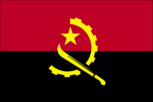
two equal horizontal bands of red (top) and black with a centered yellow emblem consisting of a five-pointed star within half a cogwheel crossed by a machete (in the style of a hammer and sickle)
Independence
11 November 1975 (from Portugal)
Judicial branch
Supreme Court (Tribunal da Relacao)
Leaders
Chief of State and Head of Government— President Jose Eduardo dos SANTOS (since 21 September 1979) Political parties and leaders: only party — Popular Movement for the Liberation of Angola-Labor Party (MPLA-Labor Party), Jose Eduardo dos Santos; National Union for the Total Independence of Angola (UNITA), lost to the MPLA with Cuban military support in immediate postindependence struggle, now carrying out insurgency
Legal system
based on Portuguese civil law system and customary law, but being modified along socialist lines
Legislative branch
unicameral National People's Assembly
Member of
ACP, AfDB, CCC, FAO, G77, GATT (de facto), ICAO, I FAD, ILO, IMO, INTELSAT, ITU, NAM, OAU, SADCC, UN, UNESCO, UNICEF, UPU, WFTU, WHO, WMO
National holiday
Independence Day, 1 1 November (1975)
Suffrage
universal adult at age NA
Type
Marxist people's republic
Economy
Agriculture
cash crops — coffee, sisal, corn, cotton, sugar, manioc, tobacco; food crops — cassava, corn, vegetables, plantains, bananas, and other local foodstuffs; disruptions caused by civil war and marketing deficiencies require food imports
Aid
US commitments, including Ex-!m (FY70-88), $263 million; Western (nonUS) countries, ODA and OOF bilateral commitments (1970-87), $903 million; Communist countries (1970-88), $1.3 billion
Budget
revenues NA; expenditures $2.7 billion, including capital expenditures of NA (1986 est.)
Currency
kwanza (plural — kwanza); 1 kwanza (Kz) = 100 Iwei
Electricity
506,000 kW capacity; 770 million kWh produced, 90 kWh per capita (1989)
Exchange rates
kwanza (Kz) per US$1 — 29.62 (fixed rate since 1976)
Exports
$2.9 billion (f.o.b., 1989 est.); commodities — oil, coffee, diamonds, sisal, fish and fish products, timber, cotton; partners— US, USSR, Cuba, Portugal, Brazil
External debt
$3.0 billion (1989)
Fiscal year
calendar year
GDP
$5.0 billion, per capita $600; real growth rate 9.2% (1988 est.)
Imports
$2.5 billion (f.o.b., 1989 est.); commodities — capital equipment (machinery and electrical equipment), food, vehicles and spare parts, textiles and clothing, medicines; substantial military deliveries; partners— US, USSR, Cuba, Portugal, Brazil
Industrial production
growth rate NA%
Industries
petroleum, mining (phosphate rock, diamonds), fish processing, brewing, tobacco, sugar, textiles, cement, food processing, building construction
Inflation rate (consumer prices)
NA%
Overview
Subsistence agriculture provides the main livelihood for 80-90% of the population, but accounts for only 10-20% of GDP. Oil production is the most lucrative sector of the economy, contributing about 50% to GDP. In recent years, however, the impact of fighting an internal war has severely affected the economy and food has to be imported.
Unemployment rate
NA%
Communications
Airports
317 total, 184 usable; 28 with permanent-surface runways; 1 with runways over 3,659 m; 1 2 with runways 2,440-3,659 m; 60 with runways 1,2202,439 m
Branches
Army, Navy, Air Force/Air Defense; paramilitary forces — People's Defense Organization and Territorial Troops, Frontier Guard, Popular Vigilance Brigades
Civil air
27 major transport aircraft
Defense expenditures
NA
Highways
73,828 km total; 8,577 km bituminous-surface treatment, 29,350 km crushed stone, gravel, or improved earth, remainder unimproved earth
Inland waterways
1,295 km navigable
Merchant marine
12 ships (1,000 GRT or over) totaling 66,348 GRT/ 102,825 DWT; includes 1 1 cargo, 1 petroleum, oils, and lubricants (POL) tanker
Military manpower
males 15-49, 2,049,295; 1,030,868 fit for military service; 90,877 reach military age (18) annually
Pipelines
crude oil, 179 km
Ports
Luanda, Lobito, Namibe, Cabinda
Railroads
3,189 km total; 2,879 km 1.067-meter gauge, 310 km 0.600-meter gauge; limited trackage in use because of insurgent attacks; sections of the Benguela Railroad closed because of insurgency
Telecommunications
fair system of wire, radio relay, and troposcatter routes; high frequency used extensively for military/ Cuban links; 40,300 telephones; stations — 17 AM, 13 FM, 2 TV; 2 Atlantic Ocean INTELSAT earth stations Defense Forces