1989 Edition
CIA World Factbook 1989 (Internet Archive)
Geography
Agriculture
bananas, coconuts, vegetables, taro, breadfruit, yams, copra, pineapples, papayas
Aid
$20. 1 million in operational funds and $5.8 million in construction funds for capital improvement projects from the US Department of Interior (1989)
Climate
- temperate; snowy, cold winters and cool, dry summers
- semiarid in south and along coast to Luanda; north has cool, dry season (May to October) and hot, rainy season (November to April)
Coastline
- none — landlocked
- 1,600 km
Comparative area
- slightly more than 2.5 times the size of Washington, DC
- slightly less than twice the size of Texas
Currency
US currency is used
Disputes
civil war since independence on 11 November 1975
Environment
- deforestation, overgrazing
- locally heavy rainfall causes periodic flooding on plateau; desertification
Exchange rates
US currency is used
Exclusive fishing zone
200 nm
Fiscal year
1 October-30 September
Land boundaries
- 125 km total; France 60 km, Spain 65 km
- 5,198 km total; Congo 201 km, Namibia 1,376 km, Zaire 2,51 1 km, Zambia 1,110 km
Land use
- 2% arable land; 0% permanent crops; 56% meadows and pastures; 22% forest and woodland; 20% other
- 2% arable land; NEGL% permanent crops; 23% meadows and pastures; 43% forest and woodland; 32% other
Maritime claims
none — landlocked
Natural resources
- hydropower, mineral water, timber, iron ore, lead
- petroleum, diamonds, iron ore, phosphates, copper, feldspar, gold, bauxite, uranium
Note
- landlocked
- Cabinda is separated from rest of country by Zaire
Terrain
- rugged mountains dissected by narrow valleys
- narrow coastal plain rises abruptly to vast interior plateau
Territorial sea
20 nm
Total area
- 450 km2; land area: 450 km2
- 1,246,700 km2; land area: 1,246,700km2
People and Society
Birth rate
- 12 births/ 1,000 population (1990)
- 47 births/ 1 ,000 population (1990)
Death rate
- 4 deaths/ 1,000 population (1990)
- 20 deaths/ 1,000 population (1990)
Ethnic divisions
- Catalan stock; 61% Spanish, 30% Andorran, 6% French, 3% other
- 37% Ovimbundu, 25% Kimbundu, 13% Bakongo, 2% Mestico, 1% European
Infant mortality rate
- 7 deaths/ 1,000 live births (1990)
- 158 deaths/ 1,000 live births (1990)
Labor force
- NA
- 2,783,000 economically active; 85% agriculture, 15% industry (1985 est.)
Language
- Catalan (official); many also speak some French and Castilian
- Portuguese (official); various Bantu dialects
Life expectancy at birth
- 74 years male, 81 years female (1990)
- 42 years male, 46 years female (1990)
Literacy
- 100%
- 41%
Nationality
- noun — Andorran(s); adjective— Andorran
- noun — Angolan(s); adjective — Angolan
Net migration rate
- 18 migrants/ 1,000 population (1990)
- 2 migrants/ 1 ,000 population (1990)
Organized labor
- none
- about 450,695 (1980)
Population
- 51,895 (July 1990), growth rate 2.6% (1990)
- 8,534,483 (July 1990), growth rate 2.9% (1990)
Religion
- virtually all Roman Catholic
- 47% indigenous beliefs, 38% Roman Catholic, 15% Protestant (est.)
Total fertility rate
- 1.3 children born/ woman (1990)
- 6.7 children born/ woman (1990)
Government
Administrative divisions
7 parishes (parroquies, singular — parroquia); Andorra, Canillo, Encamp, La Massana, Les Escaldes, Ordino, Sant Julia de Loria
Capital
Andorra la Vella
Communists
negligible
Constitution
none; some pareatges and decrees, mostly custom and usage
Diplomatic representation
Andorra has no mission in the US; US — includes Andorra within the Barcelona (Spain) Consular District and the US Consul General visits Andorra periodically; Consul General Ruth A. DAVIS; Consulate General at Via Layetana 33, Barcelona 3, Spain (mailing address APO NY 09286); telephone [34] (3) 319-9550
Elections
General Council of the Valleys—last held 11 December 1989 (next to Andorra (continued) Angola be held December 1993); results— percent of vote NA; seats — (28 total) number of seats by party NA
Executive branch
two co-princes (president of France, bishop of Seo de Urgel in Spain), two designated representatives (French veguer, Episcopal veguer), two permanent delegates (French prefect for the department of Pyrenees-Orientales, Spanish vicar general for the Seo de Urgel diocese), president of government, Executive Council
Flag
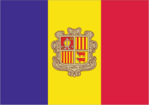
three equal vertical bands of blue (hoist side), yellow, and red with the national coat of arms centered in the yellow band; the coat of arms features a quartered shield; similar to the flag of Chad which does not have a national coat of arms in the center; also similar to the flag of Romania which has a national coat of arms featuring a mountain landscape below a red five-pointed star and the words REPUBLICA SOCIALISTA ROMANIA at the bottom
Independence
1278
Judicial branch
civil cases — Supreme Court of Andorra at Perpignan (France) or the Ecclesiastical Court of the bishop of Seo de Urgel (Spain); criminal cases — Tribunal of the Courts (Tribunal des Cortes)
Leaders
Chiefs of State — French Co-Prince Francois MITTERRAND (since 21 May 1981), represented by Veguer de Fransa Louis DEBLE; Spanish Episcopal Co-Prince Mgr. Joan MARTI y Alanis (since 31 January 1971), represented by Veguer Episcopal Francesc BADIA Batalla; Head of Government — Josep PINTAT Solans (since N A 1984) Political parties and leaders: political parties not yet legally recognized; traditionally no political parties but partisans for particular independent candidates for the General Council on the basis of competence, personality, and orientation toward Spain or France; various small pressure groups developed in 1972; first formal political party, Andorran Democratic Association, was formed in 1 976 and reorganized in 1979 as Andorran Democratic Party
Legal system
based on French and Spanish civil codes; no judicial review of legislative acts; has not accepted compulsory ICJ jurisdiction
Legislative branch
unicameral General Council of the Valleys (Consell General de las Vails)
Long-form name
- Principality of Andorra
- People's Republic of
Member of
CCC, UNESCO
National holiday
Mare de Deu de Meritxell, 8 September
Suffrage
universal at age 18
Type
unique coprincipality under formal sovereignty of president of France and Spanish bishop of Seo de Urgel, who are represented locally by officials called verguers
Economy
Agriculture
sheep raising; small quantities of tobacco, rye, wheat, barley, oats, and some vegetables
Aid
none
Budget
revenues SNA; expenditures SNA, including capital expenditures of SNA
Currency
French franc (plural — francs) and Spanish peseta (plural — pesetas); 1 French franc (F) = 100 centimes and 1 Spanish peseta (Pta) = 100 centimes
Electricity
35,000 kW capacity; 140 million kWh produced, 2,800 kWh per capita (1989)
Exchange rates
French francs (F) per US$1— 5.7598 (January 1990), 6.3801 (1989), 5.9569 (1988), 6.0107 (1987), 6.9261 (1986), 8.9852 (1985); Spanish pesetas (Ptas) per US$1— 109.69 (January 1990), 118.38(1989), 116.49(1988), 123.48 (1987), 140.05 (1986), 170.04 (1985) Fiscal yean calendar year
Exports
$0.017 million (f.o.b., 1986); commodities — electricity; partners — France, Spain
External debt
SNA
GNP
SNA, per capita SNA; real growth rate NA%
Imports
$531 million (f.o.b., 1986); commodities— NA; partners — France, Spain
Industrial production
growth rate NA%
Industries
tourism (particularly skiing), sheep, timber, tobacco, smuggling, banking
Inflation rate (consumer prices)
NA%
Overview
The mainstay of Andorra's economy is tourism. An estimated 12 million tourists visit annually, attracted by Andorra's duty-free status and by its summer and winter resorts. Agricultural production is limited by a scarcity of arable land, and most food has to be imported. The principal livestock activity is sheep raising. Manufacturing consists mainly of cigarettes, cigars, and furniture. The rapid pace of European economic integration is a potential threat to Andorra's advantages from its duty-free status.
Unemployment rate
NA%
Communications
Airports
3 total, 3 usable; 1 with permanent-surface runways; none with runways over 3,659 m; 1 with runways 2,440 to 3,659 m (international airport at Tafuna, near Pago Pago); small airstrips on Ta'u and Ofu
Highways
- 350 km total; 150 km paved, 200 km unpaved
- 96 km
Note
- defense is the responsibility of the US Sccrefionfti map V
- defense is the responsibility of France and Spain Cobindl?^. LUANDA South Atlantic Ocean /Lobito Banguela r Nam.be Set regional map VII
Ports
Pago Pago, Ta'u
Railroads
small marine railroad in Pago Pago harbor
Telecommunications
- 6,500 telephones; stations — 1 AM, no FM, 1 TV; good telex, telegraph, and facsimile services; 1 Pacific Ocean INTELSAT earth station Defense Forces
- international digital microwave network; international landline circuits to France and Spain; stations — 1 AM, no FM, no TV; 17,700 telephones Defense Forces