2023 Edition
CIA World Factbook 2023 (factbook.json @ 0d4fa4984ecb)
Introduction
Background
Ahmad Shah DURRANI unified the Pashtun tribes and founded Afghanistan in 1747. The country served as a buffer between the British and Russian Empires until it won independence from notional British control in 1919. A brief experiment in increased democracy ended in a 1973 coup and a 1978 communist countercoup. The Soviet Union invaded in 1979 to support the tottering Afghan communist regime, touching off a long and destructive war. The USSR withdrew in 1989 under relentless pressure by internationally supported anti-communist mujahidin rebels. A series of subsequent civil wars saw Kabul finally fall in 1996 to the Taliban, a hardline Pakistani-sponsored movement that emerged in 1994 to end the country's civil war and anarchy. Following the 11 September 2001 terrorist attacks, a US, Allied, and anti-Taliban Northern Alliance military action toppled the Taliban for sheltering Usama BIN LADIN. A UN-sponsored Bonn Conference in 2001 established a process for political reconstruction that included the adoption of a new constitution, a presidential election in 2004, and National Assembly elections in 2005. In December 2004, Hamid KARZAI became the first democratically elected president of Afghanistan and was reelected in August 2009. The Taliban conducted an insurgency for two decades against the Afghan Government and international forces from the United States and other countries. In February 2020, the US and the Taliban signed an agreement that led to the withdrawal from Afghanistan of international forces in exchange for commitments on counterterrorism and other assurances. The Taliban seized control of Afghanistan on 15 August 2021.
Geography
Area
- land
- 652,230 sq km
- total
- 652,230 sq km
- water
- 0 sq km
Area - comparative
almost six times the size of Virginia; slightly smaller than Texas
Climate
arid to semiarid; cold winters and hot summers
Coastline
0 km (landlocked)
Elevation
- highest point
- Noshak 7,492 m
- lowest point
- Amu Darya 258 m
- mean elevation
- 1,884 m
Geographic coordinates
33 00 N, 65 00 E
Geography - note
landlocked; the Hindu Kush mountains that run northeast to southwest divide the northern provinces from the rest of the country; the highest peaks are in the northern Vakhan (Wakhan Corridor)
Irrigated land
24,930 sq km (2020)
Land boundaries
- border countries
- China 91 km; Iran 921 km; Pakistan 2,670 km; Tajikistan 1,357 km; Turkmenistan 804 km; Uzbekistan 144 km
- total
- 5,987 km
Land use
- agricultural land
- 58.1% (2018 est.)
- agricultural land: arable land
- arable land: 11.8% (2018)
- agricultural land: permanent crops
- permanent crops: 0.3% (2018)
- agricultural land: permanent pasture
- permanent pasture: 46% (2018)
- forest
- 1.8% (2018 est.)
- other
- 40.1% (2018)
Location
Southern Asia, north and west of Pakistan, east of Iran
Major lakes (area sq km)
- salt water lake(s)
- Ab-e Istadah-ye Muqur (endorheic basin) - 520 sq km
Major rivers (by length in km)
Amu Darya (shared with Tajikistan [s], Turkmenistan, and Uzbekistan [m]) - 2,620 km; Helmand river source (shared with Iran) - 1,130 kmnote – [s] after country name indicates river source; [m] after country name indicates river mouth
Major watersheds (area sq km)
Indian Ocean drainage: Indus (1,081,718 sq km)Internal (endorheic basin) drainage: Amu Darya (534,739 sq km); Tarim Basin (1,152,448 sq km)
Map references
Asia
Maritime claims
none (landlocked)
Natural hazards
damaging earthquakes occur in Hindu Kush mountains; flooding; droughts
Natural resources
natural gas, petroleum, coal, copper, chromite, talc, barites, sulfur, lead, zinc, iron ore, salt, precious and semiprecious stones, arable land
Population distribution
populations tend to cluster in the foothills and periphery of the rugged Hindu Kush range; smaller groups are found in many of the country's interior valleys; in general, the east is more densely settled, while the south is sparsely populated
Terrain
mostly rugged mountains; plains in north and southwest
People and Society
Age structure
- 0-14 years
- 39.8% (male 7,926,748/female 7,686,979)
- 15-64 years
- 57.35% (male 11,413,654/female 11,084,665)
- 65 years and over
- 2.85% (2023 est.) (male 515,147/female 604,810)
Alcohol consumption per capita
- beer
- 0 liters of pure alcohol (2019 est.)
- other alcohols
- 0 liters of pure alcohol (2019 est.)
- spirits
- 0.01 liters of pure alcohol (2019 est.)
- total
- 0.01 liters of pure alcohol (2019 est.)
- wine
- 0 liters of pure alcohol (2019 est.)
Birth rate
34.8 births/1,000 population (2023 est.)
Child marriage
- women married by age 15
- 4.2%
- women married by age 18
- 28.3% (2017 est.)
Children under the age of 5 years underweight
19.1% (2018)
Contraceptive prevalence rate
- 18.9% (2018)
- note
- note: percent of women aged 12-49
Current health expenditure
15.5% of GDP (2020)
Currently married women (ages 15-49)
70.3% (2023 est.)
Death rate
12.1 deaths/1,000 population (2023 est.)
Dependency ratios
- elderly dependency ratio
- 4.8
- potential support ratio
- 22.5 (2021 est.)
- total dependency ratio
- 84.6
- youth dependency ratio
- 80.2
Drinking water source
- improved: rural
- rural: 68.3% of population
- improved: total
- total: 76.5% of population 70.2%
- improved: urban
- urban: 100% of population
- unimproved: rural
- rural: 31.7% of population
- unimproved: total
- total: 23.5% of population (2020 est.)
- unimproved: urban
- urban: 0% of population
Education expenditures
2.9% of GDP (2020 est.)
Ethnic groups
current, reliable statistical data on ethnicity in Afghanistan are not available; Afghanistan's 2004 Constitution cited Pashtun, Tajik, Hazara, Uzbek, Turkman, Baluch, Pachaie, Nuristani, Aymaq, Arab, Qirghiz, Qizilbash, Gujur, and Brahwui ethnicities; Afghanistan has dozens of other small ethnic groups
Gross reproduction rate
2.21 (2023 est.)
Hospital bed density
0.4 beds/1,000 population (2017)
Infant mortality rate
- female
- 94.2 deaths/1,000 live births
- male
- 111.5 deaths/1,000 live births
- total
- 103.1 deaths/1,000 live births (2023 est.)
Languages
- Languages
- Afghan Persian or Dari (official, lingua franca) 77%, Pashto (official) 48%, Uzbeki 11%, English 6%, Turkmani 3%, Urdu 3%, Pachaie 1%, Nuristani 1%, Arabic 1%, Balochi 1%, other <1% (2020 est.)
- major-language sample(s)
- کتاب حقایق جهان، مرجعی ضروری برای اطلاعات اولیە (Dari) د دنیا د حقائېقو کتاب، بنیادی معلوماتو لپاره ضروری سرچینه- (Pashto)The World Factbook, the indispensable source for basic information.
- note
- note 1: percentages sum to more than 100% because many people are multilingual note 2: Uzbeki, Turkmani, Pachaie, Nuristani, Balochi, and Pamiri are the third official languages in areas where the majority speaks them
Life expectancy at birth
- female
- 55.7 years
- male
- 52.5 years
- total population
- 54.1 years (2023 est.)
Literacy
- definition
- age 15 and over can read and write
- female
- 22.6% (2021)
- male
- 52.1%
- total population
- 37.3%
Major infectious diseases
- degree of risk
- intermediate (2023)
- food or waterborne diseases
- bacterial diarrhea, hepatitis A, and typhoid fever
- note
- note: Afghanistan is one of two countries with endemic wild polio virus (the other is Pakistan) and considered high risk for international spread of the disease; before any international travel, anyone unvaccinated, incompletely vaccinated, or with an unknown polio vaccination status should complete the routine polio vaccine series; before travel to any high-risk destination, the US Centers for Disease Control and Prevention (CDC) recommends that adults who previously completed the full, routine polio vaccine series receive a single, lifetime booster dose of polio vaccine
- vectorborne diseases
- Crimea-Congo hemorrhagic fever, malaria
Major urban areas - population
4.589 million KABUL (capital) (2023)
Maternal mortality ratio
620 deaths/100,000 live births (2020 est.)
Median age
- female
- 20 years
- male
- 19.8 years
- total
- 19.9 years (2023 est.)
Mother's mean age at first birth
- 19.9 years (2015 est.)
- note
- note: data represents median age at first birth among women 25-49
Nationality
- adjective
- Afghan
- noun
- Afghan(s)
Net migration rate
-0.1 migrant(s)/1,000 population (2023 est.)
Obesity - adult prevalence rate
5.5% (2016)
Physicians density
0.25 physicians/1,000 population (2020)
Population
39,232,003 (2023 est.)
Population distribution
populations tend to cluster in the foothills and periphery of the rugged Hindu Kush range; smaller groups are found in many of the country's interior valleys; in general, the east is more densely settled, while the south is sparsely populated
Population growth rate
2.26% (2023 est.)
Religions
Muslim 99.7% (Sunni 84.7 - 89.7%, Shia 10 - 15%), other <0.3% (2009 est.)
Sanitation facility access
- improved: rural
- rural: 52% of population
- improved: total
- total: 61.4% of population
- improved: urban
- urban: 88.2% of population
- unimproved: rural
- rural: 48% of population
- unimproved: total
- total: 38.6% of population (2020 est.)
- unimproved: urban
- urban: 11.8% of population
School life expectancy (primary to tertiary education)
- female
- 8 years (2018)
- male
- 13 years
- total
- 10 years
Sex ratio
- 0-14 years
- 1.03 male(s)/female
- 15-64 years
- 1.03 male(s)/female
- 65 years and over
- 0.85 male(s)/female
- at birth
- 1.05 male(s)/female
- total population
- 1.03 male(s)/female (2023 est.)
Tobacco use
- female
- 7.2% (2020 est.)
- male
- 39.4% (2020 est.)
- total
- 23.3% (2020 est.)
Total fertility rate
4.53 children born/woman (2023 est.)
Urbanization
- rate of urbanization
- 3.34% annual rate of change (2020-25 est.)
- urban population
- 26.9% of total population (2023)
Government
Administrative divisions
34 provinces (welayat, singular - welayat); Badakhshan, Badghis, Baghlan, Balkh, Bamyan, Daykundi, Farah, Faryab, Ghazni, Ghor, Helmand, Herat, Jowzjan, Kabul, Kandahar, Kapisa, Khost, Kunar, Kunduz, Laghman, Logar, Nangarhar, Nimroz, Nuristan, Paktika, Paktiya, Panjshir, Parwan, Samangan, Sar-e Pul, Takhar, Uruzgan, Wardak, Zabul
Capital
- daylight saving time
- does not observe daylight savings time
- etymology
- named for the Kabul River, but the river's name is of unknown origin
- geographic coordinates
- 34 31 N, 69 11 E
- name
- Kabul
- time difference
- UTC+4.5 (9.5 hours ahead of Washington, DC, during Standard Time)
Citizenship
- citizenship by birth
- no
- citizenship by descent only
- at least one parent must have been born in - and continuously lived in - Afghanistan
- dual citizenship recognized
- no
- residency requirement for naturalization
- 5 years
Constitution
- history
- several previous; latest ratified in 2004, suspended by the Taliban after taking over the country in 2021
Country name
- conventional long form
- formerly Islamic Republic of Afghanistan
- conventional short form
- Afghanistan
- etymology
- the name "Afghan" originally referred to the Pashtun people (today it is understood to include all the country's ethnic groups), while the suffix "-stan" means "place of" or "country"; so Afghanistan literally means the "Land of the Afghans"
- former
- Islamic Republic of Afghanistan
- local long form
- formerly Jamhuri-ye Islami-ye Afghanistan
- local short form
- Afghanistan
Diplomatic representation from the US
- chief of mission
- the United States does not maintain a presence in Afghanistan and bases the Department of State's Afghanistan Affairs Unit in Doha, Qatar; note - the US Embassy in Kabul closed in August 2021
- embassy
- Embassy Kabul, operations have been suspended; Department of State’s Afghanistan Affairs Unit operates from Doha, Qatar.
Diplomatic representation in the US
- chief of mission
- none; note - the Afghan Embassy closed in March 2022
Executive branch
- cabinet
- includes the acting prime minister, acting deputy prime ministers, and 26 ministries
- chief of state
- Overall Taliban Leader HAYBATULLAH Akhundzada serves as the head of the Taliban government as Amir-ul Momineennote - on 7 September 2021, the Taliban announced Mohammad HASSAN Akhund as the “acting prime minister” of the "caretaker government”; as of November 2021, the group had announced three acting “deputy prime ministers” - Abdul Ghani BERADER, Abdul Salam HANAFI, and Abdul KABIR
- elections/appointments
- the 2004 Afghan constitution directed that the president should be elected by majority popular vote for a 5-year term (eligible for a second term); election last held on 28 September 2019
- head of government
- Overall Taliban Leader HAYBATULLAH Akhundzada serves as the head of the Taliban government as Amir-ul Momineen
Flag description
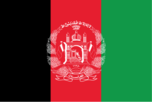
- three equal vertical bands of black (hoist side), red, and green, with the national emblem in white centered on the red band and slightly overlapping the other 2 bands; the center of the emblem features a mosque with pulpit and flags on either side, below the mosque are Eastern Arabic numerals for the solar year 1298 (1919 in the Gregorian calendar, the year of Afghan independence from the UK); this central image is circled by a border consisting of sheaves of wheat on the left and right, in the upper-center is an Arabic inscription of the Shahada (Muslim creed) below which are rays of the rising sun over the Takbir (Arabic expression meaning "God is great"), and at bottom center is a scroll bearing the name Afghanistan; black signifies the past, red is for the blood shed for independence, and green can represent either hope for the future, agricultural prosperity, or Islam
- note
- note 1: the United States has not recognized the Taliban or any other entity as the government of Afghanistan and, accordingly, continues to display the flag of Afghanistan as set forth in the country's constitution of 2004note 2: Afghanistan had more changes to its national flag in the 20th century - 19 by one count - than any other country; the colors black, red, and green appeared on most of them
Government type
theocratic; the United States does not recognize the Taliban Government
Independence
19 August 1919 (from UK control over Afghan foreign affairs)
International law organization participation
has not submitted an ICJ jurisdiction declaration; formerly accepted ICCt jurisdiction
International organization participation
member of the following organizations but cannot participate because the international community does not recognize the Taliban Government: ADB, CICA, CP, ECO, EITI (candidate country), FAO, G-77, IAEA, IBRD, ICAO, ICC (NGOs), ICCt, ICRM, IDA, IDB, IFAD, IFC, IFRCS, ILO, IMF, Interpol, IOC, IOM, IPU, ISO (correspondent), ITSO, ITU, ITUC (NGOs), MIGA, NAM, OIC, OPCW, OSCE (partner), SAARC, SACEP, SCO (dialogue member), UN, UNAMA, UNCTAD, UNESCO, UNHCR, UNIDO, UNWTO, UPU, WCO, WFTU (NGOs), WHO, WIPO, WMO, WTO
Judicial branch
- highest court(s)
- the Taliban Government has a Supreme Court: number of judges and organizational structure NA; note - before 15 August 2021, Afghanistan had a Supreme Court (consisting of a supreme court chief and 8 justices organized into criminal, public security, civil, and commercial divisions)
- judge selection and term of office
- the Taliban Supreme Court judge selection and term of office NA; note - before 15 August 2021, the Supreme Court chief and justices were appointed by the president with the approval of the Wolesi Jirga; court chief and justices served single 10-year terms
- subordinate courts
- the Taliban Government has many provincial-level courts, religious courts, and specialty courtsnote - before 15 August 2021, consisted of Appeals Courts; Primary Courts; and Special Courts for issues including narcotics, security, property, family, and juveniles
Legal system
the Taliban is implementing its own interpretation of Islamic law, which partially based on the Hanifi school of Islamic jurisprudence; before the Taliban takeover, Afghanistan had a mixed legal system of civil, customary, and Islamic law (2021)
Legislative branch
- description
- the Taliban Government has not announced the formation of a legislative branch; before the 2021 Taliban takeover, Afghanistan had a bicameral National Assembly that consisted of the House of Elders and House of the People
National anthem
- lyrics/music
- Abdul Bari JAHANI/Babrak WASA
- name
- "Milli Surood" (National Anthem)
- note
- note: adopted 2006
National heritage
- note
- note: the monumental 6th- and 7th-century statues were destroyed by the Taliban in 2001
- selected World Heritage Site locales
- Minaret of Jam; Buddhas of Bamyan
- total World Heritage Sites
- 2 (both cultural)
National holiday
previous: Independence Day, 19 August (1919); under the Taliban Government, 15 August (2022) is declared a national holiday, marking the anniversary of the victory of the Afghan jihad
National symbol(s)
lion; national colors: red, green, black
Political parties and leaders
the Taliban Government enforces an authoritarian state and has banned other political parties; note - before 15 August 2021, the Ministry of Justice had licensed 72 political parties as of April 2019
Suffrage
18 years of age; universal
Economy
Agricultural products
wheat, milk, grapes, vegetables, potatoes, watermelons, melons, rice, onions, apples
Budget
- expenditures
- $5.293 billion (2019 est.)
- revenues
- $5.093 billion (2019 est.)
Budget surplus (+) or deficit (-)
-15.1% (of GDP) (2017 est.)
Current account balance
- Current account balance 2018
- -$3.897 billion (2018 est.)
- Current account balance 2019
- -$3.792 billion (2019 est.)
- Current account balance 2020
- -$3.137 billion (2020 est.)
Debt - external
- Debt - external FY10/11
- $284 million (FY10/11)
Economic overview
extremely low-income South Asian economy; import drops, currency depreciation, disappearing central bank reserves, and increasing inflation after Taliban takeover; increasing Chinese trade; hit hard by COVID; ongoing sanctions
Exchange rates
- Currency
- afghanis (AFA) per US dollar -
- Exchange rates 2016
- 67.866 (2016 est.)
- Exchange rates 2017
- 68.027 (2017 est.)
- Exchange rates 2018
- 72.083 (2018 est.)
- Exchange rates 2019
- 77.738 (2019 est.)
- Exchange rates 2020
- 76.814 (2020 est.)
Exports
- Exports 2018
- $1.609 billion (2018 est.)
- Exports 2019
- $1.516 billion (2019 est.)
- Exports 2020
- $1.476 billion (2020 est.)
- note
- note: Data are in current year dollars and do not include illicit exports or re-exports.
Exports - commodities
- gold, figs, grapes, cotton, fruits and nuts, coal (2021)
- note
- note: Afghan opium production remains a significant illicit trade export
Exports - partners
United Arab Emirates 45%, Pakistan 24%, India 22%, China 1% (2019)
Fiscal year
21 March - 20 March
GDP - composition, by end use
- exports of goods and services
- 6.7% (2016 est.)
- government consumption
- 12% (2016 est.)
- household consumption
- 81.6% (2016 est.)
- imports of goods and services
- -47.6% (2016 est.)
- investment in fixed capital
- 17.2% (2016 est.)
- investment in inventories
- 30% (2016 est.)
GDP - composition, by sector of origin
- agriculture
- 23% (2016 est.)
- industry
- 21.1% (2016 est.)
- note
- note: data exclude opium production
- services
- 55.9% (2016 est.)
GDP (official exchange rate)
$20.24 billion (2017 est.)
Gini Index coefficient - distribution of family income
- Gini Index coefficient - distribution of family income 2008
- 29.4 (2008)
Household income or consumption by percentage share
- highest 10%
- 24% (2008)
- lowest 10%
- 3.8%
Imports
- Imports 2018
- $7.988 billion (2018 est.) note: data are in current year dollars
- Imports 2019
- $7.371 billion (2019 est.) note: data are in current year dollars
- Imports 2020
- $6.983 billion (2020 est.) note: data are in current year dollars
Imports - commodities
wheat flours, broadcasting equipment, refined petroleum, rolled tobacco, aircraft parts, synthetic fabrics (2019)
Imports - partners
United Arab Emirates 23%, Pakistan 17%, India 13%, Uzbekistan 7%, China 9% (2021)
Industrial production growth rate
-14.19% (2021 est.)
Industries
small-scale production of bricks, textiles, soap, furniture, shoes, fertilizer, apparel, food products, non-alcoholic beverages, mineral water, cement; handwoven carpets; natural gas, coal, copper
Inflation rate (consumer prices)
- Inflation rate (consumer prices) 2017
- 4.98% (2017 est.)
- Inflation rate (consumer prices) 2018
- 0.63% (2018 est.)
- Inflation rate (consumer prices) 2019
- 2.3% (2019 est.)
Labor force
9.39 million (2021 est.)
Population below poverty line
54.5% (2016 est.)
Public debt
- Public debt 2016
- 7.8% of GDP (2016 est.)
- Public debt 2017
- 7% of GDP (2017 est.)
Real GDP (purchasing power parity)
- note
- note: data are in 2017 dollars
- Real GDP (purchasing power parity) 2019
- $78.558 billion (2019 est.)
- Real GDP (purchasing power parity) 2020
- $76.711 billion (2020 est.)
- Real GDP (purchasing power parity) 2021
- $60.803 billion (2021 est.)
Real GDP growth rate
- Real GDP growth rate 2019
- 3.91% (2019 est.)
- Real GDP growth rate 2020
- -2.35% (2020 est.)
- Real GDP growth rate 2021
- -20.74% (2021 est.)
Real GDP per capita
- note
- note: data are in 2017 dollars
- Real GDP per capita 2019
- $2,100 (2019 est.)
- Real GDP per capita 2020
- $2,000 (2020 est.)
- Real GDP per capita 2021
- $1,500 (2021 est.)
Reserves of foreign exchange and gold
- Reserves of foreign exchange and gold 31 December 2018
- $8.207 billion (31 December 2018 est.)
- Reserves of foreign exchange and gold 31 December 2019
- $8.498 billion (31 December 2019 est.)
- Reserves of foreign exchange and gold 31 December 2020
- $9.749 billion (31 December 2020 est.)
Taxes and other revenues
9.9% (of GDP) (2017 est.)
Unemployment rate
- Unemployment rate 2019
- 11.22% (2019 est.)
- Unemployment rate 2020
- 11.71% (2020 est.)
- Unemployment rate 2021
- 13.28% (2021 est.)
Youth unemployment rate (ages 15-24)
- female
- 26.4%
- male
- 18.6%
- total
- 20.2% (2021 est.)
Energy
Carbon dioxide emissions
- from coal and metallurgical coke
- 4.158 million metric tonnes of CO2 (2019 est.)
- from consumed natural gas
- 267,000 metric tonnes of CO2 (2019 est.)
- from petroleum and other liquids
- 3.468 million metric tonnes of CO2 (2019 est.)
- total emissions
- 7.893 million metric tonnes of CO2 (2019 est.)
Coal
- consumption
- 2.096 million metric tons (2020 est.)
- exports
- 0 metric tons (2020 est.)
- imports
- 0 metric tons (2020 est.)
- production
- 2.096 million metric tons (2020 est.)
- proven reserves
- 66 million metric tons (2019 est.)
Electricity
- consumption
- 5.913 billion kWh (2019 est.)
- exports
- 0 kWh (2019 est.)
- imports
- 4.912 billion kWh (2019 est.)
- installed generating capacity
- 776,000 kW (2020 est.)
- transmission/distribution losses
- 61.6 million kWh (2019 est.)
Electricity access
- electrification - rural areas
- 97% (2021)
- electrification - total population
- 97.7% (2021)
- electrification - urban areas
- 99.5% (2021)
Electricity generation sources
- biomass and waste
- 0% of total installed capacity (2020 est.)
- fossil fuels
- 15.9% of total installed capacity (2020 est.)
- geothermal
- 0% of total installed capacity (2020 est.)
- hydroelectricity
- 79.1% of total installed capacity (2020 est.)
- nuclear
- 0% of total installed capacity (2020 est.)
- solar
- 5.1% of total installed capacity (2020 est.)
- tide and wave
- 0% of total installed capacity (2020 est.)
- wind
- 0% of total installed capacity (2020 est.)
Energy consumption per capita
- Total energy consumption per capita 2019
- 3.227 million Btu/person (2019 est.)
Natural gas
- consumption
- 80.193 million cubic meters (2020 est.)
- exports
- 0 cubic meters (2021 est.)
- imports
- 0 cubic meters (2021 est.)
- production
- 80.193 million cubic meters (2020 est.)
- proven reserves
- 49.554 billion cubic meters (2021 est.)
Petroleum
- crude oil and lease condensate exports
- 0 bbl/day (2018 est.)
- crude oil and lease condensate imports
- 0 bbl/day (2018 est.)
- crude oil estimated reserves
- 0 barrels (2021 est.)
- refined petroleum consumption
- 24,300 bbl/day (2019 est.)
- total petroleum production
- 0 bbl/day (2021 est.)
Refined petroleum products - exports
0 bbl/day (2015 est.)
Refined petroleum products - imports
34,210 bbl/day (2015 est.)
Refined petroleum products - production
0 bbl/day (2015 est.)
Communications
Broadband - fixed subscriptions
- subscriptions per 100 inhabitants
- 0.1 (2020 est.)
- total
- 26,570 (2020 est.)
Broadcast media
under the Taliban government, independent media outlets have decreased in number and are probably self-censoring criticism of the Taliban and the Ministry of Information and Culture monitors all mass media in Afghanistan; television and radio are key media platforms; only about a fifth of Afghans use the internet, mostly through smartphones (2023)
Internet country code
.af
Internet users
- percent of population
- 18% (2020 est.)
- total
- 7.02 million (2020 est.)
Telecommunication systems
- domestic
- before the Taliban takeover in August 2021, less than 1 per 100 for fixed-line teledensity; 57 per 100 for mobile-cellular subscriptions (2021)
- general assessment
- Afghanistan's telecom sector is facing challenges providing adequate coverage to all of the population; prior to the Taliban regaining power, the World Bank and other donors supported the development of a nationwide fiber backbone and there is terrestrial cable connectivity to five neighboring countries; work on the 'Wakhan Corridor Fiber Optic Survey Project' to connect to China has faced obstacles because of Afghanistan's economic issues. (2021)
- international
- country code - 93; multiple VSAT's provide international and domestic voice and data connectivity (2019)
Telephones - fixed lines
- subscriptions per 100 inhabitants
- (2021 est.) less than 1
- total subscriptions
- 150,000 (2021 est.)
Telephones - mobile cellular
- subscriptions per 100 inhabitants
- 57 (2021 est.)
- total subscriptions
- 23 million (2021 est.)
Transportation
Airports
46 (2021)
Airports - with paved runways
- 29
- note
- note: paved runways have a concrete or asphalt surface but not all have facilities for refueling, maintenance, or air traffic control; the length of a runway required for aircraft to safely operate depends on a number of factors including the type of aircraft, the takeoff weight (including passengers, cargo, and fuel), engine types, flap settings, landing speed, elevation of the airport, and average maximum daily air temperature; paved runways can reach a length of 5,000 m (16,000 ft.), but the “typical” length of a commercial airline runway is between 2,500-4,000 m (8,000-13,000 ft.)
Airports - with unpaved runways
- 17
- note
- note: unpaved runways have a surface composition such as grass or packed earth and are most suited to the operation of light aircraft; unpaved runways are usually short, often less than 1,000 m (3,280 ft.) in length; airports with unpaved runways often lack facilities for refueling, maintenance, or air traffic control
Civil aircraft registration country code prefix
YA
Heliports
1 (2021)
National air transport system
- annual freight traffic on registered air carriers
- 29.56 million (2018) mt-km
- annual passenger traffic on registered air carriers
- 1,722,612 (2018)
- inventory of registered aircraft operated by air carriers
- 13
- number of registered air carriers
- 3 (2020)
Pipelines
466 km gas (2013)
Ports and terminals
- river port(s)
- Hairatan, Qizil Qal`ah (Amu Darya)
Roadways
- paved
- 17,903 km (2017)
- total
- 34,903 km (2017)
- unpaved
- 17,000 km (2017)
Waterways
1,200 km (2011) (chiefly Amu Darya, which handles vessels up to 500 DWT)
Military and Security
Military - note
the Taliban’s primary security threats include ISIS-Khorasan and anti-Taliban resistance elements known as the National Resistance Front and Afghanistan Freedom Front (2023)
Military and security forces
the Taliban has established a de facto ministry of defense and a national army (aka Army of the Islamic Emirate of Afghanistan, Islamic Emirate Army, or Afghan Army); it has also formed a ministry of interior with a subordinate police force (2023)
Military and security service personnel strengths
- announced that approximately 130,000 personnel had been recruited for a new "National Army"; also announced that over 50,000 personnel had been trained for the police force under the ministry of interior (2022)
- note
- note: as of 2022, there were also up to 10,000 foreign fighters in Afghanistan, most of whom were aligned with the Taliban
Military equipment inventories and acquisitions
the Taliban military/security forces are armed largely with US-provided equipment captured from the Afghan National Defense and Security Forces when the central government in Kabul collapsed in 2021 (2023)
Military expenditures
- Military Expenditures 2015
- 2.9% of GDP (2015)
- Military Expenditures 2016
- 3.1% of GDP (2016)
- Military Expenditures 2017
- 3.3% of GDP (2017)
- Military Expenditures 2018
- 3.2% of GDP (2018)
- Military Expenditures 2019
- 3.3% of GDP (2019)
Military service age and obligation
- not available
- note
- note: the Taliban dismissed nearly all women from the former Afghan Government security forces, except those serving in detention facilities and assisting with body searches
Transnational Issues
Disputes - international
Afghanistan-China: none identifiedAfghanistan-Iran: Afghan and Iranian commissioners have discussed boundary monument densification and resurvey; Iran protests Afghanistan's restricting flow of dammed Helmand River tributaries during droughtAfghanistan-Pakistan: Pakistan has built fences in some portions of its border with Afghanistan which remains open in some areas to terrorist and other illegal activities; their alignments may not always be in conformance with the Durand Line and original surveyed definitions of the boundary; Pakistan demarcates the Durand Line differently from Afghanistan, and thus portions of the Pakistani fence may lie within what Afghanistan (and most of the international community, including the US) would consider Afghan territory; successive governments in Afghanistan, including the Taliban, have not accepted the 1947 demarcation lineAfghanistan-Tajikistan: none identifiedAfghanistan-Turkmenistan: none identifiedAfghanistan-Uzbekistan: none identified; boundary follows Amu Darya River as delimited in the Afghan-Soviet treaties and not by the river's current course; the boundary was delimited and possibly demarcated during Soviet times (pre-1991); no current negotiations between Afghanistan and Uzbekistan to redelimit the boundary have been identified
Illicit drugs
the world’s largest supplier of opiates, but it is not a major supplier to the United States; 233,000 hectares (ha) of opium poppy cultivated in Afghanistan in 2022; opium from poppies used to produce morphine and heroin; also produces large quantities of methamphetamine, cannabis, and cannabis products such as hashish; one of the world’s largest populations suffering from substance abuse; major source of precursor or essential chemicals used in the production of illicit narcotics. (2022)
Refugees and internally displaced persons
- IDPs
- 4.394 million (mostly Pashtuns and Kuchis displaced in the south and west due to natural disasters and political instability) (2022)
- refugees (country of origin)
- 59,486 (Pakistan) (mid-year 2022)
Trafficking in persons
- note
- note: The United States has not recognized the Taliban or another entity as the government of Afghanistan. On August 15, 2021, the Taliban culminated its takeover of Kabul, and on September 7, 2021, the Taliban announced a so-called interim government. As of December 2021, the Taliban had not outlined steps or a timeline to establish a new permanent government. All references to “the pre-August 15 government” refer to the Islamic Republic of Afghanistan. References to the Taliban reflect events both prior to and after August 15.
- tier rating
- Tier 3 - Afghanistan does not fully meet the minimum standards for the elimination of trafficking and is not making significant efforts to do so; therefore, Afghanistan remains on Tier 3; substantial personnel turnover and closing of some ministries after the August 15, 2021 Taliban takeover hindered Afghanistan's ability to maintain consistent anti-trafficking efforts; although the pre-August 15 government took some training and awareness steps to address trafficking, it employed or recruited child soldiers and sexual slaves in government compounds; after August 15, the Taliban continued recruiting or employing child soldiers and did not investigate, prosecute, or convict any traffickers; the Taliban shut down shelters for victims, did not identify or protect victims, and did not make any efforts to prevent trafficking; Taliban undermining the rights of women, minorities, and other vulnerable populations, further exacerbated vulnerabilities to trafficking (2022)
- trafficking profile
- human traffickers exploit domestic and foreign victims in Afghanistan and exploit Afghan victims abroad; internal trafficking is more prevalent than transnational trafficking; since the Taliban takeover, vulnerabilities to exploitation have intensified; traffickers exploit men, women, and a large number of children domestically; victims are subjected to forced labor in agriculture, brick kilns, carpet weaving, domestic servitude, commercial sex, begging, poppy cultivation and harvesting, salt mining, transnational drug smuggling, and truck driving; the Taliban and non-state armed groups, such as the Islamic State in Khorasan Province (ISIS-K), continue to unlawfully recruit and use child soldiers; sexual exploitation of boys remains pervasive nationwide, and traffickers subject some boys to sexual exploitation abroad; after the Taliban takeover, restrictions on the movement of women and girls, and severely diminished access to employment and education, increased their vulnerability to trafficking; LGBTQI+ individuals are among the most vulnerable groups in Afghanistan under the Taliban (2022)
Terrorism
Terrorist group(s)
- Haqqani Taliban Network; Harakat ul-Mujahidin; Harakat ul-Jihad-i-Islami; Islamic Jihad Union; Islamic Movement of Uzbekistan; Islamic State of Iraq and ash-Sham-Khorasan Province (ISIS-K); Islamic Revolutionary Guard Corps (IRGC)/Qods Force; Jaish-e-Mohammed; Jaysh al Adl (Jundallah); Lashkar i Jhangvi; Lashkar-e Tayyiba; al-Qa’ida; al-Qa'ida in the Indian Subcontinent (AQIS); Tehrik-e-Taliban Pakistan (TTP)
- note
- note 1: as of mid-2022, TTP was reportedly the largest component of foreign terrorist fighters in Afghanistan, with an estimated 3-4,000 armed fighters operating primarily along the Afghanistan-Pakistan bordernote 2: details about the history, aims, leadership, organization, areas of operation, tactics, targets, weapons, size, and sources of support of the group(s) appear(s) in Appendix T
Environment
Air pollutants
- carbon dioxide emissions
- 8.67 megatons (2016 est.)
- methane emissions
- 90.98 megatons (2020 est.)
- particulate matter emissions
- 62.49 micrograms per cubic meter (2019 est.)
Climate
arid to semiarid; cold winters and hot summers
Environment - current issues
limited natural freshwater resources; inadequate supplies of potable water; soil degradation; overgrazing; deforestation (much of the remaining forests are being cut down for fuel and building materials); desertification; air and water pollution in overcrowded urban areas
Environment - international agreements
- party to
- Biodiversity, Climate Change, Climate Change-Kyoto Protocol, Climate Change-Paris Agreement, Comprehensive Nuclear Test Ban, Desertification, Endangered Species, Environmental Modification, Hazardous Wastes, Marine Dumping-London Convention, Nuclear Test Ban, Ozone Layer Protection
- signed, but not ratified
- Law of the Sea, Marine Life Conservation
Food insecurity
- severe localized food insecurity
- due to civil conflict, population displacement, and economic slowdown - the latest analysis estimated the number of people in crisis or emergency food insecurity at 15.3 million people (35% of the population analyzed) between May and October 2023; although the levels of acute food insecurity have declined compared to the same season in 2022, largely due to seasonal improvements and the scale‑up of humanitarian assistance in 2022, the situation could deteriorate in areas where humanitarian assistance faces access constraints; the ban on women’s participation in the humanitarian response poses a challenge to the delivery of quality humanitarian assistance leading to significant additional access constraints, particularly to the most vulnerable, women and children (2023)
Land use
- agricultural land
- 58.1% (2018 est.)
- agricultural land: arable land
- arable land: 11.8% (2018)
- agricultural land: permanent crops
- permanent crops: 0.3% (2018)
- agricultural land: permanent pasture
- permanent pasture: 46% (2018)
- forest
- 1.8% (2018 est.)
- other
- 40.1% (2018)
Major lakes (area sq km)
- salt water lake(s)
- Ab-e Istadah-ye Muqur (endorheic basin) - 520 sq km
Major rivers (by length in km)
Amu Darya (shared with Tajikistan [s], Turkmenistan, and Uzbekistan [m]) - 2,620 km; Helmand river source (shared with Iran) - 1,130 kmnote – [s] after country name indicates river source; [m] after country name indicates river mouth
Major watersheds (area sq km)
Indian Ocean drainage: Indus (1,081,718 sq km)Internal (endorheic basin) drainage: Amu Darya (534,739 sq km); Tarim Basin (1,152,448 sq km)
Revenue from coal
0.45% of GDP (2018 est.)
Revenue from forest resources
0.2% of GDP (2018 est.)
Total renewable water resources
65.33 billion cubic meters (2020 est.)
Total water withdrawal
- agricultural
- 20 billion cubic meters (2020 est.)
- industrial
- 170 million cubic meters (2020 est.)
- municipal
- 200 million cubic meters (2020 est.)
Urbanization
- rate of urbanization
- 3.34% annual rate of change (2020-25 est.)
- urban population
- 26.9% of total population (2023)
Waste and recycling
- municipal solid waste generated annually
- 5,628,525 tons (2016 est.)