2018 Edition
CIA World Factbook 2018 Archive (Wayback Machine)
Introduction
Background
Ahmad Shah DURRANI unified the Pashtun tribes and founded Afghanistan in 1747. The country served as a buffer between the British and Russian Empires until it won independence from notional British control in 1919. A brief experiment in democracy ended in a 1973 coup and a 1978 communist countercoup. The Soviet Union invaded in 1979 to support the tottering Afghan communist regime, touching off a long and destructive war. The USSR withdrew in 1989 under relentless pressure by internationally supported anti-communist mujahidin rebels. A series of subsequent civil wars saw Kabul finally fall in 1996 to the Taliban, a hardline Pakistani-sponsored movement that emerged in 1994 to end the country's civil war and anarchy. Following the 11 September 2001 terrorist attacks, a US, Allied, and anti-Taliban Northern Alliance military action toppled the Taliban for sheltering Usama BIN LADIN. A UN-sponsored Bonn Conference in 2001 established a process for political reconstruction that included the adoption of a new constitution, a presidential election in 2004, and National Assembly elections in 2005. In December 2004, Hamid KARZAI became the first democratically elected president of Afghanistan, and the National Assembly was inaugurated the following December. KARZAI was reelected in August 2009 for a second term. The 2014 presidential election was the country's first to include a runoff, which featured the top two vote-getters from the first round, Abdullah ABDULLAH and Ashraf GHANI. Throughout the summer of 2014, their campaigns disputed the results and traded accusations of fraud, leading to a US-led diplomatic intervention that included a full vote audit as well as political negotiations between the two camps. In September 2014, GHANI and ABDULLAH agreed to form the Government of National Unity, with GHANI inaugurated as president and ABDULLAH elevated to the newly-created position of chief executive officer. The day after the inauguration, the GHANI administration signed the US-Afghan Bilateral Security Agreement and NATO Status of Forces Agreement, which provide the legal basis for the post-2014 international military presence in Afghanistan. Despite gains toward building a stable central government, the Taliban remains a serious challenge for the Afghan Government in almost every province. The Taliban still considers itself the rightful government of Afghanistan, and it remains a capable and confident insurgent force despite its last two spiritual leaders being killed; it continues to declare that it will pursue a peace deal with Kabul only after foreign military forces depart.
Geography
Area
- land
- 652,230 sq km
- total
- 652,230 sq km
- water
- 0 sq km
Area Comparative
almost six times the size of Virginia; slightly smaller than Texas
Climate
arid to semiarid; cold winters and hot summers
Coastline
0 km (landlocked)
Elevation
- elevation extremes
- 258 m lowest point: Amu Darya
- mean elevation
- 1,884 m
- note
- 7492 highest point: Noshak
Environment Current Issues
limited natural freshwater resources; inadequate supplies of potable water; soil degradation; overgrazing; deforestation (much of the remaining forests are being cut down for fuel and building materials); desertification; air and water pollution in overcrowded urban areas
Environment International Agreements
- party to
- Biodiversity, Climate Change, Desertification, Endangered Species, Environmental Modification, Marine Dumping, Ozone Layer Protection
- signed, but not ratified
- Hazardous Wastes, Law of the Sea, Marine Life Conservation
Geographic Coordinates
33 00 N, 65 00 E
Geography Note
landlocked; the Hindu Kush mountains that run northeast to southwest divide the northern provinces from the rest of the country; the highest peaks are in the northern Vakhan (Wakhan Corridor)
Irrigated Land
32,080 sq km (2012)
Land Boundaries
- border countries (6)
- China 91 km, Iran 921 km, Pakistan 2670 km, Tajikistan 1357 km, Turkmenistan 804 km, Uzbekistan 144 km
- total
- 5,987 km
Land Use
- arable land: 20.5% (2014 est.) / permanent crops: 0.37% (2014 est.) / permanent pasture: 79% (2014 est.)
- agricultural land
- 58.1% (2014 est.)
- forest
- 2.07% (2014 est.)
- other
- 39.9% (2014 est.)
Location
Southern Asia, north and west of Pakistan, east of Iran
Map References
Asia
Maritime Claims
- note
- none (landlocked)
Natural Hazards
damaging earthquakes occur in Hindu Kush mountains; flooding; droughts
Natural Resources
natural gas, petroleum, coal, copper, chromite, talc, barites, sulfur, lead, zinc, iron ore, salt, precious and semiprecious stones, arable land
Population Distribution
populations tend to cluster in the foothills and periphery of the rugged Hindu Kush range; smaller groups are found in many of the country's interior valleys; in general, the east is more densely settled, while the south is sparsely populated
Terrain
mostly rugged mountains; plains in north and southwest
People and Society
Age Structure
- 0-14 years
- 40.92% (male 7,263,716 /female 7,033,427)
- 15-24 years
- 21.85% (male 3,883,693 /female 3,749,760)
- 25-54 years
- 30.68% (male 5,456,305 /female 5,263,332)
- 55-64 years
- 3.95% (male 679,766 /female 699,308)
- 65 years and over
- 2.61% (male 420,445 /female 491,085) (2018 est.)
Birth Rate
37.5 births/1,000 population (2018 est.)
Children Under The Age Of 5 Years Underweight
25% (2013)
Contraceptive Prevalence Rate
22.5% (2015/16)
Death Rate
13.2 deaths/1,000 population (2018 est.)
Dependency Ratios
- elderly dependency ratio
- 4.7 (2015 est.)
- potential support ratio
- 21.2 (2015 est.)
- total dependency ratio
- 88.8 (2015 est.)
- youth dependency ratio
- 84.1 (2015 est.)
Drinking Water Source
- improved: urban: 78.2% of population
- rural: 47% of population
- total: 55.3% of population
- unimproved: urban: 21.8% of population
- rural: 53% of population
- total: 44.7% of population (2015 est.)
Education Expenditures
3.2% of GDP (2015)
Ethnic Groups
- Pashtun, Tajik, Hazara, Uzbek, other (includes smaller numbers of Baloch, Turkmen, Nuristani, Pamiri, Arab, Gujar, Brahui, Qizilbash, Aimaq, Pashai, and Kyrghyz) (2015)
- note
- current statistical data on the sensitive subject of ethnicity in Afghanistan are not available, and ethnicity data from small samples of respondents to opinion polls are not a reliable alternative; Afghanistan's 2004 constitution recognizes 14 ethnic groups: Pashtun, Tajik, Hazara, Uzbek, Baloch, Turkmen, Nuristani, Pamiri, Arab, Gujar, Brahui, Qizilbash, Aimaq, and Pashai
Health Expenditures
8.2% of GDP (2014)
Hiv Aids Adult Prevalence Rate
<.1% (2016 est.)
Hiv Aids Deaths
<500 (2016 est.)
Hiv Aids People Living With Hiv Aids
7,500 (2016 est.)
Hospital Bed Density
0.5 beds/1,000 population (2014)
Infant Mortality Rate
- female
- 100.9 deaths/1,000 live births (2018 est.)
- male
- 115.7 deaths/1,000 live births (2018 est.)
- total
- 108.5 deaths/1,000 live births (2018 est.)
Languages
- Afghan Persian or Dari (official) 80% (Dari functions as the lingua franca), Pashto (official) 47%, Uzbek 11%, English 5%, Turkmen 2%, Urdu 2%, Pashayi 1%, Nuristani 1%, Arabic 1%, Balochi, Shughni, Pamiri, Hindi, Russian, German, French (2017 est.)
- note
- data represent most widely spoken languages; shares sum to more than 100% because there is much bilingualism in the country and because respondents were allowed to select more than one language note: the Turkic languages Uzbek and Turkmen, as well as Balochi, Pashayi, Nuristani, and Pamiri are the third official languages in areas where the majority speaks them
Life Expectancy At Birth
- female
- 53.6 years (2018 est.)
- male
- 50.6 years (2018 est.)
- total population
- 52.1 years (2018 est.)
Literacy
- definition
- age 15 and over can read and write (2015 est.)
- female
- 24.2% (2015 est.)
- male
- 52% (2015 est.)
- total population
- 38.2% (2015 est.)
Major Infectious Diseases
- degree of risk
- intermediate (2016)
- food or waterborne diseases
- bacterial diarrhea, hepatitis A, and typhoid fever (2016)
- vectorborne diseases
- malaria (2016)
Major Urban Areas Population
4.012 million KABUL (capital) (2018)
Maternal Mortality Rate
396 deaths/100,000 live births (2015 est.)
Median Age
- female
- 19.1 years (2018 est.)
- male
- 19 years
- total
- 19 years
Mother S Mean Age At First Birth
- 19.9 years (2015 est.)
- note
- median age at first birth among women 25-29
Nationality
- adjective
- Afghan
- noun
- Afghan(s)
Net Migration Rate
-0.9 migrant(s)/1,000 population (2017 est.)
Obesity Adult Prevalence Rate
5.5% (2016)
Physicians Density
0.3 physicians/1,000 population (2016)
Population
34,940,837 (July 2018 est.)
Population Growth Rate
2.37% (2018 est.)
Religions
Muslim 99.7% (Sunni 84.7 - 89.7%, Shia 10 - 15%), other 0.3% (2009 est.)
Sanitation Facility Access
- improved: urban: 45.1% of population (2015 est.)
- rural: 27% of population (2015 est.)
- total: 31.9% of population (2015 est.)
- unimproved: urban: 54.9% of population (2015 est.)
- rural: 73% of population (2015 est.)
- total: 68.1% of population (2015 est.)
School Life Expectancy Primary To Tertiary Education
- female
- 8 years (2014)
- male
- 13 years (2014)
- total
- 11 years (2014)
Sex Ratio
- 0-14 years
- 1.03 male(s)/female (2017 est.)
- 15-24 years
- 1.04 male(s)/female (2017 est.)
- 25-54 years
- 1.04 male(s)/female (2017 est.)
- 55-64 years
- 0.97 male(s)/female (2017 est.)
- 65 years and over
- 0.86 male(s)/female (2017 est.)
- at birth
- 1.04 male(s)/female (2017 est.)
- total population
- 1.03 male(s)/female (2017 est.)
Total Fertility Rate
5.02 children born/woman (2018 est.)
Urbanization
- rate of urbanization
- 3.37% annual rate of change (2015-20 est.)
- urban population
- 25.5% of total population (2018)
Government
Administrative Divisions
34 provinces (welayat, singular - welayat); Badakhshan, Badghis, Baghlan, Balkh, Bamyan, Daykundi, Farah, Faryab, Ghazni, Ghor, Helmand, Herat, Jowzjan, Kabul, Kandahar, Kapisa, Khost, Kunar, Kunduz, Laghman, Logar, Nangarhar, Nimroz, Nuristan, Paktika, Paktiya, Panjshir, Parwan, Samangan, Sar-e Pul, Takhar, Uruzgan, Wardak, Zabul
Capital
- geographic coordinates
- 34 31 N, 69 11 E
- name
- Kabul
- note
- etymology: named for the Kabul River, but the river's name is of unknown origin
- time difference
- UTC+4.5 (9.5 hours ahead of Washington, DC, during Standard Time)
Citizenship
- citizenship by birth
- no
- citizenship by descent only
- at least one parent must have been born in - and continuously lived in - Afghanistan
- dual citizenship recognized
- no
- residency requirement for naturalization
- 5 years
Constitution
- amendments
- proposed by a commission formed by presidential decree followed by the convention of a Grand Council (Loya Jirga) decreed by the president; passage requires at least two-thirds majority vote of the Loya Jirga membership and endorsement by the president (2017)
- history
- several previous; latest drafted 14 December 2003 - 4 January 2004, signed 16 January 2004, ratified 26 January 2004 (2017)
Country Name
- conventional long form
- Islamic Republic of Afghanistan
- conventional short form
- Afghanistan
- etymology
- the name "Afghan" originally referred to the Pashtun people (today it is understood to include all the country's ethnic groups), while the suffix "-stan" means "place of" or "country"; so Afghanistan literally means the "Land of the Afghans"
- former
- Republic of Afghanistan
- local long form
- Jamhuri-ye Islami-ye Afghanistan
- local short form
- Afghanistan
Diplomatic Representation From The Us
- chief of mission
- Ambassador John BASS (since December 2017)
- embassy
- Bibi Mahru, Kabul
- FAX
- [00 93] 0700 108 564
- mailing address
- U.S. Embassy Kabul, APO, AE 09806
- telephone
- [00 93] 0700 108 001
Diplomatic Representation In The Us
- chancery
- 2341 Wyoming Avenue NW, Washington, DC 20008
- chief of mission
- Ambassador Hamdullah MOHIB (since 17 September 2015)
- consulate(s) general
- Los Angeles, New York, Washington, DC
- FAX
- [1] (202) 483-6488
- telephone
- [1] (202) 483-6410
Executive Branch
- cabinet
- Cabinet consists of 25 ministers appointed by the president, approved by the National Assembly
- chief of state
- President of the Islamic Republic of Afghanistan Ashraf GHANI Ahmadzai (since 29 September 2014); CEO Abdullah ABDULLAH, Dr. (since 29 September 2014); First Vice President Abdul Rashid DOSTAM (since 29 September 2014); Second Vice President Sarwar DANESH (since 29 September 2014); First Deputy CEO Khyal Mohammad KHAN; Second Deputy CEO Mohammad MOHAQQEQ; note - the president is both chief of state and head of government
- election results
- Ashraf GHANI elected president in the second round; percent of vote in first round - Abdullah ABDULLAH (National Coalition of Afghanistan) 45%, Ashraf GHANI (independent) 31.6%, Zalmai RASSOUL 11.4%, other 12%; percent of vote in second round - Ashraf GHANI 56.4%, Abdullah ABDULLAH 43.6%
- elections/appointments
- president directly elected by absolute majority popular vote in 2 rounds if needed for a 5-year term (eligible for a second term); election last held in 2 rounds on 5 April and 14 June 2014 (next originally scheduled for April 2019 has been postponed by several months)
- head of government
- President of the Islamic Republic of Afghanistan Ashraf GHANI Ahmadzai (since 29 September 2014); CEO Abdullah ABDULLAH, Dr. (since 29 September 2014); First Vice President Abdul Rashid DOSTAM (since 29 September 2014); Second Vice President Sarwar DANESH (since 29 September 2014); First Deputy CEO Khyal Mohammad KHAN; Second Deputy CEO Mohammad MOHAQQEQ
Flag Description
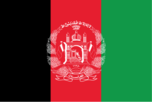
- three equal vertical bands of black (hoist side), red, and green, with the national emblem in white centered on the red band and slightly overlapping the other 2 bands; the center of the emblem features a mosque with pulpit and flags on either side, below the mosque are numerals for the solar year 1298 (1919 in the Gregorian calendar, the year of Afghan independence from the UK); this central image is circled by a border consisting of sheaves of wheat on the left and right, in the upper-center is an Arabic inscription of the Shahada (Muslim creed) below which are rays of the rising sun over the Takbir (Arabic expression meaning "God is great"), and at bottom center is a scroll bearing the name Afghanistan; black signifies the past, red is for the blood shed for independence, and green can represent either hope for the future, agricultural prosperity, or Islam
- note
- Afghanistan had more changes to its national flag in the 20th century - 19 by one count - than any other country; the colors black, red, and green appeared on most of them
Government Type
presidential Islamic republic
Independence
19 August 1919 (from UK control over Afghan foreign affairs)
International Law Organization Participation
has not submitted an ICJ jurisdiction declaration; accepts ICCt jurisdiction
International Organization Participation
ADB, CICA, CP, ECO, EITI (candidate country), FAO, G-77, IAEA, IBRD, ICAO, ICC (NGOs), ICCt, ICRM, IDA, IDB, IFAD, IFC, IFRCS, ILO, IMF, Interpol, IOC, IOM, IPU, ISO (correspondent), ITSO, ITU, ITUC (NGOs), MIGA, NAM, OIC, OPCW, OSCE (partner), SAARC, SACEP, SCO (dialogue member), UN, UNAMA, UNCTAD, UNESCO, UNHCR, UNIDO, UNWTO, UPU, WCO, WFTU (NGOs), WHO, WIPO, WMO, WTO
Judicial Branch
- highest courts
- Supreme Court or Stera Mahkama (consists of the supreme court chief and 8 justices organized into criminal, public security, civil, and commercial divisions or dewans)
- judge selection and term of office
- court chief and justices appointed by the president with the approval of the Wolesi Jirga; court chief and justices serve single 10-year terms
- subordinate courts
- Appeals Courts; Primary Courts; Special Courts for issues including narcotics, security, property, family, and juveniles
Legal System
mixed legal system of civil, customary, and Islamic law
Legislative Branch
- description
- bicameral National Assembly consists of:Meshrano Jirga or House of Elders (102 seats; 34 members indirectly elected by district councils to serve 3-year terms, 34 indirectly elected by provincial councils to serve 4-year terms, and 34 nominated by the president of which 17 must be women, 2 must represent the disabled, and 2 must be Kuchi nomads; members nominated by the president serve 5-year terms)Wolesi Jirga or House of People (249 seats; members directly elected in multi-seat constituencies by proportional representation vote to serve 5-year terms)
- election results
- Meshrano Jirga - percent of vote by party - NA; seats by party - NA; composition - men 84, women 18, percent of women 17.6%Wolesi Jirga - percent of vote by party NA; seats by party - NA; composition - men 148, women 69, percent of women 27.7%; note - total National Assembly percent of women 24.8%
- elections
- Meshrano Jirga - last held 10 January 2015 (next to be held in 2018) Wolesi Jirga - last held on 20 October 2018) (next tobe held in 2023)
- note
- the constitution allows the government to convene a constitutional Loya Jirga (Grand Council) on issues of independence, national sovereignty, and territorial integrity; it consists of members of the National Assembly and chairpersons of the provincial and district councils; a Loya Jirga can amend provisions of the constitution and prosecute the president; no constitutional Loya Jirga has ever been held, and district councils have never been elected; the president appointed 34 members of the Meshrano Jirga that the district councils should have indirectly elected
National Anthem
- lyrics/music
- Abdul Bari JAHANI/Babrak WASA
- name
- "Milli Surood" (National Anthem)
- note
- adopted 2006; the 2004 constitution of the post-Taliban government mandated that a new national anthem should be written containing the phrase "Allahu Akbar" (God is Greatest) and mentioning the names of Afghanistan's ethnic groups
National Holiday
Independence Day, 19 August (1919)
National Symbol S
lion; national colors: red, green, black
Political Parties And Leaders
note - the Ministry of Justice licensed 57 political parties as of September 2016
Suffrage
18 years of age; universal
Economy
Agriculture Products
opium, wheat, fruits, nuts, wool, mutton, sheepskins, lambskins, poppies
Budget
- expenditures
- 5.328 billion (2017 est.)
- revenues
- 2.276 billion (2017 est.)
Budget Surplus Or Deficit
-15.1% (of GDP) (2017 est.)
Commercial Bank Prime Lending Rate
- 15% (31 December 2016 est.)
- 15% (31 December 2015 est.)
Current Account Balance
- $1.014 billion (2017 est.)
- $1.409 billion (2016 est.)
Debt External
$2.84 billion (FY/)
Distribution Of Family Income Gini Index
29.4 (2008)
Economy Overview
Despite improvements in life expectancy, incomes, and literacy since 2001, Afghanistan is extremely poor, landlocked, and highly dependent on foreign aid. Much of the population continues to suffer from shortages of housing, clean water, electricity, medical care, and jobs. Corruption, insecurity, weak governance, lack of infrastructure, and the Afghan Government's difficulty in extending rule of law to all parts of the country pose challenges to future economic growth. Afghanistan's living standards are among the lowest in the world. Since 2014, the economy has slowed, in large part because of the withdrawal of nearly 100,000 foreign troops that had artificially inflated the country’s economic growth.The international community remains committed to Afghanistan's development, pledging over $83 billion at ten donors' conferences between 2003 and 2016. In October 2016, the donors at the Brussels conference pledged an additional $3.8 billion in development aid annually from 2017 to 2020. Even with this help, Government of Afghanistan still faces number of challenges, including low revenue collection, anemic job creation, high levels of corruption, weak government capacity, and poor public infrastructure.In 2017 Afghanistan's growth rate was only marginally above that of the 2014-2016 average. The drawdown of international security forces that started in 2012 has negatively affected economic growth, as a substantial portion of commerce, especially in the services sector, has catered to the ongoing international troop presence in the country. Afghan President Ashraf GHANI Ahmadzai is dedicated to instituting economic reforms to include improving revenue collection and fighting corruption. The government has implemented reforms to the budget process and in some other areas. However, many other reforms will take time to implement and Afghanistan will remain dependent on international donor support over the next several years.
Exchange Rates
- afghanis (AFA) per US dollar -
- 7.87 (2017 est.)
- 68.03 (2016 est.)
- 67.87 (2015)
- 61.14 (2014 est.)
- 57.25 (2013 est.)
Exports
- $784 million (2017 est.)
- $614.2 million (2016 est.)
- note
- not including illicit exports or reexports
Exports Commodities
opium, fruits and nuts, handwoven carpets, wool, cotton, hides and pelts, precious and semi-precious gems, and medical herbs
Exports Partners
India 56.5%, Pakistan 29.6% (2017)
Fiscal Year
21 December - 20 December
Gdp Composition By End Use
- exports of goods and services
- 6.7% (2016 est.)
- government consumption
- 12% (2016 est.)
- household consumption
- 81.6% (2016 est.)
- imports of goods and services
- -47.6% (2016 est.)
- investment in fixed capital
- 17.2% (2016 est.)
- investment in inventories
- 30% (2016 est.)
Gdp Composition By Sector Of Origin
- agriculture
- 23% (2016 est.)
- industry
- 21.1% (2016 est.)
- note
- data exclude opium production
- services
- 55.9% (2016 est.)
Gdp Official Exchange Rate
$20.24 billion (2017 est.) (2017 est.)
Gdp Per Capita Ppp
- $2,000 (2017 est.)
- $2,000 (2016 est.)
- $2,000 (2015 est.)
- note
- data are in 2017 dollars
Gdp Purchasing Power Parity
- $69.45 billion (2017 est.)
- $67.65 billion (2016 est.)
- $66.21 billion (2015 est.)
- note
- data are in 2017 dollars
Gdp Real Growth Rate
- 2.7% (2017 est.)
- 2.2% (2016 est.)
- 1% (2015 est.)
Gross National Saving
- 22.7% of GDP (2017 est.)
- 25.8% of GDP (2016 est.)
- 21.4% of GDP (2015 est.)
Household Income Or Consumption By Percentage Share
- highest 10%
- 24% (2008)
- lowest 10%
- 3.8% (2008)
Imports
- $7.616 billion (2017 est.)
- $6.16 billion (2016 est.)
Imports Commodities
machinery and other capital goods, food, textiles, petroleum products
Imports Partners
China 21%, Iran 20.5%, Pakistan 11.8%, Kazakhstan 11%, Uzbekistan 6.8%, Malaysia 5.3% (2017)
Industrial Production Growth Rate
-1.9% (2016 est.)
Industries
small-scale production of bricks, textiles, soap, furniture, shoes, fertilizer, apparel, food products, non-alcoholic beverages, mineral water, cement; handwoven carpets; natural gas, coal, copper
Inflation Rate Consumer Prices
- 5% (2017 est.)
- 4.4% (2016 est.)
Labor Force
8.478 million (2017 est.)
Labor Force By Occupation
- agriculture
- 44.3%
- industry
- 18.1%
- services
- 37.6% (2017 est.)
Market Value Of Publicly Traded Shares
- note
- NA
Population Below Poverty Line
54.5% (2017 est.)
Public Debt
- 7% of GDP (2017 est.)
- 7.8% of GDP (2016 est.)
Reserves Of Foreign Exchange And Gold
- $7.187 billion (31 December 2017 est.)
- $6.901 billion (31 December 2015 est.)
Stock Of Broad Money
- $6.945 billion (31 December 2014 est.)
- $6.544 billion (31 December 2013 est.)
Stock Of Domestic Credit
-$240.6 million (31 December 2016 est.)
Stock Of Narrow Money
- $6.644 billion (31 December 2014 est.)
- $6.192 billion (31 December 2013 est.)
Taxes And Other Revenues
11.2% (of GDP) (2017 est.)
Unemployment Rate
- 23.9% (2017 est.)
- 22.6% (2016 est.)
Energy
Carbon Dioxide Emissions From Consumption Of Energy
9.067 million Mt (2017 est.)
Crude Oil Exports
0 bbl/day (2015 est.)
Crude Oil Imports
0 bbl/day (2015 est.)
Crude Oil Production
0 bbl/day (2017 est.)
Crude Oil Proved Reserves
0 bbl (1 January 2018 est.)
Electricity Access
- electrification - rural areas
- 32% (2012)
- electrification - total population
- 43% (2012)
- electrification - urban areas
- 83% (2012)
- population without electricity
- 18,999,254 (2012)
Electricity Consumption
5.526 billion kWh (2016 est.)
Electricity Exports
0 kWh (2016 est.)
Electricity From Fossil Fuels
45% of total installed capacity (2016 est.)
Electricity From Hydroelectric Plants
52% of total installed capacity (2017 est.)
Electricity From Nuclear Fuels
0% of total installed capacity (2017 est.)
Electricity From Other Renewable Sources
4% of total installed capacity (2017 est.)
Electricity Imports
4.4 billion kWh (2016 est.)
Electricity Installed Generating Capacity
634,100 kW (2016 est.)
Electricity Production
1.211 billion kWh (2016 est.)
Natural Gas Consumption
164.2 million cu m (2017 est.)
Natural Gas Exports
0 cu m (2017 est.)
Natural Gas Imports
0 cu m (2017 est.)
Natural Gas Production
164.2 million cu m (2017 est.)
Natural Gas Proved Reserves
49.55 billion cu m (1 January 2018 est.)
Refined Petroleum Products Consumption
35,000 bbl/day (2016 est.)
Refined Petroleum Products Exports
0 bbl/day (2015 est.)
Refined Petroleum Products Imports
34,210 bbl/day (2015 est.)
Refined Petroleum Products Production
0 bbl/day (2015 est.)
Communications
Broadband Fixed Subscriptions
- subscriptions per 100 inhabitants
- less than 1 (2017 est.)
- total
- 16,810 (2017 est.)
Broadcast Media
state-owned broadcaster, Radio Television Afghanistan (RTA), operates a series of radio and television stations in Kabul and the provinces; an estimated 150 private radio stations, 50 TV stations, and about a dozen international broadcasters are available (2018)
Internet Country Code
.af
Internet Users
- percent of population
- 10.6% (July 2016 est.)
- total
- 3,531,770 (July 2016 est.)
Telephone System
- domestic
- less than 1 per 100 for fixed-line teledensity; 70 per 100 for mobile-cellular; an increasing number of Afghans utilize mobile-cellular phone networks (2017)
- general assessment
- progress has been made on Afghanistan's first limited fixed-line telephone service and nationwide optical fibre backbone; aided by the presence of multiple providers, mobile-cellular telephone service continues to improve swiftly; the Afghan Ministry of Communications and Information claims that more than 90% of the population live in areas with access to mobile-cellular services (2017)
- international
- country code - 93; multiple VSAT's provide international and domestic voice and data connectivity (2016)
Telephones Fixed Lines
- subscriptions per 100 inhabitants
- less than 1 (2017 est.)
- total subscriptions
- 118,769 (2017 est.)
Telephones Mobile Cellular
- subscriptions per 100 inhabitants
- 70 (2017 est.)
- total subscriptions
- 23,929,713 (2017 est.)
Transportation
Airports
43 (2016)
Airports With Paved Runways
- 1,524 to 2,437 m
- 14 (2017)
- 2,438 to 3,047 m
- 4 (2017)
- 914 to 1,523 m
- 2 (2017)
- over 3,047 m
- 4 (2017)
- total
- 25 (2017)
- under 914 m
- 1 (2017)
Airports With Unpaved Runways
- 1,524 to 2,437 m
- 8 (2016)
- 2,438 to 3,047 m
- 1 (2016)
- 914 to 1,523 m
- 4 (2016)
- total
- 18 (2016)
- under 914 m
- 5 (2016)
Civil Aircraft Registration Country Code Prefix
YA (2016)
Heliports
9 (2013)
National Air Transport System
- annual freight traffic on registered air carriers
- 33,102,038 mt-km (2015)
- annual passenger traffic on registered air carriers
- 1,929,907 (2015)
- inventory of registered aircraft operated by air carriers
- 20 (2015)
- number of registered air carriers
- 4 (2015)
Pipelines
466 km gas (2013)
Ports And Terminals
- river port(s)
- Kheyrabad, Shir Khan
Roadways
- paved
- 12,350 km (2006)
- total
- 42,150 km (2006)
- unpaved
- 29,800 km (2006)
Waterways
1,200 km (chiefly Amu Darya, which handles vessels up to 500 DWT) (2011)
Military and Security
Military Branches
Afghan National Defense and Security Forces (ANDSF) comprised of military, police, and other security elements: Afghan National Army (includes Afghan Air Force), Afghan National Police, Afghan Local Police, and the National Directorate of Security (2017)
Military Expenditures
- 0.89% of GDP (2016)
- 0.99% of GDP (2015)
- 1.33% of GDP (2014)
- 1.06% of GDP (2013)
- 1.14% of GDP (2012)
Military Service Age And Obligation
18 is the legal minimum age for voluntary military service; no conscription (2017)
Transnational Issues
Disputes International
Afghan, Coalition, and Pakistan military meet periodically to clarify the alignment of the boundary on the ground and on maps and since 2014 have met to discuss collaboration on the Taliban insurgency and counterterrorism effortsAfghan and Iranian commissioners have discussed boundary monument densification and resurveyIran protests Afghanistan's restricting flow of dammed Helmand River tributaries during droughtPakistan has sent troops across and built fences along some remote tribal areas of its treaty-defined Durand Line border with Afghanistan which serve as bases for foreign terrorists and other illegal activitiesRussia remains concerned about the smuggling of poppy derivatives from Afghanistan through Central Asian countries
Illicit Drugs
world's largest producer of opium; poppy cultivation increased 63 percent, to 328,304 hectares in 2017; while eradication increased slightly, it still remains well below levels achieved in 2015; the 2017 crop yielded an estimated 9,000 mt of raw opium, a 88% increase over 2016; the Taliban and other antigovernment groups participate in and profit from the opiate trade, which is a key source of revenue for the Taliban inside Afghanistan; widespread corruption and instability impede counterdrug efforts; most of the heroin consumed in Europe and Eurasia is derived from Afghan opium; Afghanistan is also struggling to respond to a burgeoning domestic opiate addiction problem; a 2015 national drug use survey found that roughly 11% of the population tested positive for one or more illicit drugs; vulnerable to drug money laundering through informal financial networks; illicit cultivation of cannabis and regional source of hashish (2018)
Refugees And Internally Displaced Persons
- IDPs
- 1.286 million (mostly Pashtuns and Kuchis displaced in the south and west due to natural disasters and political instability) (2017)
- refugees (country of origin)
- 75,893 (Pakistan) (2017)
Terrorism
Terrorist Groups Foreign Based
- al-Qa'ida in the Indian Subcontinent (AQIS)
- aim(s): establish an Islamic caliphate in the Indian subcontinentarea(s) of operation: heaviest presence is in Afghanistan, especially in the eastern and southern regions, where most of the Afghan-based leaders are locatednote: targets primarily Afghan military and security personnel and US interests (April 2018)
- Haqqani Taliban Network (HQN)
- aim(s): expel US and Coalition forces and replace the Afghan Government with an Islamic state operating according to a strict Salafi Muslim interpretation of sharia under the Afghan Talibanarea(s) of operation: stages attacks from Kurram and North Waziristan Agency in Pakistan's Federally Administered Tribal Areas (FATA) across from Afghanistan's southeastern border; operational throughout the country, especially in Kabul and Paktiya and Khost provincesnote: plays a leading role in planning and executing high-profile attacks against Afghan personnel, NATO's Resolute Support Mission, US and Coalition Forces, and other US and Western interests (April 2018)
- Harakat ul-Jihad-i-Islami (HUJI)
- aim(s): implement sharia in Afghanistan; enhance its networks and drive foreign troops from Afghanistanarea(s) of operation: operations throughout Afghanistan, targeting primarily Afghan Government personnel and Coalition forces (April 2018)
- Harakat ul-Mujahidin (HUM)
- aim(s): enhance its networks and paramilitary training in Afghanistan and, ultimately, incorporate Kashmir into Pakistan; establish an Islamic state in Kashmirarea(s) of operation: maintains paramilitary training camps in eastern Afghanistan (April 2018)
- Jaish-e-Mohammed (JEM)
- aim(s): participate in the insurgency against Afghan and international forces to support a Taliban return to power in Afghanistan and annex the Indian state of Jammu and Kashmir to Pakistanarea(s) of operation: historically operated in Afghanistan's eastern provinces (April 2018)
- Jaysh al Adl
- aim(s): enhance its operational networks and capabilities for staging cross-border attacks into Pakistan and Iranarea(s) of operation: operational in the greater Balochistan area, where fighters stage attacks targeting Shia Muslims in Iran and Pakistannote: formerly known as Jundallah (April 2018)
- Lashkar i Jhangvi (LJ)
- aim(s): enhance its networks and paramilitary training in Afghanistan; exterminate Shia Muslims, rid the Afghanistan-Pakistan region of Western influencearea(s) of operation: headquartered in the east; operates paramilitary training camps near the Afghanistan-Pakistan border across from the central area of Pakistan's Federally Administered Tribal Areas (FATA) region; operatives conduct operations inside Afghanistan (April 2018)
- Lashkar-e Tayyiba (LT)
- aim(s): annex the Indian state of Jammu and Kashmir to Pakistan and foment Islamic insurgency in India; attack Western, Indian, and Afghan interests in Afghanistan; support the Taliban's return to power; enhance its recruitment networks and paramilitary training in Afghanistan, and, ultimately, install Islamic rule throughout South Asiaarea(s) of operation: targets Coalition forces and Western interests throughout the country; maintains several facilities, such as paramilitary training camps, medical clinics serving locals, and schools for youths; targets Pashtun youth for recruitmentAdministered Tribal Areas (FATA) region; operatives conduct operations inside Afghanistan (April 2018)
Terrorist Groups Home Based
- al-Qa'ida (AQ)
- aim(s): eject Western influence from the Islamic world, unite the worldwide Muslim community, overthrow governments perceived as un-Islamic, and ultimately, establish a pan-Islamic caliphate under a strict Salafi Muslim interpretation of shariaarea(s) of operation: maintains established networks and a longtime operational presence in Afghanistan, especially in the south, northwest, and northeast near the Afghanistan-Pakistan border (April 2018)
- Islamic Jihad Union (IJU)
- aim(s): drive NATO forces out of Afghanistan and destabilize the country; overthrow the Government of Uzbekistanarea(s) of operation: conducts attacks in collaboration with other extremist groups, including the Taliban, against NATO and Afghan forces across the country, especially in the northern and eastern Paktika, Paktia, and Nangarhar provinces (April 2018)
- Islamic Movement of Uzbekistan (IMU)
- aim(s): enhance its networks and secure territory in Afghanistan to establish a secure presence from which it can pursue its historic goal of establishing an Islamic state in the Fergana Valley, a fertile valley spread across eastern Uzbekistan, southern Kyrgyzstan, and northern Tajikistan area(s) of operation: operates mostly in the north along the Afghanistan-Pakistan border, with its heaviest presence in Badakhshan Province, where IMU has operated paramilitary training camps and basesnote: the IMU is fractured and mostly supports ISIS-K although some members have continued working with the Taliban (April 2018)
- Islamic State of Iraq and ash-Sham-Khorasan (ISIS-K)
- aim(s): establish an Islamic caliphate in Afghanistan, Pakistan, and parts of Central Asia; counter Westerners and Shia Muslimsarea(s) of operation: stronghold in Nangarhar Province near the Afghanistan-Pakistan border and operating in Kunar, Laghman, Jowzjan provinces with pockets of support throughout Afghanistannote: recruits from among the local population, Central Asian extremists in Afghanistan, and other militant groups, such as Tehrik-e Taliban Pakistan, the Afghan Taliban, and the Islamic Movement of Uzbekistan (April 2018)
- Tehrik-e-Taliban Pakistan (TTP)
- aim(s): drive foreign troops from Afghanistan; remove Pakistani forces from Pakistan's Federally Administered Tribal Areas (FATA) and, ultimately, overthrow the Pakistan Government to implement TTP's strict interpretation of shariaarea(s) of operation: headquartered in several eastern Afghanistan provinces near the Afghanistan-Pakistan border; operates primarily along the northeastern Afghanistan-Pakistan border, especially in Kunar and Paktika provinces, where TTP has established sanctuaries (April 2018)