2013 Edition
CIA World Factbook 2013 Archive (HTML)
Introduction
Background
Ahmad Shah DURRANI unified the Pashtun tribes and founded Afghanistan in 1747. The country served as a buffer between the British and Russian Empires until it won independence from notional British control in 1919. A brief experiment in democracy ended in a 1973 coup and a 1978 communist counter-coup. The Soviet Union invaded in 1979 to support the tottering Afghan communist regime, touching off a long and destructive war. The USSR withdrew in 1989 under relentless pressure by internationally supported anti-communist mujahedin rebels. A series of subsequent civil wars saw Kabul finally fall in 1996 to the Taliban, a hardline Pakistani-sponsored movement that emerged in 1994 to end the country's civil war and anarchy. Following the 11 September 2001 terrorist attacks, a US, Allied, and anti-Taliban Northern Alliance military action toppled the Taliban for sheltering Osama BIN LADIN. The UN-sponsored Bonn Conference in 2001 established a process for political reconstruction that included the adoption of a new constitution, a presidential election in 2004, and National Assembly elections in 2005. In December 2004, Hamid KARZAI became the first democratically elected president of Afghanistan and the National Assembly was inaugurated the following December. KARZAI was re-elected in August 2009 for a second term. Despite gains toward building a stable central government, a resurgent Taliban and continuing provincial instability - particularly in the south and the east - remain serious challenges for the Afghan Government.
Geography
Area
- 652,230 sq km 652,230 sq km 0 sq km
- total
- 652,230 sq km
- water
- 0 sq km
Area - comparative
slightly smaller than Texas
Climate
arid to semiarid; cold winters and hot summers
Coastline
0 km (landlocked)
Elevation extremes
- Amu Darya 258 m Noshak 7,485 m
- highest point
- Noshak 7,485 m
- lowest point
- Amu Darya 258 m
Environment - current issues
limited natural freshwater resources; inadequate supplies of potable water; soil degradation; overgrazing; deforestation (much of the remaining forests are being cut down for fuel and building materials); desertification; air and water pollution
Environment - international agreements
- Biodiversity, Climate Change, Desertification, Endangered Species, Environmental Modification, Marine Dumping, Ozone Layer Protection Hazardous Wastes, Law of the Sea, Marine Life Conservation
- party to
- Biodiversity, Climate Change, Desertification, Endangered Species, Environmental Modification, Marine Dumping, Ozone Layer Protection
- signed, but not ratified
- Hazardous Wastes, Law of the Sea, Marine Life Conservation
Freshwater withdrawal (domestic/industrial/agricultural)
- 20.28 cu km/yr (1%/1%/98%) 823.1 cu m/yr (2005)
- per capita
- 823.1 cu m/yr (2005)
- total
- 20.28 cu km/yr (1%/1%/98%)
Geographic coordinates
33 00 N, 65 00 E
Geography - note
landlocked; the Hindu Kush mountains that run northeast to southwest divide the northern provinces from the rest of the country; the highest peaks are in the northern Vakhan (Wakhan Corridor)
Irrigated land
32,080 sq km (2003)
Land boundaries
- 5,529 km China 76 km, Iran 936 km, Pakistan 2,430 km, Tajikistan 1,206 km, Turkmenistan 744 km, Uzbekistan 137 km
- border countries
- China 76 km, Iran 936 km, Pakistan 2,430 km, Tajikistan 1,206 km, Turkmenistan 744 km, Uzbekistan 137 km
- total
- 5,529 km
Land use
- 11.95% 0.18% 87.87% (2011)
- arable land
- 11.95%
- other
- 87.87% (2011)
- permanent crops
- 0.18%
Location
Southern Asia, north and west of Pakistan, east of Iran
Map references
Asia
Maritime claims
none (landlocked)
Natural hazards
damaging earthquakes occur in Hindu Kush mountains; flooding; droughts
Natural resources
natural gas, petroleum, coal, copper, chromite, talc, barites, sulfur, lead, zinc, iron ore, salt, precious and semiprecious stones
Terrain
mostly rugged mountains; plains in north and southwest
Total renewable water resources
65.33 cu km (2011)
People and Society
Age structure
- 42.6% (male 6,733,097/female 6,520,116) 21.9% (male 3,479,696/female 3,346,154) 29.1% (male 4,623,203/female 4,440,635) 3.8% (male 585,629/female 605,018) 2.5% (male 360,395/female 414,134) (2013 est.)
- 0-14 years
- 42.6% (male 6,733,097/female 6,520,116)
- 15-24 years
- 21.9% (male 3,479,696/female 3,346,154)
- 25-54 years
- 29.1% (male 4,623,203/female 4,440,635)
- 55-64 years
- 3.8% (male 585,629/female 605,018)
- 65 years and over
- 2.5% (male 360,395/female 414,134) (2013 est.)
Birth rate
39.05 births/1,000 population (2013 est.)
Child labor - children ages 5-14
- 3,252,243 25 % data on child labor in Afghanistan is uncertain and may be higher than the estimated 25% of children ages 5-14 derived from 2011 survey results; UNICEF estimated that 30% of children ages 5-14 in 2011 were engaged in child labor (2008 est.)
- percentage
- 25 %
- total number
- 3,252,243
Children under the age of 5 years underweight
32.9% (2004)
Contraceptive prevalence rate
21.8% (2010)
Death rate
14.35 deaths/1,000 population (2013 est.)
Dependency ratios
- 96 % 91.4 % 4.6 % 21.7 (2013)
- elderly dependency ratio
- 4.6 %
- potential support ratio
- 21.7 (2013)
- total dependency ratio
- 96 %
- youth dependency ratio
- 91.4 %
Drinking water source
- urban: 78% of population rural: 42% of population total: 50% of population urban: 22% of population rural: 58% of population total: 50% of population (2010)
- rural
- 58% of population
- total
- 50% of population (2010)
- urban
- 22% of population
Education expenditures
NA
Ethnic groups
Pashtun 42%, Tajik 27%, Hazara 9%, Uzbek 9%, Aimak 4%, Turkmen 3%, Baloch 2%, other 4%
Health expenditures
9.6% of GDP (2011)
HIV/AIDS - adult prevalence rate
0.01% (2001 est.)
HIV/AIDS - deaths
NA
HIV/AIDS - people living with HIV/AIDS
NA
Hospital bed density
0.4 beds/1,000 population (2010)
Infant mortality rate
- 119.41 deaths/1,000 live births 127.18 deaths/1,000 live births 111.25 deaths/1,000 live births (2013 est.)
- female
- 111.25 deaths/1,000 live births (2013 est.)
- total
- 119.41 deaths/1,000 live births
Languages
Afghan Persian or Dari (official) 50%, Pashto (official) 35%, Turkic languages (primarily Uzbek and Turkmen) 11%, 30 minor languages (primarily Balochi and Pashai) 4%, much bilingualism, but Dari functions as the lingua franca the Turkic languages Uzbek and Turkmen, as well as Balochi, Pashai, Nuristani, and Pamiri are the third official languages in areas where the majority speaks them
Life expectancy at birth
- 50.11 years 48.81 years 51.47 years (2013 est.)
- female
- 51.47 years (2013 est.)
- total population
- 50.11 years
Literacy
- age 15 and over can read and write 28.1% 43.1% 12.6% (2000 est.)
- definition
- age 15 and over can read and write
- female
- 12.6% (2000 est.)
- male
- 43.1%
- total population
- 28.1%
Major infectious diseases
- intermediate bacterial diarrhea, hepatitis A, and typhoid fever malaria rabies highly pathogenic H5N1 avian influenza has been identified in this country; it poses a negligible risk with extremely rare cases possible among US citizens who have close contact with birds (2013)
- animal contact disease
- rabies
- degree of risk
- intermediate
- food or waterborne diseases
- bacterial diarrhea, hepatitis A, and typhoid fever
- vectorborne disease
- malaria
Major urban areas - population
KABUL (capital) 3.097 million (2011)
Maternal mortality rate
460 deaths/100,000 live births (2010)
Median age
- 17.9 years 17.9 years 18 years (2013 est.)
- female
- 18 years (2013 est.)
- male
- 17.9 years
- total
- 17.9 years
Mother's mean age at first birth
20.1 Median age at first birth among women 25-29 (2010 est.)
Nationality
- Afghan(s) Afghan
- adjective
- Afghan
- noun
- Afghan(s)
Net migration rate
-2.16 migrant(s)/1,000 population (2013 est.)
Obesity - adult prevalence rate
2.2% (2008)
Physicians density
0.19 physicians/1,000 population (2010)
Population
31,108,077 (July 2013 est.)
Population growth rate
2.25% (2013 est.)
Religions
Sunni Muslim 80%, Shia Muslim 19%, other 1%
Sanitation facility access
- urban: 60% of population rural: 30% of population total: 37% of population urban: 40% of population rural: 70% of population total: 63% of population (2010 est.)
- rural
- 70% of population
- total
- 63% of population (2010 est.)
- urban
- 40% of population
School life expectancy (primary to tertiary education)
- 8 years 10 years 6 years (2009)
- female
- 6 years (2009)
- male
- 10 years
- total
- 8 years
Sex ratio
- 1.05 male(s)/female 1.03 male(s)/female 1.04 male(s)/female 1.04 male(s)/female 0.97 male(s)/female 0.87 male(s)/female 1.03 male(s)/female (2013 est.)
- 0-14 years
- 1.03 male(s)/female
- 15-24 years
- 1.04 male(s)/female
- 25-54 years
- 1.04 male(s)/female
- 55-64 years
- 0.97 male(s)/female
- 65 years and over
- 0.87 male(s)/female
- at birth
- 1.05 male(s)/female
- total population
- 1.03 male(s)/female (2013 est.)
Total fertility rate
5.54 children born/woman (2013 est.)
Urbanization
- 23.5% of total population (2011) 4.41% annual rate of change (2010-15 est.)
- rate of urbanization
- 4.41% annual rate of change (2010-15 est.)
- urban population
- 23.5% of total population (2011)
Government
Administrative divisions
34 provinces (welayat, singular - welayat); Badakhshan, Badghis, Baghlan, Balkh, Bamyan, Daykundi, Farah, Faryab, Ghazni, Ghor, Helmand, Herat, Jowzjan, Kabul, Kandahar, Kapisa, Khost, Kunar, Kunduz, Laghman, Logar, Nangarhar, Nimroz, Nuristan, Paktika, Paktiya, Panjshir, Parwan, Samangan, Sar-e Pul, Takhar, Uruzgan, Wardak, Zabul
Capital
- Kabul 34 31 N, 69 11 E UTC+4.5 (9.5 hours ahead of Washington, DC during Standard Time)
- geographic coordinates
- 34 31 N, 69 11 E
- name
- Kabul
- time difference
- UTC+4.5 (9.5 hours ahead of Washington, DC during Standard Time)
Constitution
several previous; latest drafted 14 December 2003 - 4 January 2004, signed 16 January 2004, ratified 26 January 2004 (2012)
Country name
- Islamic Republic of Afghanistan Afghanistan Jamhuri-ye Islami-ye Afghanistan Afghanistan Republic of Afghanistan
- conventional long form
- Islamic Republic of Afghanistan
- conventional short form
- Afghanistan
- former
- Republic of Afghanistan
- local long form
- Jamhuri-ye Islami-ye Afghanistan
- local short form
- Afghanistan
Diplomatic representation from the US
- Ambassador James B. CUNNINGHAM (since 12 August 2012) The Great Masood Road, Kabul U.S. Embassy Kabul, APO, AE 09806 [93] 0700 108 001 [93] 0700 108 564
- chief of mission
- Ambassador James B. CUNNINGHAM (since 12 August 2012)
- embassy
- The Great Masood Road, Kabul
- FAX
- [93] 0700 108 564
- mailing address
- U.S. Embassy Kabul, APO, AE 09806
- telephone
- [93] 0700 108 001
Diplomatic representation in the US
- Ambassador Eklil Ahmad HAKIMI (since 16 February 2011) 2341 Wyoming Avenue NW, Washington, DC 20008 [1] (202) 483-6410 [1] (202) 483-6488 Los Angeles, New York
- chancery
- 2341 Wyoming Avenue NW, Washington, DC 20008
- chief of mission
- Ambassador Eklil Ahmad HAKIMI (since 16 February 2011)
- consulate(s) general
- Los Angeles, New York
- FAX
- [1] (202) 483-6488
- telephone
- [1] (202) 483-6410
Executive branch
- President of the Islamic Republic of Afghanistan Hamid KARZAI (since 7 December 2004); First Vice President Mohammad FAHIM Khan (since 19 November 2009); Second Vice President Abdul Karim KHALILI (since 7 December 2004); note - the president is both the chief of state and head of government President of the Islamic Republic of Afghanistan Hamid KARZAI (since 7 December 2004); First Vice President Mohammad FAHIM Khan (since 19 November 2009); Second Vice President Abdul Karim KHALILI (since 7 December 2004) 25 ministers; note - ministers are appointed by the president and approved by the National Assembly the president and two vice presidents elected by direct vote for a five-year term (eligible for a second term); if no candidate receives 50% or more of the vote in the first round of voting, the two candidates with the most votes will participate in a second round; election last held on 20 August 2009 (next to be held on 5 April 2014) Hamid KARZAI reelected president; percent of vote (first round) - Hamid KARZAI 49.67%, Abdullah ABDULLAH 30.59%, Ramazan BASHARDOST 10.46%, Ashraf GHANI 2.94%; other 6.34%; note - ABDULLAH conceded the election to KARZAI following the first round vote
- cabinet
- 25 ministers; note - ministers are appointed by the president and approved by the National Assembly
- chief of state
- President of the Islamic Republic of Afghanistan Hamid KARZAI (since 7 December 2004); First Vice President Mohammad FAHIM Khan (since 19 November 2009); Second Vice President Abdul Karim KHALILI (since 7 December 2004); note - the president is both the chief of state and head of government
- election results
- Hamid KARZAI reelected president; percent of vote (first round) - Hamid KARZAI 49.67%, Abdullah ABDULLAH 30.59%, Ramazan BASHARDOST 10.46%, Ashraf GHANI 2.94%; other 6.34%; note - ABDULLAH conceded the election to KARZAI following the first round vote
- elections
- the president and two vice presidents elected by direct vote for a five-year term (eligible for a second term); if no candidate receives 50% or more of the vote in the first round of voting, the two candidates with the most votes will participate in a second round; election last held on 20 August 2009 (next to be held on 5 April 2014)
- head of government
- President of the Islamic Republic of Afghanistan Hamid KARZAI (since 7 December 2004); First Vice President Mohammad FAHIM Khan (since 19 November 2009); Second Vice President Abdul Karim KHALILI (since 7 December 2004)
Flag description
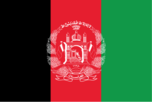
three equal vertical bands of black (hoist side), red, and green, with the national emblem in white centered on the red band and slightly overlapping the other two bands; the center of the emblem features a mosque with pulpit and flags on either side, below the mosque are numerals for the solar year 1298 (1919 in the Gregorian calendar, the year of Afghan independence from the UK); this central image is circled by a border consisting of sheaves of wheat on the left and right, in the upper-center is an Arabic inscription of the Shahada (Muslim creed) below which are rays of the rising sun over the Takbir (Arabic expression meaning "God is great"), and at bottom center is a scroll bearing the name Afghanistan; black signifies the past, red is for the blood shed for independence, and green can represent either hope for the future, agricultural prosperity, or Islam Afghanistan had more changes to its national flag in the 20th century than any other country; the colors black, red, and green appeared on most of them
Government type
Islamic republic
Independence
19 August 1919 (from UK control over Afghan foreign affairs)
International law organization participation
has not submitted an ICJ jurisdiction declaration; accepts ICCt jurisdiction
International organization participation
ADB, CICA, CP, ECO, EITI (candidate country), FAO, G-77, IAEA, IBRD, ICAO, ICC (NGOs), ICRM, IDA, IDB, IFAD, IFC, IFRCS, ILO, IMF, Interpol, IOC, IOM, IPU, ISO (correspondent), ITSO, ITU, MIGA, NAM, OIC, OPCW, OSCE (partner), SAARC, SACEP, SCO (observer), UN, UNCTAD, UNESCO, UNIDO, UNWTO, UPU, WCO, WFTU (NGOs), WHO, WIPO, WMO, WTO
Judicial branch
- Supreme Court or Stera Mahkama (consists of the Supreme Court Chief and 8 justices organized into criminal, public security, civil, and commercial divisions or dewans) court chief and justices appointed by the president with the approval of the Wolesi Jirga; court chief and justices serve single 10-year terms Appeals Courts; Primary Courts; Special Courts for issues including narcotics, security, property, family, and juveniles
- highest court(s)
- Supreme Court or Stera Mahkama (consists of the Supreme Court Chief and 8 justices organized into criminal, public security, civil, and commercial divisions or dewans)
- judge selection and term of office
- court chief and justices appointed by the president with the approval of the Wolesi Jirga; court chief and justices serve single 10-year terms
- subordinate courts
- Appeals Courts; Primary Courts; Special Courts for issues including narcotics, security, property, family, and juveniles
Legal system
mixed legal system of civil, customary, and Islamic law
Legislative branch
- the bicameral National Assembly consists of the Meshrano Jirga or House of Elders (102 seats, two-thirds of members elected from provincial councils for four-year terms, and one-third nominated by the president for five-year terms) and the Wolesi Jirga or House of People (no more than 250 seats; members directly elected for five-year terms) on rare occasions the government may convene a Loya Jirga (Grand Council) on issues of independence, national sovereignty, and territorial integrity; it can amend the provisions of the constitution and prosecute the president; it is made up of members of the National Assembly and chairpersons of the provincial and district councils last held on 18 September 2010 (next election expected in 2015) results by party - NA; note - ethnicity is the main factor influencing political alliances; composition of Loya Jirga seats by ethnic groups - Pashtun 96, Hazara 61, Tajik 53, Uzbek 15, Aimak 8, Arab 8, Turkmen 3, Nuristani 2, Baloch 1, Pahhai 1, Turkic 1; women hold 69 seats
- election results
- results by party - NA; note - ethnicity is the main factor influencing political alliances; composition of Loya Jirga seats by ethnic groups - Pashtun 96, Hazara 61, Tajik 53, Uzbek 15, Aimak 8, Arab 8, Turkmen 3, Nuristani 2, Baloch 1, Pahhai 1, Turkic 1; women hold 69 seats
- elections
- last held on 18 September 2010 (next election expected in 2015)
National anthem
- "Milli Surood" (National Anthem) Abdul Bari JAHANI/Babrak WASA adopted 2006; the 2004 constitution of the post-Taliban government mandated that a new national anthem should be written containing the phrase "Allahu Akbar" (God is Great) and mentioning the names of Afghanistan's ethnic groups
- lyrics/music
- Abdul Bari JAHANI/Babrak WASA
- name
- "Milli Surood" (National Anthem)
National holiday
Independence Day, 19 August (1919)
National symbol(s)
lion
Political parties and leaders
note - the Ministry of Justice licensed 84 political parties as of December 2012
Political pressure groups and leaders
- religious groups, tribal leaders, ethnically based groups, Taliban
- other
- religious groups, tribal leaders, ethnically based groups, Taliban
Suffrage
18 years of age; universal
Economy
Agriculture - products
opium, wheat, fruits, nuts; wool, mutton, sheepskins, lambskins
Budget
- $2.249 billion $3.974 billion (2012 est.)
- expenditures
- $3.974 billion (2012 est.)
- revenues
- $2.249 billion
Budget surplus (+) or deficit (-)
-8.7% of GDP (2012 est.)
Commercial bank prime lending rate
15% (31 December 2012 est.) 15.15% (31 December 2011 est.)
Current account balance
$18 million (2011 est.) $-736 million (2010 est.)
Debt - external
$1.28 billion (FY10/11) $2.7 billion (FY08/09)
Economy - overview
Afghanistan's economy is recovering from decades of conflict. The economy has improved significantly since the fall of the Taliban regime in 2001 largely because of the infusion of international assistance, the recovery of the agricultural sector, and service sector growth. Despite the progress of the past few years, Afghanistan is extremely poor, landlocked, and highly dependent on foreign aid. Much of the population continues to suffer from shortages of housing, clean water, electricity, medical care, and jobs. Criminality, insecurity, weak governance, lack of infrastructure, and the Afghan Government's difficulty in extending rule of law to all parts of the country pose challenges to future economic growth. Afghanistan's living standards are among the lowest in the world. The international community remains committed to Afghanistan's development, pledging over $67 billion at nine donors' conferences between 2003-10. In July 2012, the donors at the Tokyo conference pledged an additional $16 billion in civilian aid through 2015. Despite this help, the Government of Afghanistan will need to overcome a number of challenges, including low revenue collection, anemic job creation, high levels of corruption, weak government capacity, and poor public infrastructure.
Exchange rates
afghanis (AFA) per US dollar - 50.92 (2012 est.) 46.75 (2011 est.) 46.45 (2010)
Exports
$376 million (2012 est.) $2.908 billion (2011 est.) not including illicit exports or reexports
Exports - commodities
opium, fruits and nuts, handwoven carpets, wool, cotton, hides and pelts, precious and semi-precious gems
Exports - partners
Pakistan 32.2%, India 27%, Tajikistan 8.5%, US 6.2% (2012)
Fiscal year
21 December - 20 December
GDP - composition, by end use
- 96.5% 23.3% 25.4% 0% 18.1% -63.4% (2011 est.)
- exports of goods and services
- 18.1%
- government consumption
- 23.3%
- household consumption
- 96.5%
- imports of goods and services
- -63.4%
- investment in fixed capital
- 25.4%
- investment in inventories
- 0%
GDP - composition, by sector of origin
- 20% 25.6% 54.4% data exclude opium production (2011 est.)
- agriculture
- 20%
- industry
- 25.6%
- services
- 54.4%
GDP - per capita (PPP)
$1,100 (2012 est.) $1,000 (2011 est.) $900 (2010 est.) data are in 2012 US dollars
GDP - real growth rate
12.5% (2012 est.) 6.1% (2011 est.) 8.4% (2010 est.)
GDP (official exchange rate)
$20.02 billion (2012 est.)
GDP (purchasing power parity)
$33.79 billion (2012 est.) $30.04 billion (2011 est.) $28.31 billion (2010 est.) data are in 2012 US dollars
Household income or consumption by percentage share
- 3.8% 24% (2008)
- highest 10%
- 24% (2008)
- lowest 10%
- 3.8%
Imports
$6.39 billion (2012 est.) $9.174 billion (2011 est.)
Imports - commodities
machinery and other capital goods, food, textiles, petroleum products
Imports - partners
Pakistan 24.3%, US 18%, Russia 8.7%, India 5.8%, China 5.6%, Germany 4.4% (2012)
Industrial production growth rate
NA%
Industries
small-scale production of bricks, textiles, soap, furniture, shoes, fertilizer, apparel, food-products, non-alcoholic beverages, mineral water, cement; handwoven carpets; natural gas, coal, copper
Inflation rate (consumer prices)
6.8% (2012 est.) 5.7% (2011 est.)
Labor force
15 million (2004 est.)
Labor force - by occupation
- 78.6% 5.7% 15.7% (FY08/09 est.)
- agriculture
- 78.6%
- industry
- 5.7%
- services
- 15.7% (FY08/09 est.)
Market value of publicly traded shares
$NA
Population below poverty line
36% (FY08/09)
Reserves of foreign exchange and gold
$5.983 billion (31 December 2012 est.) $5.268 billion (31 December 2011 est.)
Stock of broad money
$6.499 billion (31 December 2012 est.) $6.351 billion (31 December 2011 est.)
Stock of domestic credit
$-819.6 million (31 December 2012 est.) $-520.2 million (31 December 2011 est.)
Stock of narrow money
$6.121 billion (31 December 2012 est.) $5.928 billion (31 December 2011 est.)
Taxes and other revenues
11.3% of GDP (2012 est.)
Unemployment rate
35% (2008 est.) 40% (2005 est.)
Energy
Carbon dioxide emissions from consumption of energy
6.589 million Mt (2011 est.)
Crude oil - exports
0 bbl/day (2010 est.)
Crude oil - imports
0 bbl/day (2010 est.)
Crude oil - production
1,950 bbl/day (2012 est.)
Crude oil - proved reserves
NA bbl (1 January 2013 es)
Electricity - consumption
2.489 billion kWh (2010 est.)
Electricity - exports
0 kWh (2012 est.)
Electricity - from fossil fuels
23.5% of total installed capacity (2010 est.)
Electricity - from hydroelectric plants
76.5% of total installed capacity (2010 est.)
Electricity - from nuclear fuels
0% of total installed capacity (2010 est.)
Electricity - from other renewable sources
0% of total installed capacity (2010 est.)
Electricity - imports
1.572 billion kWh (2010 est.)
Electricity - installed generating capacity
489,100 kW (2010 est.)
Electricity - production
986.1 million kWh (2010 est.)
Natural gas - consumption
140 million cu m (2010 est.)
Natural gas - exports
0 cu m (2011 est.)
Natural gas - imports
0 cu m (2011 est.)
Natural gas - production
140 million cu m (2011 est.)
Natural gas - proved reserves
49.55 billion cu m (1 January 2013 es)
Refined petroleum products - consumption
4,229 bbl/day (2011 est.)
Refined petroleum products - exports
0 bbl/day (2010 est.)
Refined petroleum products - imports
36,250 bbl/day (2010 est.)
Refined petroleum products - production
0 bbl/day (2010 est.)
Communications
Broadcast media
state-owned broadcaster, Radio Television Afghanistan (RTA), operates a series of radio and television stations in Kabul and the provinces; an estimated 150 private radio stations, 50 TV stations, and about a dozen international broadcasters are available (2007)
Communications - note
Internet access is growing through Internet cafes as well as public "telekiosks" in Kabul (2005)
Internet country code
.af
Internet hosts
223 (2012)
Internet users
1 million (2009)
Telephone system
- limited fixed-line telephone service; an increasing number of Afghans utilize mobile-cellular phone networks aided by the presence of multiple providers, mobile-cellular telephone service continues to improve rapidly; the Afghan Ministry of Communications and Information claims that more than 90 percent of the population live in areas with access to mobile-cellular services country code - 93; multiple VSAT's provide international and domestic voice and data connectivity (2012)
- domestic
- aided by the presence of multiple providers, mobile-cellular telephone service continues to improve rapidly; the Afghan Ministry of Communications and Information claims that more than 90 percent of the population live in areas with access to mobile-cellular services
- general assessment
- limited fixed-line telephone service; an increasing number of Afghans utilize mobile-cellular phone networks
- international
- country code - 93; multiple VSAT's provide international and domestic voice and data connectivity (2012)
Telephones - main lines in use
13,500 (2012)
Telephones - mobile cellular
18 million (2012)
Transportation
Airports
52 (2013)
Airports - with paved runways
- 2 (2013)
- 1,524 to 2,437 m
- 11
- 2,438 to 3,047 m
- 4
- 914 to 1,523 m
- 2
- over 3,047 m
- 4
- total
- 23
- under 914 m
- 2 (2013)
Airports - with unpaved runways
- 6 (2013)
- 1,524 to 2,437 m
- 13
- 2,438 to 3,047 m
- 4
- 914 to 1,523 m
- 6
- total
- 29
Heliports
9 (2013)
Pipelines
gas 466 km (2013)
Ports and terminals
Kheyrabad, Shir Khan
Roadways
- 42,150 km 12,350 km 29,800 km (2006)
- total
- 42,150 km
- unpaved
- 29,800 km (2006)
Waterways
1,200 km; (chiefly Amu Darya, which handles vessels up to 500 DWT) (2011)
Military and Security
Manpower available for military service
- 7,056,339 6,653,419 (2010 est.)
- females age 16-49
- 6,653,419 (2010 est.)
- males age 16-49
- 7,056,339
Manpower fit for military service
- 4,050,222 3,797,087 (2010 est.)
- females age 16-49
- 3,797,087 (2010 est.)
- males age 16-49
- 4,050,222
Manpower reaching militarily significant age annually
- 392,116 370,295 (2010 est.)
- female
- 370,295 (2010 est.)
- male
- 392,116
Military branches
- Afghan Armed Forces: Afghan National Army (ANA, includes Afghan Air Force (AAF)) (2011)
- Afghan Armed Forces
- Afghan National Army (ANA, includes Afghan Air Force (AAF)) (2011)
Military expenditures
10% of GDP (2012)
Military service age and obligation
18 is the legal minimum age for voluntary military service; no conscription (2012)
Transnational Issues
Disputes - international
Afghan, Coalition, and Pakistan military meet periodically to clarify the alignment of the boundary on the ground and on maps; Afghan and Iranian commissioners have discussed boundary monument densification and resurvey; Iran protests Afghanistan's restricting flow of dammed Helmand River tributaries during drought; Pakistan has sent troops across and built fences along some remote tribal areas of its treaty-defined Durand Line border with Afghanistan which serve as bases for foreign terrorists and other illegal activities; Russia remains concerned about the smuggling of poppy derivatives from Afghanistan through Central Asian countries
Illicit drugs
world's largest producer of opium; poppy cultivation increased 57 percent, from 115,000 hectares in 2011 to 180,000 hectares in 2012; despite the increase in area under cultivation, the effects of poor weather and crop disease resulted in lower yield so potential opium production remained stable at 4,300 mt in 2012 compared to 4,400 mt in 2011; the Taliban and other antigovernment groups participate in and profit from the opiate trade, which is a key source of revenue for the Taliban inside Afghanistan; widespread corruption and instability impede counterdrug efforts; most of the heroin consumed in Europe and Eurasia is derived from Afghan opium; Afghanistan is also struggling to respond to a burgeoning domestic opiate addiction problem; vulnerable to drug money laundering through informal financial networks; regional source of hashish (2013)
Refugees and internally displaced persons
- 16,147 (Pakistan) (2012) 612,000 (mostly Pashtuns and Kuchis displaced in the south and west due to drought and instability) (2013)
- IDPs
- 612,000 (mostly Pashtuns and Kuchis displaced in the south and west due to drought and instability) (2013)
- refugees (country of origin)
- 16,147 (Pakistan) (2012)
Trafficking in persons
- Afghanistan is a source transit, and destination country for men, women, and children subjected to forced labor and sex trafficking, although domestic trafficking is more prevalent than transnational trafficking; Afghan men are subjected to forced labor and debt bondage in Iran, Pakistan, Greece, Turkey, and the Gulf states; Afghan women and girls are forced into prostitution and domestic servitude in Pakistan, Iran, and India, while women and girls from the Philippines, Pakistan, Iran, Tajikistan, and China are reportedly sexually exploited in Afghanistan; children are increasingly subjected to forced labor in carpet-making factories, domestic servitude, forced begging, and commercial sexual exploitation; some children are sold to settle debts Tier 2 Watch List - Afghanistan does not fully comply with the minimum standards for the elimination of trafficking in persons; anti-trafficking law enforcement efforts have improved, though official complicity in human trafficking remains a problem; the first known convictions were made under the government's 2008 anti-trafficking law; Afghanistan has not developed or employed systematic procedures to identify trafficking victims or refer them to protective services and continues to rely on NGOs to provide the vast majority of victim assistance; the government has not made discernible progress in preventing human trafficking or protecting victims but has adopted an anti-trafficking action plan (2013)
- current situation
- Afghanistan is a source transit, and destination country for men, women, and children subjected to forced labor and sex trafficking, although domestic trafficking is more prevalent than transnational trafficking; Afghan men are subjected to forced labor and debt bondage in Iran, Pakistan, Greece, Turkey, and the Gulf states; Afghan women and girls are forced into prostitution and domestic servitude in Pakistan, Iran, and India, while women and girls from the Philippines, Pakistan, Iran, Tajikistan, and China are reportedly sexually exploited in Afghanistan; children are increasingly subjected to forced labor in carpet-making factories, domestic servitude, forced begging, and commercial sexual exploitation; some children are sold to settle debts
- tier rating
- Tier 2 Watch List - Afghanistan does not fully comply with the minimum standards for the elimination of trafficking in persons; anti-trafficking law enforcement efforts have improved, though official complicity in human trafficking remains a problem; the first known convictions were made under the government's 2008 anti-trafficking law; Afghanistan has not developed or employed systematic procedures to identify trafficking victims or refer them to protective services and continues to rely on NGOs to provide the vast majority of victim assistance; the government has not made discernible progress in preventing human trafficking or protecting victims but has adopted an anti-trafficking action plan (2013)