2007 Edition
CIA World Factbook 2007 (Project Gutenberg)
Introduction
Administrative divisions
34 provinces (velayat, singular - velayat); Badakhshan, Badghis, Baghlan, Balkh, Bamian, Daykondi, Farah, Faryab, Ghazni, Ghowr, Helmand, Herat, Jowzjan, Kabol, Kandahar, Kapisa, Khowst, Konar, Kondoz, Laghman, Lowgar, Nangarhar, Nimruz, Nurestan, Oruzgan, Paktia, Paktika, Panjshir, Parvan, Samangan, Sar-e Pol, Takhar, Vardak, Zabol
Age structure
0-14 years: 44.6% (male 7,095,117/female 6,763,759) 15-64 years: 53% (male 8,436,716/female 8,008,463) 65 years and over: 2.4% (male 366,642/female 386,300) (2006 est.)
Agriculture - products
opium, wheat, fruits, nuts; wool, mutton, sheepskins, lambskins
Airports
46 (2006)
Airports - with paved runways
- over 3,047 m
- 3 2,438 to 3,047 m: 3 1,524 to 2,437 m: 3 914 to 1,523 m: 1
- total
- 11
- under 914 m
- 1 (2006)
Airports - with unpaved runways
- over 3,047 m
- 1 2,438 to 3,047 m: 5 1,524 to 2,437 m: 16 914 to 1,523 m: 4
- total
- 35
- under 914 m
- 9 (2006)
Area
- land
- 647,500 sq km
- total
- 647,500 sq km
- water
- 0 sq km
Area - comparative
slightly smaller than Texas
Background
Ahmad Shah DURRANI unified the Pashtun tribes and founded Afghanistan in 1747. The country served as a buffer between the British and Russian empires until it won independence from notional British control in 1919. A brief experiment in democracy ended in a 1973 coup and a 1978 Communist counter-coup. The Soviet Union invaded in 1979 to support the tottering Afghan Communist regime, touching off a long and destructive war. The USSR withdrew in 1989 under relentless pressure by internationally supported anti-Communist mujahedin rebels. Subsequently, a series of civil wars saw Kabul finally fall in 1996 to the Taliban, a hardline Pakistani-sponsored movement that emerged in 1994 to end the country's civil war and anarchy. Following the 11 September 2001 terrorist attacks, a US, Allied, and anti-Taliban Northern Alliance military action toppled the Taliban for sheltering Osama BIN LADIN. The UN-sponsored Bonn Conference in 2001 established a process for political reconstruction that included the adoption of a new constitution and a presidential election in 2004, and National Assembly elections in 2005. On 7 December 2004, Hamid KARZAI became the first democratically elected president of Afghanistan. The National Assembly was inaugurated on 19 December 2005. Geography Afghanistan
Birth rate
46.6 births/1,000 population (2006 est.)
Budget
- expenditures
- $561 million; including capital expenditures of $41.7 million
- note
- Afghanistan has also received $273 million from the Reconstruction Trust Fund and $63 million from the Law and Order Trust Fund (FY04-05 budget est.)
- revenues
- $269 million
Capital
- geographic coordinates
- 34 31 N, 69 12 E
- name
- Kabul
- time difference
- UTC+4.5 (9.5 hours ahead of Washington, DC during Standard Time)
Climate
arid to semiarid; cold winters and hot summers
Coastline
0 km (landlocked)
Communications - note
in March 2003, 'af' was established as Afghanistan's domain name; Internet access is growing through Internet cafes as well as public "telekiosks" in Kabul (2002) Transportation Afghanistan
Constitution
new constitution drafted 14 December 2003-4 January 2004; signed 16 January 2004
Country name
- conventional long form
- Islamic Republic of Afghanistan
- conventional short form
- Afghanistan
- former
- Republic of Afghanistan
- local long form
- Jomhuri-ye Eslami-ye Afghanestan
- local short form
- Afghanestan
Currency (code)
afghani (AFA)
Currency code
AFA
Death rate
20.34 deaths/1,000 population (2006 est.)
Debt - external
$8 billion in bilateral debt, mostly to Russia; Afghanistan has $500 million in debt to Multilateral Development Banks (2004)
Diplomatic representation from the US
- chief of mission
- Ambassador Ronald E. NEUMANN
- embassy
- The Great Masood Road, Kabul
- mailing address
- U.S. Embassy Kabul, APO, AE 09806
- telephone
- [00 93] (20) 230-0436
Diplomatic representation in the US
- chancery
- 2341 Wyoming Avenue NW, Washington, DC 20008
- chief of mission
- Ambassador Said Tayeb JAWAD
- telephone
- [1] 202-483-6410
Disputes - international
most Afghan refugees in Pakistan have been repatriated, but thousands still remain in Iran, many at their own choosing; Coalition and Pakistani forces continue to patrol remote tribal areas to control the borders and stem organized terrorist and other illegal cross-border activities; regular meetings between Pakistani and Coalition allies aim to resolve periodic claims of boundary encroachments; regional conflicts over water-sharing arrangements with Amu Darya and Helmand River states
Economic aid - recipient
international pledges made by more than 60 countries and international financial institutions at the Berlin Donors Conference for Afghan reconstruction in March 2004 reached $8.9 billion for 2004-09
Economy - overview
- Afghanistan's economy is recovering from decades of conflict. The economy has improved significantly since the fall of the Taliban regime in 2001 largely because of the infusion of international assistance, the recovery of the agricultural sector, and service sector growth. Real GDP growth probably exceeded 8% in 2006. Despite the progress of the past few years, Afghanistan is extremely poor, landlocked, and highly dependent on foreign aid, agriculture, and trade with neighboring countries. Much of the population continues to suffer from shortages of housing, clean water, electricity, medical care, and jobs. Criminality, insecurity, and the Afghan Government's inability to extend rule of law to all parts of the country pose challenges to future economic growth. It will probably take the remainder of the decade and continuing donor aid and attention to significantly raise Afghanistan's living standards from its current status, among the lowest in the world. While the international community remains committed to Afghanistan's development, pledging over $24 billion at three donors' conferences since 2002, Kabul will need to overcome a number of challenges. Expanding poppy cultivation and a growing opium trade generate roughly $3 billion in illicit economic activity and looms as one of Kabul's most serious policy concerns. Other long-term challenges
- include
- budget sustainability, job creation, corruption, government capacity, and rebuilding war torn infrastructure.
Electricity - consumption
782.9 million kWh (2004)
Electricity - exports
0 kWh (2004)
Electricity - imports
100 million kWh (2004)
Electricity - production
734.3 million kWh (2004)
Electricity - production by source
- fossil fuel
- 36.3%
- hydro
- 63.7%
- nuclear
- 0%
- other
- 0% (2001)
Elevation extremes
- highest point
- Nowshak 7,485 m
- lowest point
- Amu Darya 258 m
Environment - current issues
limited natural fresh water resources; inadequate supplies of potable water; soil degradation; overgrazing; deforestation (much of the remaining forests are being cut down for fuel and building materials); desertification; air and water pollution
Environment - international agreements
- party to
- Biodiversity, Climate Change, Desertification, Endangered Species, Environmental Modification, Marine Dumping
- signed, but not ratified
- Hazardous Wastes, Law of the Sea, Marine Life Conservation
Ethnic groups
Pashtun 42%, Tajik 27%, Hazara 9%, Uzbek 9%, Aimak 4%, Turkmen 3%, Baloch 2%, other 4%
Exchange rates
afghanis per US dollar - 541 (2005), 48 (2004), 49 (2003), 41 (2002), note, in 2002, the afghani was revalued and the currency stabilized at about 50 afghanis to the dollar; before 2002, the market rate varied widely from the official rate
Executive branch
- cabinet
- 25 ministers; note - under the new constitution, ministers are appointed by the president and approved by the National Assembly
- chief of state
- President of the Islamic Republic of Afghanistan Hamid KARZAI (since 7 December 2004); Vice Presidents Ahmad Zia MASOOD and Abdul Karim KHALILI (since 7 December 2004); note - the president is both the chief of state and head of government; former King ZAHIR Shah holds the honorific, "Father of the Country," and presides symbolically over certain occasions, but lacks any governing authority; the honorific is not hereditary
- election results
- Hamid KARZAI elected president; percent of vote - Hamid KARZAI 55.4%, Yunus QANUNI 16.3%, Ustad Mohammad MOHAQQEQ 11.6%, Abdul Rashid DOSTAM 10.0%, Abdul Latif PEDRAM 1.4%, Masooda JALAL 1.2%
- elections
- the president and two vice presidents are elected by direct vote for a five-year term (eligible for a second term); if no candidate receives 50% or more of the vote in the first round of voting, the two candidates with the most votes will participate in a second round; a president can only be elected for two terms; election last held 9 October 2004 (next to be held in 2009)
- head of government
- President of the Islamic Republic of Afghanistan Hamid KARZAI (since 7 December 2004); Vice Presidents Ahmad Zia MASOOD and Abdul Karim KHALILI (since 7 December 2004)
Exports
$471 million; note - not including illicit exports or reexports (2005 est.)
Exports - commodities
opium, fruits and nuts, handwoven carpets, wool, cotton, hides and pelts, precious and semi-precious gems
Exports - partners
US 25.8%, India 21.2%, Pakistan 20.3%, Finland 4.1% (2005)
FAX
- [1] 202-483-6488
- [00 93] (20) 230-1364
- consulate(s) general
- Los Angeles, New York
Fiscal year
21 March - 20 March Communications Afghanistan
Flag description
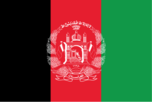
three equal vertical bands of black (hoist), red, and green, with a gold emblem centered on the red band; the emblem features a temple-like structure encircled by a wreath on the left and right and by a bold Islamic inscription above Economy Afghanistan
GDP - composition by sector
- agriculture
- 38%
- industry
- 24%
- note
- data exclude opium production (2005 est.)
- services
- 38%
GDP - per capita (PPP)
$800 (2004 est.)
GDP - real growth rate
8.4% (2006 est.)
GDP (official exchange rate)
$7.095 billion (2005 est.)
GDP (purchasing power parity)
$21.5 billion (2004 est.)
Geographic coordinates
33 00 N, 65 00 E
Geography - note
landlocked; the Hindu Kush mountains that run northeast to southwest divide the northern provinces from the rest of the country; the highest peaks are in the northern Vakhan (Wakhan Corridor) People Afghanistan
Government type
Islamic republic
Heliports
9 (2006)
HIV/AIDS - adult prevalence rate
0.01% (2001 est.)
HIV/AIDS - deaths
NA
HIV/AIDS - people living with HIV/AIDS
NA
Household income or consumption by percentage share
- highest 10%
- NA%
- lowest 10%
- NA%
IDPs
136,565 (mostly Pashtuns and Kuchis displaced in south and west due to drought and instability) (2006)
Illicit drugs
world's largest producer of opium; cultivation dropped 48% to 107,400 hectares in 2005; better weather and lack of widespread disease returned opium yields to normal levels, meaning potential opium production declined by only 10% to 4,475 metric tons; if the entire poppy crop were processed, it is estimated that 526 metric tons of heroin could be processed; source of hashish; many narcotics-processing labs throughout the country; drug trade source of instability and some antigovernment groups profit from the trade; 80-90% of the heroin consumed in Europe comes from Afghan opium; vulnerable to narcotics money laundering through informal financial networks This page was last updated on 8 February, 2007
Imports
$3.87 billion (2005 est.)
Imports - commodities
capital goods, food, textiles, petroleum products
Imports - partners
Pakistan 38.6%, US 9.5%, Germany 5.5%, India 5.2%, Turkey 4.1%, Turkmenistan 4% (2005)
Independence
19 August 1919 (from UK control over Afghan foreign affairs)
Industrial production growth rate
NA%
Industries
small-scale production of textiles, soap, furniture, shoes, fertilizer, cement; handwoven carpets; natural gas, coal, copper
Infant mortality rate
- female
- 155.45 deaths/1,000 live births (2006 est.)
- male
- 164.77 deaths/1,000 live births
- total
- 160.23 deaths/1,000 live births
Inflation rate (consumer prices)
16.3% (2005 est.)
International organization participation
AsDB, CP, ECO, FAO, G-77, IAEA, IBRD, ICAO, ICCt, ICRM, IDA, IDB, IFAD, IFC, IFRCS, ILO, IMF, Interpol, IOC, IOM, ISO (correspondent), ITU, MIGA, NAM, OIC, OPCW, OSCE (partner), SACEP, UN, UNCTAD, UNESCO, UNIDO, UNWTO, UPU, WCO, WFTU, WHO, WIPO, WMO, WTO (observer)
Internet country code
.af
Internet hosts
22 (2006)
Internet Service Providers (ISPs)
1 (2000)
Internet users
30,000 (2005)
Irrigated land
27,200 sq km (2003)
Judicial branch
the constitution establishes a nine-member Stera Mahkama or Supreme Court (its nine justices are appointed for 10-year terms by the president with approval of the Wolesi Jirga) and subordinate High Courts and Appeals Courts; there is also a minister of justice; a separate Afghan Independent Human Rights Commission established by the Bonn Agreement is charged with investigating human rights abuses and war crimes
Labor force
15 million (2004 est.)
Labor force - by occupation
- agriculture
- 80%
- industry
- 10%
- services
- 10% (2004 est.)
Land boundaries
- border countries
- China 76 km, Iran 936 km, Pakistan 2,430 km, Tajikistan 1,206 km, Turkmenistan 744 km, Uzbekistan 137 km
- total
- 5,529 km
Land use
- arable land
- 12.13%
- other
- 87.66% (2005)
- permanent crops
- 0.21%
Languages
Afghan Persian or Dari (official) 50%, Pashtu (official) 35%, Turkic languages (primarily Uzbek and Turkmen) 11%, 30 minor languages (primarily Balochi and Pashai) 4%, much bilingualism
Legal system
according to the new constitution, no law should be "contrary to Islam"; the state is obliged to create a prosperous and progressive society based on social justice, protection of human dignity, protection of human rights, realization of democracy, and to ensure national unity and equality among all ethnic groups and tribes; the state shall abide by the UN charter, international treaties, international conventions that Afghanistan signed, and the Universal Declaration of Human Rights
Legislative branch
- the bicameral National Assembly consists of the Wolesi Jirga or House of People (no more than 249 seats), directly elected for five-year terms, and the Meshrano Jirga or House of Elders (102 seats, one-third elected from provincial councils for four-year terms, one-third elected from local district councils for three-year terms
- election results
- the single non-transferable vote (SNTV) system used in the election did not make use of political party slates; most candidates ran as independents
- elections
- last held 18 September 2005 (next to be held for the Wolesi Jirga by September 2009; next to be held for the provincial councils to the Meshrano Jirga by September 2008)
- note
- on rare occasions the government may convene a Loya Jirga (Grand Council) on issues of independence, national sovereignty, and territorial integrity; it can amend the provisions of the constitution and prosecute the president; it is made up of members of the National Assembly and chairpersons of the provincial and district councils
Life expectancy at birth
- female
- 43.53 years (2006 est.)
- male
- 43.16 years
- total population
- 43.34 years
Literacy
- definition
- age 15 and over can read and write
- female
- 21% (1999 est.)
- male
- 51%
- total population
- 36%
Location
Southern Asia, north and west of Pakistan, east of Iran
Major infectious diseases
- animal contact disease
- rabies
- degree of risk
- high
- food or waterborne diseases
- bacterial and protozoal diarrhea, hepatitis A, and typhoid fever
- note
- highly pathogenic H5N1 avian influenza has been identified among birds in this country or surrounding region; it poses a negligible risk with extremely rare cases possible among US citizens who have close contact with birds (2007)
- vectorborne disease
- malaria is a high risk countrywide below 2,000 meters from March through November
Manpower available for military service
- females age 22-49
- 4,663,963 (2005 est.)
- males age 22-49
- 4,952,812
Manpower fit for military service
- females age 22-49
- 2,508,574 (2005 est.)
- males age 22-49
- 2,662,946
Manpower reaching military service age annually
- females age 22-49
- 259,935 (2005 est.)
- males age 18-49
- 275,362
Map references
Asia
Maritime claims
none (landlocked)
Median age
- female
- 17.6 years (2006 est.)
- male
- 17.6 years
- total
- 17.6 years
Military branches
Afghan National Army (includes Afghan Air Force) (2006)
Military expenditures - dollar figure
$122.4 million (2005 est.)
Military expenditures - percent of GDP
1.7% (2005 est.) Transnational Issues Afghanistan
Military service age and obligation
22 years of age; inductees are contracted into service for a 4-year term (2005)
National holiday
Independence Day, 19 August (1919)
Nationality
- adjective
- Afghan
- noun
- Afghan(s)
Natural gas - consumption
20 million cu m (2004 est.)
Natural gas - exports
0 cu m (2004 est.)
Natural gas - imports
0 cu m (2004 est.)
Natural gas - production
20 million cu m (2004 est.)
Natural gas - proved reserves
99.96 billion cu m (1 January 2005 est.)
Natural hazards
damaging earthquakes occur in Hindu Kush mountains; flooding; droughts
Natural resources
natural gas, petroleum, coal, copper, chromite, talc, barites, sulfur, lead, zinc, iron ore, salt, precious and semiprecious stones
Net migration rate
0.42 migrant(s)/1,000 population (2006 est.)
Oil - consumption
4,500 bbl/day (2004 est.)
Oil - exports
NA bbl/day (2005)
Oil - imports
NA bbl/day (2005)
Oil - production
0 bbl/day (2004)
Oil - proved reserves
0 bbl (1 January 2002)
People - note
of the estimated 4 million refugees in October 2001, 2.3 million have returned Government Afghanistan
Pipelines
gas 466 km (2006)
Political parties and leaders
note - includes only political parties approved by the Ministry of Justice; De Afghan Watan Islami Gond [Mohammad Osman SALEKZADA]; De Afghanistan De Mili Mubarizeeno Islami Gond [Amanat NINGARHAREE]; De Afghanistan De Mili Wahdat Wolesi Tahreek [Abdul Hakim NOORZAI]; De Afghanistan De Solay Ghorzang Gond [Shahnawaz TANAI]; De Afghanistan De Solay Mili Islami Gond [Shah Mohammood Popal ZAI]; Hezb-e Esteqlal-e-Mili Afghanistan [Taj Mohammad WARDAK]; Hezb-e Hambastagee Mili Aqwam-e-Afghanistan [Mohammad Zarif NASERI]; Hezb-e Harakat-e-Islami-e-Afghanistan [Mohammad Ali JAWID]; Hezb-e Jamihat-e-Islami [Ustad RABBANI]; Hezb-e Paiwand Mihahani Afghanistan [Sayed Kamal SADAT]; Hezb-e-Aarman-e-Mardom-e-Afghanistan [Ilhaj Saraj-u-din ZAFAREE]; Hezb-e-Aazaadi Khwahan Maihan [Abdul Hadi DABEER]; Hezb-e-Aazadee Khwahan Mardom-e-Afghanistan [Feda Mohammad EHSAS]; Hezb-e-Adalat-e-Islami Afghanistan [Mohammad Kabir MARZBAN]; Hezb-e-Afghan Melat [Anwarul Haq AHADI]; Hezb-e-Afghanistan-e-Naween [Mohammad Yunis QANUNI]; Hezb-e-Afghanistan-e-Wahid [Mohammad Wasil RAHIMEE]; Hezb-e-Azadee-e-Afghanistan [Ilaj Abdul MALEK]; Hezb-e-Democracy Afghanistan [Tawos ARAB]; Hezb-e-Domcrat-e-Afghanistan [Abdul Kabir RANJBAR]; Hezb-e-Eatedal-e-Mili Islami-e-Afghanistan [Qara Bik Eized YAAR]; Hezb-e-Eqtedar-e-Mili [Sayed Mustafa KAZEMI]; Hezb-e-Falah-e-Mardom-e-Afghanistan [Ustad Mohammad ZAREEF]; Hezb-e-Hambastagee Mili Jawanan-e-Afghanistan [Mohammad Jamil KARZAI]; Hezb-e-Hambastagee-e-Afghanistan [Abdul Khaleq NEMAT]; Hezb-e-Harakat-e-Islami Mardom-e-Afghanistan [Ilhaj Said Hussain ANWARY]; Hezb-e-Harakat-e-Mili Wahdat-e-Afghanistan [Mohammad Nadir AATASH]; Hezb-e-Ifazat Az Uqooq-e-Bashar Wa Inkishaf-e-Afghanistan [Baryalai NASRATI]; Hezb-e-Islami-e-Afghanistan-e-Jawan [Sayed Jawad HUSSINEE]; Hezb-e-Isteqlal-e-Afghanistan [Dr. Ghulam Farooq NEJRABEE]; Hezb-e-Jamahat-ul-Dawat ilal Quran-wa-Sunat-e-Afghanistan [Mawlawee Samiullah NAJEEBEE]; Hezb-e-Jamhoree Khwahane-Afghanistan [Sebghatullah SANJAR]; Hezb-e-Junbish Democracy Mardom-e-Afghanistan [Sharif NAZARI]; Hezb-e-Junbish Mili Islami-e-Afghanistan [Sayed NOORULLAH]; Hezb-e-Kangra-e-Mili-e-Afghanistan [Abdul Latif PEDRAM]; Hezb-e-Kar Wa Tawsiha-e-Afghanistan [Zulfiqar OMID]; Hezb-e-Lebral-e-Aazadee Khwa-e-Afghanistan [Ajmal SUHAIL]; Hezb-e-Majmeh Mili Faleen-Sulh-e-Afghanistan [Shamsul Haq Noor SHAMS]; Hezb-e-Mardom-e-Afghanistan [Ahmad Shah ASAR]; Hezb-e-Mardom-e-Mosalman-e-Afghanistan [Besmellah JOYAN]; Hezb-e-Mili Afghanistan [Abdul Rashid ARYAN]; Hezb-e-Mili Heward [GHULAM MOHAMMAD]; Hezb-e-Mili Islami-e-Afghanistan [Rohullah LOUDIN]; Hezb-e-Mili Wahdat-e-Aqwam-e-Islami-e-Afghanistan [Mohammad Shah KHOGYANI]; Hezb-e-Mutahed Mili [Noorul Haq ULOOMI]; Hezb-e-Nahzat-e-Aazadee Wa Democracy-e-Afghanistan [Abdul Raqib Jawid KOHISTANEE]; Hezb-e-Nahzat-e-Hambastagee Mili-e-Afghanistan [Pir Sayed Eshaq GAILANEE]; Hezb-e-Nakhbagan-e-Mardom-e-Afghanistan [Abdul Hamid JAWAD]; Hezb-e-Paiwand Mili Afghanistan [Sayed Mansoor NADREEI]; Hezb-e-Rastakhaiz-e-Mardom-e-Afghanistan [Sayed Zahir Qayed Omul BELADI]; Hezb-e-Refah-e-Afghanistan [Meer Asef ZAEEFI]; Hezb-e-Refah-e-Mardom-e-Afghanistan [Mia Gul WASIQ]; Hezb-e-Refah-e-Mili Afghanistan [Mohammad Hassan JAHFAREE]; Hezb-e-Resalat-e-Mardom-e-Afghanistan [Noor Aqa ROEENE]; Hezb-e-Sahadat-e-Mardom-e-Afghanistan [Mohammad Zubair PAIROZ]; Hezb-e-Sahadat-e-Mili Islami-e-Afghanistan [Mohammad Osman SALEKZADA]; Hezb-e-Subat-e-Mili Islami-e-Afghanistan [Mohammad Same KHAROTI]; Hezb-e-Sulh Wa Wahdat-e-Mili-e-Afghanistan [Gulabuddin Shir ZAEE]; Hezb-e-Sulh-e-Mili Islami Aqwam-e-Afghanistan [Abdul Qaher SHARIATEE]; Hezb-e-Tafahum Wa Democracy-e-Afghanistan [Ahamad SHAHEEN]; Hezb-e-Tahreek Wahdat-e-Mili-e-Afghanistan [Sultan Mohammad GHAZI]; Hezb-e-Tahreek Wahdat-ul-Musimeen Afghanistan [Wazir Mohammad WAHDAT]; Hezb-e-Tanzim Jabha Mili Nejat-e-Afghanistan [Seghatullah MOJADDEDI]; Hezb-e-Taraqee Democrat Afghanistan [Wali ARYA]; Hezb-e-Taraqee Mili Afghanistan [Dr. Aref BAKTASH]; Hezb-e-Umat-e-Islam-e-Afghanistan [Toran Noor Aqa Ahmad ZAI]; Hezb-e-Wahdat-e-Islami Mardom-e-Afghanistan [Ustad Mohammad MOHAQQEQ]; Hezb-e-Wahdat-e-Islami-e-Afghanistan [Mohammad Karim KHALILI]; Hezb-e-Wahdat-e-Islami-e-Melat-e-Afghanistan [Qurban Ali URFANI]; Hezb-e-Wahdat-e-Mili Afghanistan [Abdul Rashid JALILI]; Hezb-e-Wahdat-e-Mili Islami-e-Afghanistan [Mohammad AKBAREE]; Mahaz-e-Mili Islami Afghanistan [Pir Sayed Ahmad GAILANEE]; Mili Dreez Gong [Habibullah JANBDAD]; Nahzat-e-Hakemyat-e-Mardom-e-Afghanistan [Hayatullah SUBHANEE]; Nahzat-e-Mili Afghanistan [Ahmad Wali MASOOUD]; Tanzim Daawat-e-Islami-e-Afghanistan [Abdul Rasoul SAYYAF]; (20 August 2005)
Population
31,056,997 (July 2006 est.)
Population below poverty line
53% (2003)
Population growth rate
2.67% (2006 est.)
Ports and terminals
Kheyrabad, Shir Khan Military Afghanistan
Radio broadcast stations
AM 21, FM 5, shortwave 1 (broadcasts in Pashtu, Afghan Persian (Dari), Urdu, and English) (2006)
Radios
167,000 (1999)
Religions
Sunni Muslim 80%, Shi'a Muslim 19%, other 1%
Roadways
- paved
- 8,229 km
- total
- 34,782 km
- unpaved
- 26,553 km (2004)
Sex ratio
- at birth
- 1.05 male(s)/female
- total population
- 1.05 male(s)/female (2006 est.)
- under 15 years
- 1.05 male(s)/female 15-64 years: 1.05 male(s)/female 65 years and over: 0.95 male(s)/female
Suffrage
18 years of age; universal
Telephone system
- domestic
- telephone service is improving with the licensing of several wireless telephone service providers in 2005 and 2006; approximately 4 in 100 Afghans own a wireless telephone; telephone main lines remain limited.
- general assessment
- very limited telephone and telegraph service; many Afghans utilize growing cellular phone coverage in major cities
- international
- country code - 93; five VSAT's installed in Kabul, Herat, Mazar-e-Sharif, Kandahar, and Jalalabad provide international and domestic voice and data connectivity
Telephones - main lines in use
280,000 (2005)
Telephones - mobile cellular
1.4 million (2005)
Television broadcast stations
at least 7 (one government-run central television station in Kabul and regional stations in nine of the 34 provinces; the regional stations operate on a reduced schedule; also, in 1997, there was a station in Mazar-e-Sharif reaching four northern Afghanistan provinces) (2006)
Televisions
100,000 (1999)
Terrain
mostly rugged mountains; plains in north and southwest
Total fertility rate
6.69 children born/woman (2006 est.)
Unemployment rate
40% (2005 est.)
Waterways
1,200 km (chiefly Amu Darya, which handles vessels up to 500 DWT) (2005)