2004 Edition
CIA World Factbook 2004 (Project Gutenberg)
Introduction
Background
Afghanistan's recent history is a story of war and civil unrest. The Soviet Union invaded in 1979, but was forced to withdraw 10 years later by anti-Communist mujahidin forces. The Communist regime in Kabul collapsed in 1992. Fighting that subsequently erupted among the various mujahidin factions eventually helped to spawn the Taliban, a hardline Pakistani-sponsored movement that fought to end the warlordism and civil war which gripped the country. The Taliban seized Kabul in 1996 and were able to capture most of the country outside of Northern Alliance srongholds primarily in the northeast. Following the 11 September 2001 terrorist attacks, a US, Allied, and Northern Alliance military action toppled the Taliban for sheltering Osama BIN LADIN. In late 2001, a conference in Bonn, Germany, established a process for political reconstruction that ultimately resulted in the adoption of a new constitution and presidential election in 2004. On 9 October 2004, Hamid KARZAI became the first democratically elected president of Afghanistan. The new Afghan government's next task is to hold National Assembly elections, tentatively scheduled for April 2005.
Geography
Area
- land
- 647,500 sq km
- total
- 647,500 sq km
- water
- 0 sq km
Area - comparative
slightly smaller than Texas
Climate
arid to semiarid; cold winters and hot summers
Coastline
0 km (landlocked)
Elevation extremes
- highest point
- Nowshak 7,485 m
- lowest point
- Amu Darya 258 m
Environment - current issues
limited natural fresh water resources; inadequate supplies of potable water; soil degradation; overgrazing; deforestation (much of the remaining forests are being cut down for fuel and building materials); desertification; air and water pollution
Environment - international agreements
- Environmental Modification, Marine Dumping
- the Sea, Marine Life Conservation
- party to
- Biodiversity, Desertification, Endangered Species,
- signed, but not ratified
- Climate Change, Hazardous Wastes, Law of
Geographic coordinates
33 00 N, 65 00 E
Geography - note
landlocked; the Hindu Kush mountains that run northeast to southwest divide the northern provinces from the rest of the country; the highest peaks are in the northern Vakhan (Wakhan Corridor)
Irrigated land
23,860 sq km (1998 est.)
Land boundaries
- Tajikistan 1,206 km, Turkmenistan 744 km, Uzbekistan 137 km
- border countries
- China 76 km, Iran 936 km, Pakistan 2,430 km,
- total
- 5,529 km
Land use
- arable land
- 12.13%
- other
- 87.65% (2001)
- permanent crops
- 0.22%
Location
Southern Asia, north and west of Pakistan, east of Iran
Map references
Asia
Maritime claims
none (landlocked)
Natural hazards
damaging earthquakes occur in Hindu Kush mountains; flooding; droughts
Natural resources
natural gas, petroleum, coal, copper, chromite, talc, barites, sulfur, lead, zinc, iron ore, salt, precious and semiprecious stones
Terrain
mostly rugged mountains; plains in north and southwest
People and Society
Age structure
0-14 years: 44.7% (male 6,525,929; female 6,222,497) 15-64 years: 52.9% (male 7,733,707; female 7,346,226) 65 years and over: 2.4% (male 334,427; female 350,891) (2004 est.)
Birth rate
47.27 births/1,000 population (2004 est.)
Death rate
21.12 deaths/1,000 population (2004 est.)
Ethnic groups
Pashtun 42%, Tajik 27%, Hazara 9%, Uzbek 9%, Aimak 4%, Turkmen 3%, Baloch 2%, other 4%
HIV/AIDS - adult prevalence rate
0.01% (2001 est.)
HIV/AIDS - deaths
NA
HIV/AIDS - people living with HIV/AIDS
NA
Infant mortality rate
- female
- 160.82 deaths/1,000 live births (2004 est.)
- male
- 170.85 deaths/1,000 live births
- total
- 165.96 deaths/1,000 live births
Languages
Pashtu (official) 35%, Afghan Persian (Dari) 50%, Turkic languages (primarily Uzbek and Turkmen) 11%, 30 minor languages (primarily Balochi and Pashai) 4%, much bilingualism
Life expectancy at birth
- female
- 42.66 years (2004 est.)
- male
- 42.27 years
- total population
- 42.46 years
Literacy
- definition
- age 15 and over can read and write
- female
- 21% (1999 est.)
- male
- 51%
- total population
- 36%
Median age
- female
- 17.6 years (2004 est.)
- male
- 17.5 years
- total
- 17.5 years
Nationality
- adjective
- Afghan
- noun
- Afghan(s)
Net migration rate
23.06 migrant(s)/1,000 population (2004 est.)
People - note
of the estimated 4 million refugees in October 2001, 2.3 million have returned
Population
28,513,677 (July 2004 est.)
Population growth rate
- 4.92%
- its continuing impact (2004 est.)
- note
- this rate does not take into consideration the recent war and
Religions
Sunni Muslim 80%, Shi'a Muslim 19%, other 1%
Sex ratio
- 15-64 years: 1.05 male(s)/female 65 years and over: 0.95 male(s)/female
- at birth
- 1.05 male(s)/female
- total population
- 1.05 male(s)/female (2004 est.)
- under 15 years
- 1.05 male(s)/female
Total fertility rate
6.78 children born/woman (2004 est.)
Government
Administrative divisions
34 provinces (velayat, singular - velayat); Badakhshan, Badghis, Baghlan, Balkh, Bamian, Daykondi, Farah, Faryab, Ghazni, Ghowr, Helmand, Herat, Jowzjan, Kabol, Kandahar, Kapisa, Khowst, Konar, Kondoz, Laghman, Lowgar, Nangarhar, Nimruz, Nurestan, Oruzgan, Paktia, Paktika, Panjshir, Parvan, Samangan, Sar-e Pol, Takhar, Vardak, and Zabol
Capital
Kabul
Constitution
new constitution drafted 14 December 2003 - 4 January 2004; signed 16 January 2004
Country name
- conventional long form
- Islamic Republic of Afghanistan
- conventional short form
- Afghanistan
- former
- Republic of Afghanistan
- local long form
- Dowlat-e Eslami-ye Afghanestan
- local short form
- Afghanestan
Diplomatic representation from the US
- FAX: [0093] (2) 230-1364
- chief of mission
- Ambassador Zalmay KHALILZAD
- embassy
- The Great Masood Road, Kabul
- mailing address
- 6180 Kabul Place, Dulles, VA 20189-6180
- telephone
- [00] (2) 230-0436
Diplomatic representation in the US
- FAX: [1] 202-483-6488
- chancery
- 2118 Kalorama Road NW, Washington, DC 20008
- chief of mission
- Ambassador Said Tayeb JAWAD
- consulate(s) general
- New York
- telephone
- [1] 202-483-6410
Executive branch
- Hamid KARZAI (since 7 December 2004); note - the president is both the chief of state and head of government; former King ZAHIR Shah holds the honorific, "Father of the Country," and presides symbolically over certain occasions, but lacks any governing authority; the honorific is not hereditary
- Afghanistan, Hamid KARZAI (since 7 December 2004); note - the president is both chief of state and head of government
- are appointed by the president and approved by the National Assembly
- direct vote for a five-year term; if no candidate receives 50% or more of the vote in the first round of voting, the two candidates with the most votes will participate in a second round; a president can only be elected for two terms; election last held 9 October 2004 (next to be held in 2009)
- Hamid KARZAI - 55.4%, Yunus QANOONI - 16.3%, Mohammad MOHAQEQ - 11.6%, Abdul Rashid DOSTAM 10.0%, Abdul Latif PEDRAM - 1.4%, Masooda JALAL - 1.2%
- cabinet
- 27 ministers; note - under the new constitution, ministers
- chief of state
- President of the Islamic Republic of Afghanistan,
- election results
- Hamid KARZAI elected president; percent of vote -
- elections
- the president and two vice presidents are elected by
- head of government
- President of the Islamic Republic of
Flag description
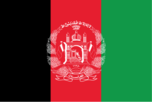
three equal vertical bands of black (hoist), red, and green, with a gold emblem centered on the red band; the emblem features a temple-like structure encircled by a wreath on the left and right and by a bold Islamic inscription above
Government type
Islamic republic
Independence
19 August 1919 (from UK control over Afghan foreign affairs)
International organization participation
AsDB, CP, ECO, FAO, G-77, GUUAM, IAEA, IBRD, ICAO, ICCt, ICRM, IDA, IDB, IFAD, IFC, IFRCS, ILO, IMF, Interpol, IOC, IOM, ITU, MIGA, NAM, NATO, OIC, OPCW, OSCE, SACEP, UN, UNCTAD, UNESCO, UNIDO, UPU, WCO, WFTU, WHO, WMO, WTO (observer), WToO
Judicial branch
the new constitution establishes a nine-member Stera Mahkama or Supreme Court (its nine justices are appointed for 10-year terms by the president with approval of the Wolesi Jirga) and subordinate High Courts and Appeals Courts; there is also a Minister of Justice; a separate Afghan Independent Human Rights Commission established by the Bonn Agreement is charged with investigating human rights abuses and war crimes
Legal system
according to the new constitution, no law should be "contrary to Islam"; the state is obliged to create a prosperous and progressive society based on social justice, protection of human dignity, protection of human rights, realization of democracy, and to ensure national unity and equality among all ethnic groups and tribes; the state shall abide by the UN charter, international treaties, international conventions that Afghanistan signed, and the Universal Declaration of Human Rights
Legislative branch
- nonfunctioning as of January 2004; government is empowered by the constitution to issue legislation by decree until the new assembly is seated; under the new constitution, the bicameral National Assembly will consist of the Wolesi Jirga or House of People (no more than 249 seats), directly elected for a five-year term, and the Meshrano Jirga or House of Elders (102 seats, one third elected from provincial councils for a four-year term, one third elected from local district councils for a three-year term, and one third presidential appointees for a five-year term; the presidential appointees will include two representatives of Kuchis and two representatives of the disabled; half of the presidential appointees will be women)
- issues of independence, national sovereignty, and territorial integrity; it can amend the provisions of the constitution and prosecute the president; it is made up of members of the National Assembly and chairpersons of the provincial and district councils
- elections
- scheduled for spring 2005
- note
- on rare occasions the government may convene the Loya Jirga on
National holiday
Independence Day, 19 August (1919)
Political parties and leaders
note - includes only political parties approved by the Ministry of Justice: Afghan Millat [Anwarul Haq AHADI]; De Afghanistan De Solay Ghorzang Gond [Shahnawaz TANAI]; De Afghanistan De Solay Mili Islami Gond [Shah Mahmood Polal ZAI]; Harakat-e-Islami Afghanistan [Mohammad Asif MOHSINEE]; Hezb-e-Aarman-e-Mardum-e-Afghanistan [Iihaj Saraj-u-din ZAFAREE]; Hezb-e-Aazadee Afghanistan [Abdul MALIK]; Hezb-e-Adalat-e-Islami Afghanistan [Mohammad Kabeer MARZBAN]; Hezb-e-Afghanistan-e-Wahid [Mohammad Wasil RAHEEMEE]; Hezb-e-Afghan Watan Islami Gond [NA leader]; Hezb-e-Congra-e-Mili Afghanistan [Lateef PIDRAM]; Hezb-e-Falah-e-Mardum-e-Afghanistan [Mohammad ZAREEF]; Hezb-e-Libral-e-Aazadee Khwa-e-Mardum-e-Afghanistan [Ajmal SOHAIL]; Hezb-e-Hambastagee Mili Jawanan-e-Afghanistan [Mohammad Jamil KARZAI]; Hezb-e-Hamnbatagee-e-Afghanistan [Abdul Khaleq NEMAT]; Hezb-e-Harakat-e-Mili Wahdat-e-Afghanistan [Moahammad Nadir AATASH]; Hezb-e-Harak-e-Islami Mardum-e-Afghanistan [Ilhaj Said Hssain ANWARY]; Hezb-e-Ifazat Az Uqoq-e-Bashar Wa Inkishaf-e-Afghanistan [Baryalai NASRATEE]; Hezb-e-Istiqlal-e-Afghanistan [Dr. Gh. Farooq NIJZRABEE]; Hezb-e-Jamhoree Khwahan [Sibghatullah SANJAR]; Hezb-e-Kar Wa Tawsiha-e-Afghanistan [Zulfiar OMID]; Hezb-e-Mili Afghanistan [Abdul Rasheed AARYAN]; Hezb-e-Mili Wahdat-e-Aqwam-e-Islami Afghanistan [Mohammad Shah KHOGYANEE]; Hezb-e-Nuhzhat-e-Mili Afghanistan [Ahmad Wali MASOUD]; Hezb-e-Paiwand-e-Mili Afghanistan [Said Mansoor NADIRI]; Hezb-e-Rastakhaiz-e-Islami Mardum-e-Afghanistan [Said ZAHIR]; Hezb-e-Refah-e-Mardum-e-Afghanistan [Mia Gul WASEEQ]; Hezb-e-Risalat-e-Mardum-e-Afghanistan [Noor Aqa ROEEN]; Hezb-e-Sahadat-e-Mardum-e-Afghanistan [Mohammad Zubair PAIROZ]; Hezb-e-Sahadat-e-Mili Wa Islami Afghanistan [Mohammad Usman SALIGZADA]; Hezb-e-Sulh-e-Mili Islami Aqwam-e-Afghanistan [Abdul Qahir SHARYATEE]; Hezb-e-Sulh Wa Wahdat-e-Mili Afghanistan [Abdul Qadir IMAMEE]; Hezb-e-Tafahum-e-Wa Democracy Afghanistan [Ahamad SHAHEEN]; Hezb-e-Wahdat-e-Islami Afghanistan [Mohammad Karim KHALILI]; Hezb-e-Wahdat-e-Islami Mardum-e-Afghanistan [Haji Mohammad MUHAQIQ]; Hezb-e-Wahdat-e-Mili Afghanistan [Abdul Rasheed Jalili]; Jamahat-ul-Dahwat ilal Qurhan-wa-Sunat-ul-Afghanistan [Mawlawee Samiullah NAJEEBEE]; Jombesh-e Milli [Abdul Rashjid DOSTUM]; Mahaz-e-Mili Islami Afghanistan [Said Ahmad GAILANEE]; Majmah-e-Mili Fahaleen-e-Sulh-e-Afghanistan [Shams ul Haq Noor SHAMS]; Nuhzat-e-Aazadee Wa democracy Afghanistan [Abdul Raqeeb Jawid KUHISTANEE]; Nuhzat-e-Hambastagee Mili Afghanistan [Peer Said Ishaq GAILANEE]; Sazman-e-Islami Afghanistan-e-Jawan [Siad Jawad HUSSAINEE]; Tahreek Wahdat-e-Mili [Sultan Mahmood DHAZI] (30 Sep 2004)
Political pressure groups and leaders
Jamiat-e Islami (Society of Islam), [former President Burhanuddin RABBANI]; Ittihad-e Islami (Islamic Union for the Liberation of Afghanistan), [Abdul Rasul SAYYAF]; there are also small monarchist, communist, and democratic groups
Suffrage
18 years of age; universal
Economy
Agriculture - products
opium, wheat, fruits, nuts, wool, mutton, sheepskins, lambskins
Budget
- (2003 plan)
- expenditures
- $550 million, including capital expenditures of NA
- revenues
- $200 million
Currency
afghani (AFA)
Currency code
AFA
Debt - external
$8 billion in bilateral debt, mostly to Russia; Afghanistan has $500 million in debt to Multilateral Development Banks (2004)
Economic aid - recipient
international pledges made by more than 60 countries and international financial institutions at the Tokyo Donors Conference for Afghan reconstruction in January 2002 reached $4.5 billion through 2006, with $1.8 billion allocated for 2002; another $1.7 billion was pledged for 2003.
Economy - overview
Afghanistan's economic outlook has improved significantly over the past two years because of the infusion of over $2 billion in international assistance, dramatic improvements in agricultural production, and the end of a four-year drought in most of the country. However, Afghanistan remains extremely poor, landlocked, and highly dependent on foreign aid, farming, and trade with neighboring countries. It will probably take the remainder of the decade and continuing donor aid and attention to raise Afghanistan's living standards up from its current status among the lowest in the world. Much of the population continues to suffer from shortages of housing, clean water, electricity, medical care, and jobs, but the Afghan government and international donors remain committed to improving access to these basic necessities by prioritizing infrastructure development, education, housing development, jobs programs, and economic reform over the next year. Growing political stability and continued international commitment to Afghan reconstruction create an optimistic outlook for maintaining improvements to the Afghan economy in 2004. The replacement of the opium trade - which may account for one-third of GDP - is one of several potential spoilers for the economy over the long term.
Electricity - consumption
511.4 million kWh (2001)
Electricity - exports
0 kWh (2001)
Electricity - imports
200 million kWh (2001)
Electricity - production
334.8 million kWh (2001)
Exchange rates
afghanis per US dollar - 50 (2003), 50 (2002), 3,000 (2001), 3,000 (2000), 3,000 (1999) : note: in 2002, the afghani was revalued and the currency stabilized at about 50 afghanis to the dollar; before 2002, the market rate varied widely from the official rate
Exports
$98 million (not including illicit exports) (2002 est.)
Exports - commodities
opium, fruits and nuts, handwoven carpets, wool, cotton, hides and pelts, precious and semi-precious gems
Exports - partners
US 27%, France 17.5%, India 16.6%, Pakistan 13.3% (2003)
Fiscal year
21 March - 20 March
GDP
purchasing power parity - $20 billion (2003 est.)
GDP - composition by sector
- agriculture
- 60%
- industry
- 20%
- services
- 20% (1990 est.)
GDP - per capita
purchasing power parity - $700 (2003 est.)
GDP - real growth rate
29% (2003 est.) : note: this high growth rate reflects the extremely low levels of activity between 1999 and 2002, as well as the end of a four-year drought and the impact of donor assistance
Household income or consumption by percentage share
- highest 10%
- NA
- lowest 10%
- NA
Imports
$1.007 billion (2002 est.)
Imports - commodities
capital goods, food, textiles, petroleum products
Imports - partners
Pakistan 30.1%, South Korea 9.2%, Japan 7.6%, Germany 6.9%, Turkmenistan 5.4%, Kenya 4.6%, US 4.5%, Russia 4% (2003)
Industrial production growth rate
NA
Industries
small-scale production of textiles, soap, furniture, shoes, fertilizer, cement; handwoven carpets; natural gas, coal, copper
Inflation rate (consumer prices)
5.2% (2003)
Labor force
11.8 million (2001 est.)
Labor force - by occupation
agriculture 80%, industry 10%, services 10% (1990 est.)
Natural gas - consumption
220 million cu m (2001 est.)
Natural gas - exports
0 cu m (2001 est.)
Natural gas - imports
0 cu m (2001 est.)
Natural gas - production
220 million cu m (2001 est.)
Natural gas - proved reserves
49.98 billion cu m (1 January 2002)
Oil - consumption
3,500 bbl/day (2001 est.)
Oil - exports
NA (2001)
Oil - imports
NA (2001)
Oil - production
0 bbl/day (2001 est.)
Oil - proved reserves
0 bbl (1 January 2002)
Population below poverty line
23% (2002)
Unemployment rate
NA (2003)
Communications
Communications - note
in March 2003 'af' was established as Afghanistan's domain name; Internet access is growing through Internet cafes as well as public "telekiosks" in Kabul that are part of a nationwide network proposed by the Transitional Authority for Internet access (2002)
Internet country code
.af
Internet Service Providers (ISPs)
1 (2000)
Internet users
1,000 (2002)
Radio broadcast stations
AM 21, FM 23, shortwave 1 (broadcasts in Pashtu, Afghan Persian (Dari), Urdu, and English) (2003)
Radios
167,000 (1999)
Telephone system
- two mobile phone operators by 2003; telephone main lines remain weak with only .1 line per 10 people
- Herat, Mazar-e-Sharif, Kandahar, and Jalalabad provide international and domestic voice and data connectivity
- domestic
- telephone service is improving with the establishment of
- general assessment
- very limited telephone and telegraph service
- international
- country code - 93; five VSAT's installed in Kabul,
Telephones - main lines in use
33,100 (2002)
Telephones - mobile cellular
15,000 (2002)
Television broadcast stations
at least 10 (one government-run central television station in Kabul and regional stations in nine of the 32 provinces; the regional stations operate on a reduced schedule; also, in 1997, there was a station in Mazar-e Sharif reaching four northern Afghanistan provinces) (1998)
Televisions
100,000 (1999)
Transportation
Airports
47 (2003 est.)
Airports - with paved runways
- 2,438 to 3,047 m: 4
- 1,524 to 2,437 m: 2
- over 3,047 m
- 3
- total
- 10
- under 914 m
- 1 (2004 est.)
Airports - with unpaved runways
- 914 to 1,523 m: 4
- 2,438 to 3,047 m: 7 1,524 to 2,437 m: 14
- over 3,047 m
- 1
- total
- 37
- under 914 m
- 11 (2004 est.)
Heliports
5 (2003 est.)
Highways
- paved
- 2,793 km
- total
- 21,000 km
- unpaved
- 18,207 km (1999 est.)
Pipelines
gas 387 km (2004)
Ports and harbors
Kheyrabad, Shir Khan
Waterways
- 1,200 km
- note
- chiefly Amu Darya, which handles vessels up to 500 DWT (2004)
Military and Security
Military branches
Afghan National Army, currently being trained by the US with the assistance of the international community, is 7,000 strong; note - the December 2001 Bonn Agreement called for all militia forces to come under the authority of the central government, but regional leaders have continued to retain their militias and the formation of a national army remains a gradual process; Afghanistan's militia forces continue to be factionalized, largely along ethnic lines
Military expenditures - dollar figure
$61 million (2003)
Military expenditures - percent of GDP
1% (2003)
Military manpower - availability
- males age 15-49
- 6,785,414 (2004 est.)
Military manpower - fit for military service
- males age 15-49
- 3,642,659 (2004 est.)
Military manpower - military age and obligation
22 years of age (2004 est.)
Military manpower - reaching military age annually
- males
- 263,406 (2004 est.)
Transnational Issues
Disputes - international
despite largely successful UN efforts at voluntary repatriation, 2-3 million Afghan refugees continue to reside in Iran and Pakistan, many at their own choosing; Pakistan has sent troops into remote tribal areas to control the border and stem organized terrorist and other illegal cross-border activites; regular meetings between Pakistani and coalition allies aim to resolve periodic claims of boundary encroachments; occasional conflicts over water-sharing arrangements with Amu Darya and Helmand River states
Illicit drugs
world's largest producer of opium; cultivation of opium poppy reached unprecedented level of 206,700 hectares in 2004; counterdrug efforts largely unsuccessful; potential opium production of 4,950 metric tons; potential heroin production of 582 metric tons if all opium was processed; source of hashish; many narcotics-processing labs throughout the country; drug trade source of instability and some antigovernment groups profit from the trade; 80-90% of the heroin consumed in Europe comes from Afghan opium; vulnerable to narcotics money laundering through informal financial networks This page was last updated on 10 February, 2005 @Akrotiri
Refugees and internally displaced persons
IDPs: 167,000 - 200,000 (mostly Pashtuns and Kuchis displaced in south and west due to drought and instability) (2004)