2003 Edition
CIA World Factbook 2003 (Project Gutenberg)
Introduction
Administrative divisions
32 provinces (velayat, singular - velayat); Badakhshan, Badghis, Baghlan, Balkh, Bamian, Farah, Faryab, Ghazni, Ghowr, Helmand, Herat, Jowzjan, Kabol, Kandahar, Kapisa, Khowst, Konar, Kondoz, Laghman, Lowgar, Nangarhar, Nimruz, Nurestan, Oruzgan, Paktia, Paktika, Parvan, Samangan, Sar-e Pol, Takhar, Vardak, and Zabol
Age structure
0-14 years: 41.8% (male 6,123,971; female 5,868,013) 15-64 years: 55.4% (male 8,240,743; female 7,671,242) 65 years and over: 2.8% (male 427,710; female 385,534) (2003 est.)
Agriculture - products
opium, wheat, fruits, nuts, wool, mutton, sheepskins, lambskins
Airports
47 (2002)
Airports - with paved runways
- over 3,047 m
- 3 2,438 to 3,047 m: 4
- total
- 10
- under 914 m
- 1 (2002) 1,524 to 2,437 m: 2
Airports - with unpaved runways
- over 3,047 m
- 1 2,438 to 3,047 m: 7 1,524 to 2,437 m: 14
- total
- 37
- under 914 m
- 11 (2002) 914 to 1,523 m: 4
Area
- land
- 647,500 sq km
- total
- 647,500 sq km
- water
- 0 sq km
Area - comparative
slightly smaller than Texas
Background
Afghanistan's recent history is characterized by war and civil unrest. The Soviet Union invaded in 1979, but was forced to withdraw 10 years later by anti-Communist mujahidin forces supplied and trained by the US, Saudi Arabia, Pakistan, and others. Fighting subsequently continued among the various mujahidin factions, giving rise to a state of warlordism that eventually spawned the Taliban. Backed by foreign sponsors, the Taliban developed as a political force and eventually seized power. The Taliban were able to capture most of the country, aside from Northern Alliance strongholds primarily in the northeast, until US and allied military action in support of the opposition following the 11 September 2001 terrorist attacks forced the group's downfall. In late 2001, major leaders from the Afghan opposition groups and diaspora met in Bonn, Germany, and agreed on a plan for the formulation of a new government structure that resulted in the inauguration of Hamid KARZAI as Chairman of the Afghan Interim Authority (AIA) on 22 December 2001. The AIA held a nationwide Loya Jirga (Grand Assembly) in June 2002, and KARZAI was elected President by secret ballot of the Transitional Islamic State of Afghanistan (TISA). The Transitional Authority has an 18-month mandate to hold a nationwide Loya Jirga to adopt a constitution and a 24-month mandate to hold nationwide elections. In December 2002, the TISA marked the one-year anniversary of the fall of the Taliban. In addition to occasionally violent political jockeying and ongoing military action to root out remaining terrorists and Taliban elements, the country suffers from enormous poverty, a crumbling infrastructure, and widespread land mines. Geography Afghanistan
Birth rate
40.63 births/1,000 population (2003 est.)
Budget
- expenditures
- $550 million, including capital expenditures of $NA (2003 plan est.)
- revenues
- $200 million
Capital
Kabul
Climate
arid to semiarid; cold winters and hot summers
Coastline
0 km (landlocked)
Constitution
the Bonn Agreement called for a Loya Jirga (Grand Council) to be convened within 18 months of the establishment of the Transitional Authority to draft a new constitution for the country; the basis for the next constitution is the 1964 Constitution, according to the Bonn Agreement
Country name
- conventional long form
- Transitional Islamic State of Afghanistan
- conventional short form
- Afghanistan
- former
- Republic of Afghanistan
- local long form
- Dowlat-e Eslami-ye Afghanestan
- local short form
- Afghanestan
Currency
afghani (AFA)
Currency code
AFA
Death rate
17.15 deaths/1,000 population (2003 est.)
Debt - external
NA (1996 est.)
Diplomatic representation from the US
- chief of mission
- Ambassador Robert Patrick John FINN; note - embassy in Kabul reopened 16 December 2001, following closure in January 1989
- embassy
- Great Masood Road, Kabul
- mailing address
- 6180 Kabul Place, Dulles, VA 20189-6180
- telephone
- [93] (2) 290002, 290005, 290154
Diplomatic representation in the US
- chancery
- 2341 Wyoming Avenue NW, Washington, DC 20008
- chief of mission
- ambassador Seyyed Tayeb JAWAD
Disputes - international
thousands of Afghan refugees still reside in Iran and Pakistan; isolating terrain and close ties among Pashtuns in Pakistan make cross-border activities difficult to control; prolonged regional drought strains water-sharing arrangements for Amu Darya and Helmand River states
Economic aid - recipient
international pledges made by more than 60 countries and international financial institutions at the Tokyo Donors Conference for Afghan reconstruction in January 2002 reached $4.5 billion through 2006, with $1.8 billion allocated for 2002; another $1.7 billion was pledged for 2003.
Economy - overview
Afghanistan is an extremely poor, landlocked country, highly dependent on foreign aid, farming and livestock raising (sheep and goats), and trade with neighboring countries. Economic considerations have played second fiddle to political and military upheavals during more than two decades of war, including the nearly 10-year Soviet military occupation (which ended 15 February 1989). During that conflict, one-third of the population fled the country, with Pakistan and Iran sheltering a combined peak of 4 to 6 million refugees. Gross domestic product has fallen substantially over the past 20 years because of the loss of labor and capital and the disruption of trade and transport; severe drought added to the nation's difficulties in 1998-2002. The majority of the population continues to suffer from insufficient food, clothing, housing, and medical care, and a dearth of jobs, problems exacerbated by political uncertainties and the general level of lawlessness. International efforts to rebuild Afghanistan were addressed at the Tokyo Donors Conference for Afghan Reconstruction in January 2002, when $4.5 billion was pledged, $1.7 billion for 2002. Of that approximately $900 million was directed to humanitarian aid - food, clothing, and shelter - and another $90 million for the Afghan Transitional Authority. Further World Bank and other aid came in 2003. Priority areas for reconstruction include upgrading education, health, and sanitation facilities; providing income generating opportunities; enhancing administrative and security arrangements, especially in regional areas; developing the agricultural sector; rebuilding transportation, energy, and telecommunication infrastructure; and reabsorbing 2 million returning refugees. The replacement of the opium trade - which may account for one-third of GDP - and the search for oil and gas resources in the northern region are two major long-term issues.
Electricity - consumption
511.4 million kWh (2001)
Electricity - exports
0 kWh (2001)
Electricity - imports
200 million kWh (2001)
Electricity - production
334.8 million kWh (2001)
Electricity - production by source
- fossil fuel
- 36.3%
- hydro
- 63.7%
- nuclear
- 0%
- other
- 0% (2001)
Elevation extremes
- highest point
- Nowshak 7,485 m
- lowest point
- Amu Darya 258 m
Environment - current issues
limited natural fresh water resources; inadequate supplies of potable water; soil degradation; overgrazing; deforestation (much of the remaining forests are being cut down for fuel and building materials); desertification; air and water pollution
Environment - international agreements
- party to
- Desertification, Endangered Species, Environmental Modification, Marine Dumping, Nuclear Test Ban
- signed, but not ratified
- Biodiversity, Climate Change, Hazardous Wastes, Law of the Sea, Marine Life Conservation
Ethnic groups
Pashtun 44%, Tajik 25%, Hazara 10%, minor ethnic groups (Aimaks, Turkmen, Baloch, and others) 13%, Uzbek 8%
Exchange rates
afghanis per US dollar - 3,000 (October-December 2002), 3,000 (2001), 3,000 (2000), 3,000 (1999), 3,000 (1998), note: before 2002 the market rate varied widely from the official rate; in 2002 the afghani was revalued and the currency stabilized
Executive branch
- cabinet
- the 30-member TISA
- chief of state
- President of the TISA, Hamid KARZAI (since 10 June 2002); note - presently the president and head of government
- elections
- nationwide elections are to be held by June 2004, according to the Bonn Agreement
- head of government
- President of the TISA, Hamid KARZAI (since 10 June 2002); note - presently the president and head of government
- note
- following the Taliban's refusal to hand over Usama bin LADIN to the US for his suspected involvement in the 11 September 2001 terrorist attacks in the US, a US-led international coalition was formed; after several weeks of aerial bombardment by coalition forces and military action on the ground, including Afghan opposition forces, the Taliban was ousted from power on 17 November 2001; in December 2001, a number of prominent Afghans met under UN auspices in Bonn, Germany, to decide on a plan for governing the country; as a result, the Afghan Interim Authority (AIA) - made up of 30 members, headed by a chairman - was inaugurated on 22 December 2001 with a six-month mandate to be followed by a two-year Transitional Authority (TA), after which elections are to be held; the structure of the follow-on TA was announced on 10 June 2002, when the Loya Jirga (Grand Assembly) convened establishing the Transitional Islamic State of Afghanistan (TISA), which has 18 months to hold a Loya Jirga to adopt a constitution and 24 months to hold nationwide elections
Exports
$1.2 billion (not including illicit exports) (2001 est.)
Exports - commodities
opium, fruits and nuts, handwoven carpets, wool, cotton, hides and pelts, precious and semi-precious gems
Exports - partners
Pakistan 26.8%, India 26.5%, Finland 5.8%, Germany 5.1%, UAE 4.4%, Belgium 4.3%, Russia 4.2%, US 4.2% (2002)
FAX
- 202-483-6487
- 00932290153
- consulate(s) general
- New York
- telephone
- 202-483-6410
Fiscal year
21 March - 20 March Communications Afghanistan
Flag description
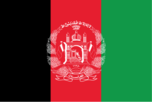
three equal vertical bands of black (hoist), red, and green, with a gold emblem centered on the red band; the emblem features a temple-like structure encircled by a wreath on the left and right and by a bold Islamic inscription above Economy Afghanistan
GDP
purchasing power parity - $19 billion (2002 est.)
GDP - composition by sector
- agriculture
- 60%
- industry
- 20%
- services
- 20% (1990 est.)
GDP - per capita
purchasing power parity - $700 (2002 est.)
GDP - real growth rate
NA%
Geographic coordinates
33 00 N, 65 00 E
Geography - note
landlocked; the Hindu Kush mountains that run northeast to southwest divide the northern provinces from the rest of the country; the highest peaks are in the northern Vakhan (Wakhan Corridor) People Afghanistan
Government type
transitional
Heliports
5 (2002) Military Afghanistan
Highways
- paved
- 2,793 km
- total
- 21,000 km
- unpaved
- 18,207 km (1999 est.)
HIV/AIDS - adult prevalence rate
0.01% (2001 est.)
HIV/AIDS - deaths
NA
HIV/AIDS - people living with HIV/AIDS
NA
Household income or consumption by percentage share
- highest 10%
- NA%
- lowest 10%
- NA%
Illicit drugs
world's largest producer of opium; cultivation of opium poppy - used to make heroin - expanded to 30,750 hectares in 2002, despite eradication; potential opium production of 1,278 metric tons; source of hashish; many narcotics-processing labs throughout the country; drug trade source of instability and some government groups profit from the trade; 80-90% of the heroin consumed in Europe comes from Afghan opium; vulnerable to narcotics money laundering through the hawala system This page was last updated on 18 December, 2003
Imports
$1.3 billion (2001 est.)
Imports - commodities
capital goods, food, textiles, petroleum products
Imports - partners
Pakistan 25.1%, South Korea 14.4%, Japan 9.4%, US 9%, Kenya 5.8%, Germany 5.4% (2002)
Independence
19 August 1919 (from UK control over Afghan foreign affairs)
Industrial production growth rate
NA%
Industries
small-scale production of textiles, soap, furniture, shoes, fertilizer, cement; handwoven carpets; natural gas, coal, copper
Infant mortality rate
- female
- 138.8 deaths/1,000 live births (2003 est.)
- male
- 145.99 deaths/1,000 live births
- total
- 142.48 deaths/1,000 live births
Inflation rate (consumer prices)
NA%
International organization participation
AsDB, CP, ECO, ESCAP, FAO, G-77, GUUAM, IAEA, IBRD, ICAO, ICCt, ICRM, IDA, IDB, IFAD, IFC, IFRCS, ILO, IMF, Interpol, IOM (observer), ITU, NAM, OIC, OPCW (signatory), UN, UNCTAD, UNESCO, UNIDO, UPU, WFTU, WHO, WMO, WToO
Internet country code
.af
Internet Service Providers (ISPs)
1 (2000)
Internet users
NA Transportation Afghanistan
Irrigated land
23,860 sq km (1998 est.)
Judicial branch
the Bonn Agreement called for the establishment of a Supreme Court; there is also a Minister of Justice
Labor force
10 million (2000 est.)
Labor force - by occupation
agriculture 80%, industry 10%, services 10% (1990 est.)
Land boundaries
- border countries
- China 76 km, Iran 936 km, Pakistan 2,430 km, Tajikistan 1,206 km, Turkmenistan 744 km, Uzbekistan 137 km
- total
- 5,529 km
Land use
- arable land
- 12.13%
- other
- 87.65% (1998 est.)
- permanent crops
- 0.22%
Languages
Pashtu 35%, Afghan Persian (Dari) 50%, Turkic languages (primarily Uzbek and Turkmen) 11%, 30 minor languages (primarily Balochi and Pashai) 4%, much bilingualism
Legal system
the Bonn Agreement calls for a judicial commission to rebuild the justice system in accordance with Islamic principles, international standards, the rule of law, and Afghan legal traditions
Legislative branch
nonfunctioning as of June 1993
Life expectancy at birth
- female
- 46.23 years (2003 est.)
- male
- 47.67 years
- total population
- 46.97 years
Literacy
- definition
- age 15 and over can read and write
- female
- 21% (1999 est.)
- male
- 51%
- total population
- 36%
Location
Southern Asia, north and west of Pakistan, east of Iran
Map references
Asia
Maritime claims
none (landlocked)
Median age
- female
- 18.7 years (2002)
- male
- 19.1 years
- total
- 18.9 years
Military branches
NA; note - the December 2001 Bonn Agreement called for all militia forces to come under the authority of the central government, but regional leaders have continued to retain their militias and the formation of a nation army will be a gradual process; Afghanistan's forces continue to be factionalized, largely along ethnic lines
Military expenditures - dollar figure
$525.2 million (FY02)
Military expenditures - percent of GDP
7.7% (FY02) Transnational Issues Afghanistan
Military manpower - availability
- males age 15-49
- 7,160,603 (2003 est.)
Military manpower - fit for military service
- males age 15-49
- 3,837,646 (2003 est.)
Military manpower - military age
22 years of age (2003 est.)
Military manpower - reaching military age annually
- males
- 275,223 (2003 est.)
National holiday
Independence Day, 19 August (1919)
Nationality
- adjective
- Afghan
- noun
- Afghan(s)
Natural gas - consumption
220 million cu m (2001 est.)
Natural gas - exports
0 cu m (2001 est.)
Natural gas - imports
0 cu m (2001 est.)
Natural gas - production
220 million cu m (2001 est.)
Natural gas - proved reserves
49.98 billion cu m (37257)
Natural hazards
damaging earthquakes occur in Hindu Kush mountains; flooding; droughts
Natural resources
natural gas, petroleum, coal, copper, chromite, talc, barites, sulfur, lead, zinc, iron ore, salt, precious and semiprecious stones
Net migration rate
10.32 migrant(s)/1,000 population (2003 est.)
Oil - consumption
3,500 bbl/day (2001 est.)
Oil - exports
NA (2001)
Oil - imports
NA (2001)
Oil - production
0 bbl/day (2001 est.)
Oil - proved reserves
0 bbl (37257)
People - note
large numbers of Afghan refugees create burdens on neighboring states Government Afghanistan
Pipelines
gas 651 km (2003)
Political parties and leaders
NA; note - political parties in Afghanistan are in flux and many prominent players have plans to create new parties; the Transitional Islamic State of Afghanistan (TISA) is headed by President Hamid KARZAI; the TISA is a coalition government formed of leaders from across the Afghan political spectrum; there are also several political factions not holding positions in the Transitional government that are forming new groups and parties in the hopes of participating in 2004 elections
Political pressure groups and leaders
NA; note - ministries formed under the Transitional Islamic State of Afghanistan (TISA) include former influential Afghans, diaspora members, and former political leaders
Population
28,717,213 (July 2003 est.)
Population below poverty line
NA%
Population growth rate
- 3.38%
- note
- this rate does not take into consideration the recent war and its continuing impact (2003 est.)
Ports and harbors
Kheyrabad, Shir Khan
Radio broadcast stations
AM 7 (6 are inactive; the active station is in Kabul), FM 1, shortwave 1 (broadcasts in Pashtu, Afghan Persian (Dari), Urdu, and English) (1999)
Radios
167,000 (1999)
Railways
- broad gauge
- 9.6 km 1.524-m gauge from Gushgy (Turkmenistan) to Towraghondi; 15 km 1.524-m gauge from Termiz (Uzbekistan) to Kheyrabad transshipment point on south bank of Amu Darya (2001)
- total
- 24.6 km
Religions
Sunni Muslim 84%, Shi'a Muslim 15%, other 1%
Sex ratio
- at birth
- 1.05 male(s)/female
- total population
- 1.06 male(s)/female (2003 est.)
- under 15 years
- 1.04 male(s)/female 15-64 years: 1.07 male(s)/female 65 years and over: 1.11 male(s)/female
Suffrage
NA; previously males 15-50 years of age
Telephone system
- domestic
- in 1997, telecommunications links were established between Mazar-e Sharif, Herat, Kandahar, Jalalabad, and Kabul through satellite and microwave systems
- general assessment
- very limited telephone and telegraph service
- international
- satellite earth stations - 1 Intelsat (Indian Ocean) linked only to Iran and 1 Intersputnik (Atlantic Ocean region); commercial satellite telephone center in Ghazni
Telephones - main lines in use
29,000 (1998)
Telephones - mobile cellular
NA
Television broadcast stations
at least 10 (one government-run central television station in Kabul and regional stations in nine of the 32 provinces; the regional stations operate on a reduced schedule; also, in 1997, there was a station in Mazar-e Sharif reaching four northern Afghanistan provinces) (1998)
Televisions
100,000 (1999)
Terrain
mostly rugged mountains; plains in north and southwest
Total fertility rate
5.64 children born/woman (2003 est.)
Unemployment rate
NA%
Waterways
- 1,200 km
- note
- chiefly Amu Darya, which handles vessels up to 500 DWT (2001)