2002 Edition
CIA World Factbook 2002 (Project Gutenberg)
Introduction
Background
Afghanistan's recent history is characterized by war and civil strife, with intermittent periods of relative calm and stability. The Soviet Union invaded in 1979 but was forced to withdraw 10 years later by anti-Communist mujahidin forces supplied and trained by the US, Saudi Arabia, Pakistan, and others. Fighting subsequently continued among the various mujahidin factions, giving rise to a state of warlordism that spawned the Taliban in the early 1990s. The Taliban was able to seize most of the country, aside from Northern Alliance strongholds primarily in the northeast, until US and allied military action in support of the opposition following the 11 September 2001 terrorist attacks forced the group's downfall. The four largest Afghan opposition groups met in Bonn, Germany, in late 2001 and agreed on a plan for the formulation of a new government structure that resulted in the inauguration of Hamid KARZAI as Chairman of the Afghan Interim Authority (AIA) on 22 December 2001. In addition to occasionally violent political jockeying and ongoing military action to root out remaining terrorists and Taliban elements, the country suffers from enormous poverty, a crumbling infrastructure, and widespread land mines.
Geography
Area
total: 647,500 sq km water: 0 sq km land: 647,500 sq km
Area - comparative
slightly smaller than Texas
Climate
arid to semiarid; cold winters and hot summers
Coastline
0 km (landlocked)
Elevation extremes
lowest point: Amu Darya 258 m highest point: Nowshak 7,485 m
Environment - current issues
limited natural fresh water resources; inadequate supplies of potable water; soil degradation; overgrazing; deforestation (much of the remaining forests are being cut down for fuel and building materials); desertification; air and water pollution
Environment - international agreements
party to: Desertification, Endangered Species, Environmental Modification, Marine Dumping, Nuclear Test Ban signed, but not ratified: Biodiversity, Climate Change, Hazardous Wastes, Law of the Sea, Marine Life Conservation
Geographic coordinates
33 00 N, 65 00 E
Geography - note
landlocked; the Hindu Kush mountains that run northeast to southwest divide the northern provinces from the rest of the country; the highest peaks are in the northern Vakhan (Wakhan Corridor)
Irrigated land
23,860 sq km (1998 est.)
Land boundaries
total: 5,529 km border countries: China 76 km, Iran 936 km, Pakistan 2,430 km, Tajikistan 1,206 km, Turkmenistan 744 km, Uzbekistan 137 km
Land use
arable land: 12% permanent crops: 0% other: 88% (1998 est.)
Location
Southern Asia, north and west of Pakistan, east of Iran
Map references
Asia
Maritime claims
none (landlocked)
Natural hazards
damaging earthquakes occur in Hindu Kush mountains; flooding; droughts
Natural resources
natural gas, petroleum, coal, copper, chromite, talc, barites, sulfur, lead, zinc, iron ore, salt, precious and semiprecious stones
Terrain
mostly rugged mountains; plains in north and southwest
People and Society
Age structure
0-14 years: 42% (male 5,953,291; female 5,706,542) 15-64 years: 55.2% (male 7,935,101; female 7,382,101) 65 years and over: 2.8% (male 410,278; female 368,462) (2002 est.)
Birth rate
41.03 births/1,000 population (2002 est.)
Death rate
17.43 deaths/1,000 population (2002 est.)
Ethnic groups
Pashtun 44%, Tajik 25%, Hazara 10%, minor ethnic groups (Aimaks, Turkmen, Baloch, and others) 13%, Uzbek 8%
HIV/AIDS - adult prevalence rate
less than 0.01% (1999 est.)
HIV/AIDS - deaths
NA
HIV/AIDS - people living with HIV/AIDS
NA
Infant mortality rate
144.76 deaths/1,000 live births (2002 est.)
Languages
Pashtu 35%, Afghan Persian (Dari) 50%, Turkic languages (primarily Uzbek and Turkmen) 11%, 30 minor languages (primarily Balochi and Pashai) 4%, much bilingualism
Life expectancy at birth
45.85 years (2002 est.) male: Total fertility rate: 5.72 children born/woman (2002 est.)
Literacy
definition: age 15 and over can read and write male: 51% female: 21% (1999 est.) total population: 36%
Nationality
noun: Afghan(s) adjective: Afghan
Net migration rate
10.7 migrant(s)/1,000 population (2002 est.)
People - note
large numbers of Afghan refugees create burdens on neighboring states
Population
27,755,775 (July 2002 est.)
Population growth rate
3.43% note: this rate reflects the continued return of refugees from Iran (2002 est.)
Religions
Sunni Muslim 84%, Shi'a Muslim 15%, other 1%
Sex ratio
at birth: 1.05 male(s)/female under 15 years: 1.04 male(s)/female 15-64 years: 1.07 male(s)/female 65 years and over: 1.11 male(s)/female total population: 1.06 male(s)/female (2002 est.)
Government
Administrative divisions
32 provinces (velayat, singular - velayat); Badakhshan, Badghis, Baghlan, Balkh, Bamian, Farah, Faryab, Ghazni, Ghowr, Helmand, Herat, Jowzjan, Kabol, Kandahar, Kapisa, Konar, Kondoz, Laghman, Lowgar, Nangarhar, Nimruz, Oruzgan, Paktia, Paktika, Parvan, Samangan, Sar-e Pol, Takhar, Vardak, Zabol, Nurestan, and Khowst
Capital
Kabul
Constitution
the Bonn Agreement calls for a Constitutional Loya Jirga (Grand Council) to be convened within 18 months of the establishment of the Transitional Authority to draft a new constitution for the country; the basis for the next constitution is the 1963/64 Constitution, according to the Bonn Agreement
Country name
conventional long form: Islamic State of Afghanistan conventional short form: Afghanistan local short form: Afghanestan former: Republic of Afghanistan local long form: Dowlat-e Eslami-ye Afghanestan
Diplomatic representation from the US
chief of mission: Ambassador Robert Patrick John FINN; note - embassy in Kabul reopened 16 December 2001 following closure in January 1989 embassy: FAX: NA
Diplomatic representation in the US
ambassador Ishaq SHAHRYAR (as of 19 June 2002) chancery: consulate(s) general: New York telephone: 202-483-6410
Executive branch
note: following the Taliban's refusal to hand over Usama bin LADIN to the US for his suspected involvement in the 11 September 2001 terrorist attacks in the US, a US-led international coalition was formed; after several weeks of aerial bombardment by coalition forces and military action on the ground, including Afghan opposition forces, the Taliban was ousted from power on 17 November 2001; in December 2001 a number of prominent Afghans met under UN auspices in Bonn, Germany, to decide on a plan for governing the country; as a result, the Afghan Interim Authority (AIA) - made up of 30 members, headed by a chairman and five deputy chairmen - was inaugurated on 22 December 2001 with about a six-month mandate to be followed by a two-year Transitional Authority (TA) after which elections are to be held; the structure of the follow-on TA will be announced on 10 June 2002 when the Loya Jirga (grand assembly) is convened chief of state: Chairman of the AIA, Hamad KARZAI (since 22 December 2001); note - presently the chairman is both chief of state and head of government head of government: Chairman of the AIA, Hamad KARZAI (since 22 December 2001); note - presently the chairman is both chief of state and head of government cabinet: the 30-member AIA elections: NA
Flag description
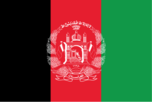
three equal vertical bands of black (hoist), red, and green with a gold emblem centered on the red band; the emblem features a temple-like structure encircled by a wreath on the left and right and by a bold Islamic inscription above
Government type
transitional
Independence
19 August 1919 (from UK control over Afghan foreign affairs)
International organization participation
AsDB, CP, ECO, ESCAP, FAO, G-77, IAEA, IBRD, ICAO, ICRM, IDA, IDB, IFAD, IFC, IFRCS, ILO, IMF, IOC (suspended), IOM (observer), ITU, NAM, OIC, OPCW (signatory), UN, UNCTAD, UNESCO, UNIDO, UPU, WFTU, WHO, WMO, WToO
Judicial branch
the Bonn Agreement calls for the establishment of a Supreme Court
Legal system
the Bonn Agreement calls for a judicial commission to rebuild the justice system in accordance with Islamic principles, international standards, the rule of law, and Afghan legal traditions
Legislative branch
nonfunctioning as of June 1993
National holiday
Independence Day, 19 August (1919)
Political parties and leaders
NA; note - political parties in Afghanistan are in flux and many prominent players have plans to create new parties; the three main groups represented in the Afghan Interim Authority (AIA) are: the Northern Alliance (also known as the United Islamic Front for the Salvation of Afghanistan) - the main opposition to the Taliban - composed of different ethnic and political groups; the Rome Group, associated with the former king of Afghanistan, composed mainly of expatriate Afghans; and the Peshawar Group, another expatriate group; there are also several "independent" groups
Political pressure groups and leaders
NA; note - ministries formed under the Afghan Interim Authority(AIA) include former pressure group leaders
Suffrage
NA; previously males 15-50 years of age
Economy
Agriculture - products
wheat, fruits, nuts, wool, mutton, sheepskin, and lambskin
Budget
revenues: $NA expenditures: $NA, including capital expenditures of $NA
Currency
afghani (AFA)
Currency code
AFA
Debt - external
$5.5 billion (1996 est.)
Economic aid - recipient
international pledges made by more than 60 countries and international financial institutions at the Tokyo Donors Conference for Afghan reconstruction in January 2002 reached $4.5 billion through 2006, with $1.8 billion allocated for 2002; according to a joint preliminary assessment conducted by the World Bank, the Asian Development Bank, and the UN Development Program, rebuilding Afghanistan will cost roughly $15 billion over the next ten years
Electricity - consumption
453.75 million kWh (2000)
Electricity - exports
0 kWh (2000)
Electricity - imports
105 million kWh (2000)
Electricity - production
375 million kWh (2000)
Electricity - production by source
fossil fuel: 36% hydro: 64% other: 0% (2000) nuclear: 0%
Exchange rates
afghanis per US dollar - 4,700 (January 2000), 4,750 (February 1999), 17,000 (December 1996), 7,000 (January 1995), 1,900 (January 1994), 1,019 (March 1993), 850 (1991); note - these rates reflect the free market exchange rates rather than the official exchange rate, which was fixed at 50.600 afghanis to the dollar until 1996, when it rose to 2,262.65 per dollar, and finally became fixed again at 3,000.00 per dollar in April 1996
Exports
$1.2 billion (2001 est.)
Exports - commodities
opium, fruits and nuts, handwoven carpets, wool, cotton, hides and pelts, precious and semi-precious gems
Exports - partners
Pakistan 32%, India 8%, Belgium 7%, Germany 5%, Russia 5%, UAE 4% (1999)
Fiscal year
21 March - 20 March
GDP
purchasing power parity - $21 billion (2000 est.)
GDP - composition by sector
agriculture: 60% industry: 20% services: 20% (1990 est.)
GDP - per capita
purchasing power parity - $800 (2000 est.)
GDP - real growth rate
NA%
Household income or consumption by percentage share
lowest 10%: NA% highest 10%: NA%
Imports
$1.3 billion (2001 est.)
Imports - commodities
capital goods, food and petroleum products; most consumer goods
Imports - partners
Pakistan 19%, Japan 16%, Kenya 9%, South Korea 7%, India 6%, Turkmenistan 6% (1999)
Industries
small-scale production of textiles, soap, furniture, shoes, fertilizer, and cement; handwoven carpets; natural gas, coal, copper
Inflation rate (consumer prices)
NA%
Labor force
10 million (2000 est.)
Labor force - by occupation
agriculture 80%, industry 10%, services 10% (1990 est.)
Population below poverty line
NA%
Unemployment rate
NA%
Communications
Internet country code
.af
Internet Service Providers (ISPs)
1 (2000)
Internet users
NA
Radio broadcast stations
AM 7 (6 are inactive; the active station is in Kabul), FM 1, shortwave 1 (broadcasts in Pashtu, Afghan Persian (Dari), Urdu, and English) (1999)
Radios
167,000 (1999)
Telephone system
very limited telephone and telegraph service domestic: Herat, Kandahar, Jalalabad, and Kabul through satellite and microwave systems international: satellite earth stations - 1 Intelsat (Indian Ocean) linked only to Iran and 1 Intersputnik (Atlantic Ocean region); commercial satellite telephone center in Ghazni
Telephones - main lines in use
29,000 (1998)
Telephones - mobile cellular
NA
Television broadcast stations
at least 10 (one government-run central television station in Kabul and regional stations in nine of the 32 provinces; the regional stations operate on a reduced schedule; also, in 1997, there was a station in Mazar-e Sharif reaching four northern Afghanistan provinces) (1998)
Televisions
100,000 (1999)
Transportation
Airports
46 (2001)
Airports - with paved runways
total: 10 over 3,047 m: 3 2,438 to 3,047 m: 4 under 914 m: 1 (2001) 1,524 to 2,437 m: 2
Airports - with unpaved runways
7 1,524 to 2,437 m: Heliports: 2 (2001)
Highways
total: 21,000 km paved: 2,793 km unpaved: 18,207 km (1998 est.)
Pipelines
natural gas 180 km note: product pipelines from Uzbekistan and Turkmenistan have been in disrepair and disuse for years (2002)
Ports and harbors
Kheyrabad, Shir Khan
Railways
total: 24.6 km broad gauge: 9.6 km 1.524-m gauge from Gushgy (Turkmenistan) to Towraghondi; 15 km 1.524-m gauge from Termiz (Uzbekistan) to Kheyrabad transshipment point on south bank of Amu Darya (2001)
Waterways
1,200 km note: chiefly Amu Darya, which handles vessels up to 500 DWT (2001)
Military and Security
Military branches
NA; note - the December 2001 Bonn Agreement calls for all militia forces to come under Afghan Interim Authority (AIA) control, but formation of a national army is likely to be a gradual process; Afghanistan's forces continue to be factionalized largely along ethnic lines
Military expenditures - dollar figure
$NA
Military expenditures - percent of GDP
NA%
Military manpower - availability
males age 15-49: 6,896,623 (2002 est.)
Military manpower - fit for military service
males age 15-49: 3,696,379 (2002 est.)
Military manpower - military age
22 years of age (2002 est.)
Military manpower - reaching military age annually
males: 252,869 (2002 est.)
Transnational Issues
Disputes - international
close ties with Pashtuns in Pakistan make long border difficult to control
Illicit drugs
poppy ban cut 2001 cultivation by 97% to 1,695 hectares, with potential production of 74 tons of opium; a major source of hashish; many heroin-processing laboratories throughout the country; major political factions in the country profit from the drug trade This page was last updated on 1 January 2002 Algeria