1996 Edition
CIA World Factbook 1996 (Project Gutenberg)
Introduction
Description
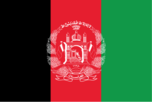
three equal horizontal bands of green (top), white, and black with a gold emblem centered on the three bands; the emblem features a temple-like structure with Islamic inscriptions above and below, encircled by a wreath on the left and right and by a bolder Islamic inscription above, all of which are encircled by two crossed scimitars
Location
33 00 N, 65 00 E -- Southern Asia, north of Pakistan Flag ----
Geography
Area
- comparative area
- slightly smaller than Texas
- land area
- 647,500 sq km
- total area
- 647,500 sq km
Climate
arid to semiarid; cold winters and hot summers
Coastline
0 km (landlocked)
Environment
- current issues
- soil degradation; overgrazing; deforestation (much of the remaining forests are being cut down for fuel and building materials); desertification
- international agreements
- party to - Endangered Species, Environmental Modification, Marine Dumping, Nuclear Test Ban; signed, but not ratified - Biodiversity, Climate Change, Desertification, Hazardous Wastes, Law of the Sea, Marine Life Conservation
- natural hazards
- damaging earthquakes occur in Hindu Kush mountains; flooding
Geographic coordinates
33 00 N, 65 00 E
Geographic note
landlocked
International disputes
periodic disputes with Iran over Helmand water rights; Iran supports clients in country, private Pakistani and Saudi sources also are active; power struggles among various groups for control of Kabul, regional rivalries among emerging warlords, traditional tribal disputes continue; support to Islamic fighters in Tajikistan's civil war; border dispute with Pakistan (Durand Line); support to Islamic militants worldwide by some factions
Irrigated land
26,600 sq km (1989 est.)
Land boundaries
- border countries
- China 76 km, Iran 936 km, Pakistan 2,430 km, Tajikistan 1,206 km, Turkmenistan 744 km, Uzbekistan 137 km
- total
- 5,529 km
Land use
- arable land
- 12%
- forest and woodland
- 3%
- meadows and pastures
- 46%
- other
- 39%
- permanent crops
- 0%
Location
Southern Asia, north of Pakistan
Map references
Asia
Maritime claims
none (landlocked)
Natural resources
natural gas, petroleum, coal, copper, talc, barites, sulfur, lead, zinc, iron ore, salt, precious and semiprecious stones
Terrain
- mostly rugged mountains; plains in north and southwest
- highest point
- Nowshak 7,485 m
- lowest point
- Amu Darya 258 m
People and Society
Age structure
0-14 years: 43% (male 4,972,469; female 4,784,900) 15-64 years: 54% (male 6,377,231; female 5,916,954) 65 years and over: 3% (male 325,808; female 286,774) (July 1996 est.)
Birth rate
43.03 births/1,000 population (1996 est.)
Death rate
18.16 deaths/1,000 population (1996 est.)
Ethnic divisions
Pashtun 38%, Tajik 25%, Uzbek 6%, Hazara 19%, minor ethnic groups (Chahar Aimaks, Turkmen, Baloch, and others)
Infant mortality rate
149.7 deaths/1,000 live births (1996 est.)
Languages
Pashtu 35%, Afghan Persian (Dari) 50%, Turkic languages (primarily Uzbek and Turkmen) 11%, 30 minor languages (primarily Balochi and Pashai) 4%, much bilingualism
Life expectancy at birth
- female
- 45.24 years (1996 est.)
- male
- 46.43 years
- total population
- 45.85 years
Literacy
- age 15 and over can read and write (1995 est.)
- female
- 15%
- male
- 47.2%
- total population
- 31.5%
Nationality
- adjective
- Afghan
- noun
- Afghan(s)
Net migration rate
22.94 migrant(s)/1,000 population (1996 est.)
Population
22,664,136 (July 1996 est.)
Population growth rate
4.78% (1996 est.)
Religions
Sunni Muslim 84%, Shi'a Muslim 15%, other 1%
Sex ratio
- all ages
- 1.06 male(s)/female (1996 est.)
- at birth
- 1.05 male(s)/female
- under 15 years
- 1.04 male(s)/female 15-64 years: 1.08 male(s)/female 65 years and over: 1.14 male(s)/female
Total fertility rate
6.14 children born/woman (1996 est.)
Government
Administrative divisions
- 30 provinces (velayat, singular - velayat); Badakhshan, Badghis, Baghlan, Balkh, Bamian, Farah, Faryab, Ghazni, Ghowr, Helmand, Herat, Jowzjan, Kabol, Kandahar, Kapisa, Konar, Kondoz, Laghman, Lowgar, Nangarhar, Nimruz, Oruzgan, Paktia, Paktika, Parvan, Samangan, Sar-e Pol, Takhar, Vardak, Zabol
- note
- there may be two new provinces of Nurestan (Nuristan) and Khowst
Capital
Kabul
Constitution
none
Data code
AF
Diplomatic representation in US
- chancery
- 2341 Wyoming Avenue NW, Washington, DC 20008
- chief of mission
- Ambassador (vacant); Charge d'Affaires Abdul RAHIM
- telephone
- [1] (202) 234-3770, 3771
Executive branch
- cabinet
- Council of Ministers; note - term of present government expired 28 December 1994; factional fighting since 1 January 1994 has kept government officers from actually occupying ministries and discharging government responsibilities; the government's authority to remove cabinet members, including the prime minister, following the expiration of their term is questionable
- chief of state
- President Burhanuddin RABBANI (interim president July-December 1992, president since 2 January 1993) was elected to a two-year term (later amended by multi-party agreement to 18 months) by a national shura (council); election last held 31 December 1992 (next to be held NA); results - percent of vote NA; Vice President Mohammad NABI MOHAMMADI (since NA) was appointed by the president; note - in June 1994 failure to agree on a transfer mechanism resulted in RABBANI's extending his term to 28 December 1994; following the expiration of the term and while negotiations on the formation of a new government go on, RABBANI continues in office
- head of government
- Prime Minister Ahmad Shah AHMADZAI (since NA) was appointed by President RABBANI as de facto prime minister, but does not have any real authority; First Deputy Prime Minister Qutbuddin HELAL (since 17 March 1993) and Deputy Prime Minister Arsala RAHMANI (since 17 March 1993)
FAX
- [1] (202) 328-3516
- consulate(s)
- Washington, DC
- consulate(s) general
- New York
Flag
three equal horizontal bands of green (top), white, and black with a gold emblem centered on the three bands; the emblem features a temple-like structure with Islamic inscriptions above and below, encircled by a wreath on the left and right and by a bolder Islamic inscription above, all of which are encircled by two crossed scimitars
Independence
19 August 1919 (from UK)
International organization participation
AsDB, CP, ECO, ESCAP, FAO, G-77, IAEA, IBRD, ICAO, ICRM, IDA, IDB, IFAD, IFC, IFRCS, ILO, IMF, Intelsat, IOC, IOM (observer), ITU, NAM, OIC, UN, UNCTAD, UNESCO, UNIDO, UPU, WFTU, WHO, WMO, WToO
Judicial branch
an interim Chief Justice of the Supreme Court has been appointed by the president in consultation with the prime minister, but a new court system has not yet been organized
Legal system
a new legal system has not been adopted but the transitional government has declared it will follow Islamic law (Shari'a)
Legislative branch
a unicameral parliament consisting of 205 members was chosen by a national shura (council) in January 1993; non-functioning as of June 1993
Name of country
- conventional long form
- Islamic State of Afghanistan
- conventional short form
- Afghanistan
- former
- Republic of Afghanistan
- local long form
- Dowlat-e Eslami-ye Afghanestan
- local short form
- Afghanestan
National holiday
Victory of the Muslim Nation, 28 April; Remembrance Day for Martyrs and Disabled, 4 May; Independence Day, 19 August
Other political or pressure groups
the former resistance commanders are the major power brokers in the countryside and their shuras (councils) are now administering most cities outside Kabul; tribal elders and religious students are trying to wrest control from them; ulema (religious scholars); tribal elders; religious students (talib)
Political parties and leaders
- current political organizations include Jamiat-i-Islami (Islamic Society), Burhanuddin RABBANI, Ahmad Shah MASOOD; Hizbi Islami-Gulbuddin (Islamic Party), Gulbuddin HIKMATYAR faction; Hizbi Islami-Khalis (Islamic Party), Yunis KHALIS faction; Ittihad-i-Islami Barai Azadi Afghanistan (Islamic Union for the Liberation of Afghanistan), Abdul Rasul SAYYAF; Harakat-Inqilab-i-Islami (Islamic Revolutionary Movement), Mohammad Nabi MOHAMMADI; Jabha-i-Najat-i-Milli Afghanistan (Afghanistan National Liberation Front), Sibghatullah MOJADDEDI; Mahaz-i-Milli-Islami (National Islamic Front), Sayed Ahamad GAILANI; Hizbi Wahdat-Khalili faction (Islamic Unity Party), Abdul Karim KHALILI; Hizbi Wahdat-Akbari faction (Islamic Unity Party), Mohammad Akbar AKBARI; Harakat-i-Islami (Islamic Movement), Mohammed Asif MOHSENI; Jumbesh-i-Milli Islami (National Islamic Movement), Abdul Rashid DOSTAM; Taliban (Religious Students Movement), Mohammad OMAR
- note
- the former ruling Watan Party has been disbanded
Suffrage
undetermined; previously males 15-50 years of age
Type of government
transitional government
US diplomatic representation
the US does not have an embassy in Afghanistan (embassy closed January 1989)
Economy
Agriculture
wheat, fruits, nuts, karakul pelts; wool, mutton
Budget
- expenditures
- $NA, including capital expenditures of $NA
- revenues
- $NA
Currency
1 afghani (AF) = 100 puls
Economic aid
- note
- US provided $450 million assistance (1985-93); the UN provides assistance in the form of food aid, immunization, land mine removal, and a wide range of aid to refugees and displaced persons
- recipient
- ODA, $NA
Economic overview
Afghanistan is an extremely poor, landlocked country, highly dependent on farming (wheat especially) and livestock raising (sheep and goats). Economic considerations have played second fiddle to political and military upheavals during more than 16 years of war, including the nearly 10-year Soviet military occupation (which ended 15 February 1989). Over the past decade, one-third of the population fled the country, with Pakistan and Iran sheltering more than 6 million refugees. Now, only 1.0 million Afghan refugees remain in Pakistan and about 1.3 million in Iran. Another 1 million probably moved into and around urban areas within Afghanistan. Gross domestic product has fallen substantially over the past 15 years because of the loss of labor and capital and the disruption of trade and transport. Millions of people continue to suffer from insufficient food, clothing, housing, and lack of medical care. Numerical data are extremely shaky.
Electricity
- capacity
- 480,000 kW
- consumption per capita
- 39 kWh (1993)
- production
- 550 million kWh
Exchange rates
afghanis (Af) per US$1 - 7,000 (January 1995), 1,900 (January 1994), 1,019 (March 1993), 850 (1991); note - these rates reflect the free market exchange rates rather than the official exchange rate, which is a fixed rate of 50.600 afghanis to the dollar
Exports
- $188.2 million (f.o.b., 1991)
- commodities
- fruits and nuts, handwoven carpets, wool, cotton, hides and pelts, precious and semi-precious gems
- partners
- FSU countries, Pakistan, Iran, Germany, India, UK, Belgium, Luxembourg, Czechoslovakia
External debt
$2.3 billion (March 1991 est.)
Fiscal year
21 March - 20 March
GDP
purchasing power parity - $12.8 billion (1995 est.)
GDP composition by sector
- agriculture
- 65%
- industry
- 15%
- services
- 20%
GDP per capita
$600 (1995 est.)
GDP real growth rate
NA%
Illicit drugs
an illicit cultivator of opium poppy and cannabis for the international drug trade; world's second-largest opium producer after Burma (1,250 metric tons in 1995) and a major source of hashish
Imports
- $616.4 million (c.i.f., 1991)
- commodities
- food and petroleum products; most consumer goods
- partners
- FSU countries, Pakistan, Iran, Japan, Singapore, India, South Korea, Germany
Industries
small-scale production of textiles, soap, furniture, shoes, fertilizer, and cement; handwoven carpets; natural gas, oil, coal, copper
Inflation rate (consumer prices)
NA%
Labor force
- 4.98 million
- by occupation
- agriculture and animal husbandry 67.8%, industry 10.2%, construction 6.3%, commerce 5.0%, services and other 10.7% (1980 est.)
Unemployment rate
NA%
Communications
Branches
NA; note - the military still does not exist on a national scale; some elements of the former Army, Air and Air Defense Forces, National Guard, Border Guard Forces, National Police Force (Sarandoi), and tribal militias still exist but are factionalized among the various mujahedin and former regime leaders
Defense expenditures
$NA, NA% of GDP
Manpower availability
- males age 15-49
- 5,549,602
- males fit for military service
- 2,976,741
- males reach military age (22) annually
- 220,532 (1996 est.)
Radio broadcast stations
AM 5, FM 0, shortwave 2
Radios
NA
Telephone system
- domestic
- very limited telephone and telegraph service; 1 public telephone in Kabul
- international
- satellite earth stations - 1 Intelsat (Indian Ocean) linked only to Iran and 1 Intersputnik (Atlantic Ocean Region)
Telephones
31,200 (1983 est.)
Television broadcast stations
- NA
- note
- several television stations run by factions and local councils which provide intermittent service
Televisions
100,000 (1993 est.) Defense
Transportation
Airports
- total
- 35
- with paved runways 1 524 to 2 437 m
- 2
- with paved runways 2 438 to 3 047 m
- 4
- with paved runways over 3 047 m
- 3
- with paved runways under 914 m
- 7
- with unpaved runways 1 524 to 2 437 m
- 13
- with unpaved runways 2 438 to 3 047 m
- 3
- with unpaved runways 914 to 1 523 m
- 3 (1995 est.)
Heliports
3 (1995 est.)
Highways
- paved
- 2,800 km
- total
- 21,000 km
- unpaved
- 18,200 km (1984 est.)
Pipelines
petroleum products - Uzbekistan to Bagram and Turkmenistan to Shindand; natural gas 180 km
Ports
Kheyrabad, Shir Khan
Railways
- broad gauge
- 9.6 km 1.524-m gauge from Gushgy (Turkmenistan) to Towraghondi; 15 km 1,524-m gauge from Termiz (Uzbekistan) to Kheyrabad transshipment point on south bank of Amu Darya
- total
- 24.6 km
Waterways
1,200 km; chiefly Amu Darya, which handles vessels up to about 500 DWT