1992 Edition
CIA World Factbook 1992 (Project Gutenberg)
Geography
Climate
arid to semiarid; cold winters and hot summers
Coastline
none - landlocked
Comparative area
slightly smaller than Texas
Disputes
Pashtunistan issue over the North-West Frontier Province with Pakistan; periodic disputes with Iran over Helmand water rights; Pakistan, Saudi Arabia, and Iran continue to support clients in country; power struggles among various groups for control of Kabul, regional rivalries among emerging warlords, and traditional tribal disputes continue
Environment
damaging earthquakes occur in Hindu Kush mountains; soil degradation, desertification, overgrazing, deforestation, pollution
Land area
647,500 km2
Land boundaries
5,529 km total; China 76 km, Iran 936 km, Pakistan 2,430 km, Tajikistan 1,206 km, Turkmenistan 744 km, Uzbekistan 137 km
Land use
arable land 12%; permanent crops NEGL%; meadows and pastures 46%; forest and woodland 3%; other 39%; includes irrigated NEGL%
Maritime claims
none - landlocked
Natural resources
natural gas, crude oil, coal, copper, talc, barites, sulphur, lead, zinc, iron ore, salt, precious and semiprecious stones
Note
landlocked
Terrain
mostly rugged mountains; plains in north and southwest
Total area
647,500 km2
People and Society
Birth rate
44 births/1,000 population (1992)
Death rate
20 deaths/1,000 population (1992)
Ethnic divisions
Pashtun 38%, Tajik 25%, Uzbek 6%, Hazara 19%; minor ethnic groups include Chahar Aimaks, Turkmen, Baloch, and others
Infant mortality rate
162 deaths/1,000 live births (1992)
Labor force
4,980,000; agriculture and animal husbandry 67.8%, industry 10.2%, construction 6.3%, commerce 5.0%, services and other 10.7%, (1980 est.)
Languages
Pashtu 35%, Afghan Persian (Dari) 50%, Turkic languages (primarily Uzbek and Turkmen) 11%, 30 minor languages (primarily Balochi and Pashai) 4%; much bilingualism
Life expectancy at birth
45 years male, 43 years female (1992)
Literacy
29% (male 44%, female 14%) age 15 and over can read and write (1990 est.)
Nationality
noun - Afghan(s); adjective - Afghan
Net migration rate
0 migrants/1,000 population (1992); note - there are flows across the border in both directions, but data are fragmentary and unreliable
Organized labor
some small government-controlled unions existed under the former regime but probably now have disbanded
Population
US Bureau of the Census - 16,095,664 (July 1992), growth rate 2.4% (1992) and excludes 3,750,796 refugees in Pakistan and 1,607,281 refugees in Iran; note - another report indicates a July 1990 population of 16,904,904, including 3,271,580 refugees in Pakistan and 1,277,700 refugees in Iran
Religions
Sunni Muslim 84%, Shi`a Muslim 15%, other 1%
Total fertility rate
6.4 children born/woman (1992)
Government
Administrative divisions
30 provinces (velayat, singular - velayat); Badakhshan, Badghis, Baghlan, Balkh, Bamian, Farah, Faryab, Ghazni, Ghowr, Helmand, Herat, Jowzjan, Kabol, Kandahar, Kapisa, Konar, Kondoz, Laghman, Lowgar, Nangarhar, Nimruz, Oruzgan, Paktia, Paktika, Parvan, Samangan, Sar-e Pol, Takhar, Vardak, Zabol; note - there may be a new province of Nurestan (Nuristan)
Capital
Kabul
Chief of State and Head of Government
Interim President Burhanuddin RABBANI; First Vice President Abdul Wahed SORABI (since 7 January 1991); Prime Minister Fazil Haq KHALIQYAR (since 21 May 1990)
Communists
the former ruling Watan (Homeland) Party has been disbanded
Constitution
the old Communist-era constitution probably will be replaced with an Islamic constitution
Diplomatic representation
previous Minister-Counselor, Charge d'Affaires Abdul Ghafur JOUSHAN; Chancery at 2341 Wyoming Avenue NW, Washington, DC 20008; telephone (202) 234-3770 or 3771; a new representative has not yet been named US: Charge d'Affaires (vacant); Embassy at Ansari Wat, Wazir Akbar Khan Mina, Kabul; telephone 62230 through 62235 or 62436; note - US Embassy in Kabul was closed in January 1989
Elections
the transition government has promised elections in October 1992
Executive branch
a 51-member transitional council headed by Sibghatullah MOJADDEDI rules Kabul; this body is to turn over power to a leadership council, which will function as the government and organize elections; Burhanuddin RABBANI will serve as interim President
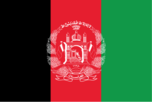
Flag
a new flag of unknown description reportedly has been adopted; previous flag consisted of three equal horizontal bands of black (top), red, and green, with the national coat of arms superimposed on the hoist side of the black and red bands; similar to the flag of Malawi, which is shorter and bears a radiant, rising red sun centered in the black band
Independence
19 August 1919 (from UK)
Judicial branch
an interim Chief Justice of the Supreme Court has been appointed, but a new court system has not yet been organized
Legal system
a new legal system has not been adopted but the transitional government has declared it will follow Islamic law (Shari`a)
Legislative branch
previous bicameral legislature has been abolished
Long-form name
Islamic State of Afghanistan
Member of
Has previously been a member of AsDB, CP, ESCAP, FAO, G-77, IAEA, IBRD, ICAO, IDA, IDB, IFAD, IFC, ILO, IMF, INTELSAT, IOC, ITU, LORCS, NAM, OIC, UN, UNCTAD, UNESCO, UNIDO, UPU, WFTU, WHO, WMO, WTO; note - the new government has not yet announced whether it will continue to be a member of these bodies; the former resistance government in exile (Afghan Interim Government) was given membership in the OIC in 1989
National holiday
28 April, Victory of the Muslim Nation; 4 May, Remembrance Day for Martyrs and Disabled; 19 August, Independence Day
Other political or pressure groups
the former resistance commanders are the major power brokers in the countryside; shuras (councils) of commanders are now administering most cities outside Kabul; ulema (religious scholars); tribal elders
Political parties and leaders
the former resistance parties represent the only current political organizations and include Jamiat-i-Islami (Islamic Society), Burhanuddin RABBANI; Hizbi Islami-Gulbuddin (Islamic Party), Gulbuddin Hikmatyar Faction; Hizbi Islami-Khalis (Islamic Party) Yunis Khalis Faction; Ittihad-i-Islami Barai Azadi Afghanistan (Islamic Union for the Liberation of Afghanistan), Abdul Rasul SAYYAF; Harakat-Inqilab-i-Islami (Islamic Revolutionary Movement), Mohammad Nabi MOHAMMADI; Jabha-i-Najat-i-Milli Afghanistan (Afghanistan National Liberation Front), Sibghatullah MOJADDEDI; Mahaz-i-Milli-Islami (National Islamic Front), Sayed Ahamad GAILANI; Jonbesh-i-Milli Islami (National Islamic Movement), Ahmad Shah MASOOD and Rashid DOSTAM; Hizbi Wahdat (Islamic Unity Party), and a number of minor resistance parties; the former ruling Watan Party has been disbanded
Suffrage
undetermined; previously universal, male ages 15-50
Type
transitional
Economy
Agriculture
largely subsistence farming and nomadic animal husbandry; cash products - wheat, fruits, nuts, karakul pelts, wool, mutton
Budget
revenues NA; expenditures NA, including capital expenditures of NA
Currency
afghani (plural - afghanis); 1 afghani (Af) = 100 puls
Economic aid
US commitments, including Ex-Im (FY70-89), $380 million; Western (non-US) countries, ODA and OOF bilateral commitments (1970-89), $510 million; OPEC bilateral aid (1979-89), $57 million; Communist countries (1970-89), $4.1 billion; net official Western disbursements (1985-89), $270 million
Electricity
480,000 kW capacity; 1,450 million kWh produced, 90 kWh per capita (1991)
Exchange rates
afghanis (Af) per US$1 - 550 (May 1992, free market exchange rate), 900 (free market exchange rate as of November 1991), 850 (1991), 700 (1989-90), 220 (1988-89); note - these rates reflect the bazaar rates rather than the official exchange rates
Exports
$236 million (f.o.b., FY91 est.) commodities: natural gas 55%, fruits and nuts 24%, handwoven carpets, wool, cotton, hides, and pelts partners: mostly former USSR
External debt
$2.3 billion (March 1991 est.)
Fiscal year
21 March - 20 March
GDP
exchange rate conversion - $3 billion, per capita $200; real growth rate 0% (1989 est.)
Illicit drugs
an illicit producer of opium poppy and cannabis for the international drug trade; world's second-largest opium producer (after Burma) and a major source of hashish
Imports
$874 million (c.i.f., FY91 est.) commodities: food and petroleum products partners: mostly former USSR
Industrial production
growth rate 2.3% (FY91 est.); accounts for about 25% of GDP
Industries
small-scale production of textiles, soap, furniture, shoes, fertilizer, and cement; handwoven carpets; natural gas, oil, coal, copper
Inflation rate (consumer prices)
over 90% (1991 est.)
Overview
Fundamentally, Afghanistan is an extremely poor, landlocked country, highly dependent on farming (wheat especially) and livestock raising (sheep and goats). Economic considerations, however, have played second fiddle to political and military upheavals during more than 13 years of war, including the nearly 10-year Soviet military occupation (which ended 15 February 1989). Over the past decade, one-third of the population fled the country, with Pakistan sheltering more than 3 million refugees and Iran about 1.3 million. Another 1 million probably moved into and around urban areas within Afghanistan. Although reliable data are unavailable, gross domestic product is lower than 12 years ago because of the loss of labor and capital and the disruption of trade and transport.
Unemployment rate
NA%
Communications
Airports
41 total, 37 usable; 9 with permanent-surface runways; none with runways over 3,659 m; 10 with runways 2,440-3,659 m; 18 with runways 1,220-2,439 m
Civil air
2 Tu-154, 2 Boeing 727, 4 Yak-40, assorted smaller transports
Highways
21,000 km total (1984); 2,800 km hard surface, 1,650 km bituminous-treated gravel and improved earth, 16,550 km unimproved earth and tracks
Inland waterways
total navigability 1,200 km; chiefly Amu Darya, which handles steamers up to about 500 metric tons
Pipelines
petroleum products - former USSR to Bagram and former USSR to Shindand; natural gas 180 km
Ports
Shir Khan and Kheyrabad (river ports)
Railroads
9.6 km (single track) 1.524-meter gauge from Kushka (Turkmenistan) to Towraghondi and 15.0 km from Termez (Uzbekistan) to Kheyrabad transshipment point on south bank of Amu Darya
Telecommunications
limited telephone, telegraph, and radiobroadcast services; television introduced in 1980; 31,200 telephones; broadcast stations - 5 AM, no FM, 1 TV; 1 satellite earth station
Military and Security
Branches
the military currently is being reorganized by the new government and does not yet exist on a national scale; some elements of the former Army, Air and Air Defense Forces, National Guard, Border Guard Forces, National Police Force (Sarandoi), and Tribal Militias remain intact and are supporting the new government; the government has asked all military personnel to return to their stations; a large number of former resistance groups also field irregular military forces; the Ministry of State Security (WAD) has been disbanded
Defense expenditures
the new government has not yet adopted a defense budget
Manpower availability
males 15-49, 3,989,232; 2,139,771 fit for military service; 150,572 reach military age (22) annually
To find internal information, search for
country section, as above. THE CIA WORLD FACTBOOK 1992
To find the beginning of any country, search for
country