1989 Edition
CIA World Factbook 1989 (Internet Archive)
Geography
Climate
arid to semiarid; cold winters and hot summers
Coastline
none — landlocked
Comparative area
slightly smaller than Texas
Disputes
Pashtun question with Pakistan; Baloch question with Iran and Pakistan; periodic disputes with Iran over Helmand water rights; insurgency with Iranian and Pakistani involvement; traditional tribal rivalries
Environment
damaging earthquakes occur in Hindu Kush mountains; soil degradation, desertification, overgrazing, deforestation, pollution
Land boundaries
5,826 km total; China 76 km, Iran 936 km, Pakistan 2,430 km, USSR 2,384 km
Land use
12% arable land; NEGL% permanent crops; 46% meadows and pastures; 3% forest and woodland; 39% other; includes NEGL% irrigated
Maritime claims
none — landlocked
Natural resources
natural gas, crude oil, coal, copper, talc, barites, sulphur, lead, zinc, iron ore, salt, precious and semiprecious stones
Note
landlocked
Terrain
mostly rugged mountains; plains in north and southwest
Total area
647,500 km2; land area: 647,500 km2
People and Society
Birth rate
44 births/ 1,000 population (1990)
Death rate
18 deaths/ 1,000 population (1990)
Ethnic divisions
50% Pashtun, 25% Tajik, 9% Uzbek, 12-15% Hazara; minor ethnic groups include Chahar Aimaks, Turkmen, Baloch, and others
Infant mortality rate
154 deaths/ 1,000 live births (1990)
Labor force
4,980,000; 67.8% agriculture and animal husbandry, 10.2% industry, 6.3% construction, 5.0% commerce, 10.7% services and other (1980 est.)
Language
50% Pashtu, 35% Afghan Persian (Dari), 1 1% Turkic languages (primarily Uzbek and Turkmen), 4% thirty minor languages (primarily Balochi and Pashai); much bilingualism
Life expectancy at birth
47 years male, 46 years female (1990)
Literacy
12%
Nationality
noun — Afghan(s); adjective — Afghan
Net migration rate
51 migrants/ 1,000 population (1990); note — there are flows across the border in both directions, but data are fragmentary and unreliable
Organized labor
some small governmentcontrolled unions
Population
15,862,293 (July 1990), growth rate 7.7% (1990)
Religion
74% Sunni Muslim, 15% Shi'a Muslim, 11% other
Total fertility rate
6.4 children born/ woman (1990)
Government
Administrative divisions
30 provinces (velayat, singular — velSyat); Badakhshan, Badghls, Baghlan, Balkh, Bamian, Far5h, Faryab, Ghaznl, Ghowr, Helmand, Herat, Jowzjan, Kabol, Kandahar, KapTsa, Kenan, Kondoz, l.aghman, Lowgar, NangarhSr, Nlmrflz, Orflzgan, Paktia, Paktlka, Parvan, Samangan, Sar-e Pol, Takhar, Vardak, Zabol; note — there may be a new province of Nflrestan (Nuristan)
Capital
Kabul
Communists
the PDPA claims 200,000 members (1988)
Constitution
adopted 30 November 1987
Diplomatic representation
Minister-Counselor, Charge d' Affaires MIAGOL; Chancery at 2341 Wyoming Avenue NW, Washington DC 20008; telephone (202) 234-3770 or 3771; US— Charge d'Affaires (vacant); Embassy at Ansari Wat, Wazir Akbar Khan Mina, Kabul; telephone 62230 through 62235 or 62436; note — US Embassy in Kabul was closed in January 1989
Elections
Senate — last held NA April 1988 (next to be held April 1991); results — PDPA is the only party; seats — (192 total, 115 elected) PDPA 115; House of Representatives — last held N A April 1988 (next to be held April 1993); results — PDPA is the only party; seats — (234 total) PDPA 184, 50 seats reserved for opposition
Executive branch
president, four vice presidents, prime minister, deputy prime minister, Council of Ministers (cabinet)
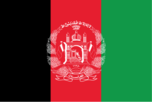
Flag
three equal horizontal bands of black (top), red, and green with the national coat of arms superimposed on the hoist side of the black and red bands; similar to the flag of Malawi which is shorter and bears a radiant, rising, red sun centered in the black band
Independence
19 August 1919 (from UK)
Judicial branch
Supreme Court
Leaders
Chief of State and Head of Government— President (Mohammad) NAJIBULLAH (Ahmadzai) (since 30 November 1987); Chairman of the Council of Ministers Executive Committee Soltan Ali KESHTMAND (since 21 February 1989) Political parties and leaders: only party — the People's Democratic Party of Afghanistan (PDPA) has two factions — the Parchami faction has been in power since December 1 979 and members of the deposed Khalqi faction continue to hold some important posts mostly in the military and Ministry of Interior; nonparty figures hold some posts
Legal system
has not accepted compulsory ICJ jurisdiction
Legislative branch
bicameral National Assembly (Meli Shura) consists of an upper house or Senate (Sena) and a lower house or House of Representatives (Wolasi Jirgah)
Long-form name
Republic of Afghanistan
Member of
ADB, CCC, Colombo Plan, ESCAP, FAO, G-77, IAEA, IBRD, ICAO, IDA, IDB — Islamic Development Bank, IFAD, IFC, ILO, IMF, INTELSAT, ITU, NAM, UN, UNESCO, UPU, WFTU, WHO, WMO, WTO, WSG; suspended from OIC in January 1980
National holiday
Anniversary of the Saur Revolution, 27 April (1978)
Other political or pressure groups
the military and other branches of internal security have been rebuilt by the USSR; insurgency continues throughout the country; widespread anti-Soviet and antiregime sentiment and opposition on religious and political grounds
Suffrage
universal, male ages 1 5-50
Type
authoritarian
Economy
Overview
Fundamentally, Afghanistan is an extremely poor, landlocked country, highly dependent on farming (wheat especially) and livestock raising (sheep and goats). Economic considerations, however, have played second fiddle to political and military upheavals, including the nineyear Soviet military occupation (ended 1 5 February 1989) and the continuing bloody civil war. Over the past decade, one-third of the population has fled the country, with Pakistan sheltering some 3 million refugees and Iran perhaps 2 million.