Introduction
<p>South Sudan, which gained independence from Sudan in 2011, is the world’s newest country. Home to a diverse array of mainly Nilotic ethnolinguistic groups that settled in the territory in the 15th through 19th centuries, South Sudanese society is heavily dependent on seasonal migration and seasonal fluctuations in precipitation. Modern-day South Sudan was conquered first by Egypt and later ruled jointly by Egyptian-British colonial administrators in the late 19th century. Christian missionaries helped spread the English language and Christianity in the area, leading to significant cultural differences with the northern part of Sudan, where Arabic and Islam are dominant. When Sudan gained its independence in 1956, the southern region received assurances that it would participate fully in the political system. However, the Arab government in Khartoum reneged on its promises, prompting two periods of civil war (1955-1972 and 1983-2005) in which as many as 2.5 million people died -- mostly civilians -- due largely to starvation and drought. The second Sudanese civil war was one of the deadliest since WWII and left southern Sudanese society devastated. Peace talks resulted in a US-backed Comprehensive Peace Agreement in 2005, which granted the South six years of autonomy followed by a referendum on final status. The result of this referendum, held in 2011, was a vote of 98% in favor of secession.<br><br>Since independence, South Sudan has struggled to form a viable governing system and has been plagued by widespread corruption, political conflict, and communal violence. In 2013, conflict erupted between forces loyal to President Salva KIIR, a Dinka, and forces loyal to Vice President Riek MACHAR, a Nuer. The conflict quickly spread through the country along ethnic lines, killing tens of thousands and creating a humanitarian crisis with millions of South Sudanese displaced. KIIR and MACHAR signed a peace agreement in 2015 that created a Transitional Government of National Unity the next year. However, renewed fighting broke out in Juba between KIIR and MACHAR’s forces, plunging the country back into conflict and drawing in additional armed opposition groups. A "revitalized" peace agreement was signed in 2018, mostly ending the fighting and laying the groundwork for a unified national army, a transitional government, and elections. The transitional government was formed in 2020, when MACHAR returned to Juba as first vice president. Since 2020, implementation of the peace agreement has been stalled amid wrangling over power-sharing, which has contributed to an uptick in communal violence and the country’s worst food crisis since independence, with 7 of 11 million South Sudanese citizens in need of humanitarian assistance. The transitional period was extended an additional two years in 2022, pushing elections to late 2024.</p>
Geography
- Land
- NA
- Total
- 644,329 sq km
- Water
- NA
more than four times the size of Georgia; slightly smaller than Texas
hot with seasonal rainfall influenced by the annual shift of the Inter-Tropical Convergence Zone; rainfall heaviest in upland areas of the south and diminishes to the north
0 km (landlocked)
Africa
- Highest point
- Kinyeti 3,187 m
- Lowest point
- White Nile 381 m
8 00 N, 30 00 E
landlocked; The Sudd is a vast swamp in the north central region of South Sudan, formed by the White Nile; its size is variable but can reach some 15% of the country's total area during the rainy season; it is one of the world's largest wetlands
1,000 sq km (2012)
- Border countries
- Central African Republic 1,055 km; Democratic Republic of the Congo 714 km; Ethiopia 1,299 km; Kenya 317 km; Sudan 2,158 km; Uganda 475 km
- Note
- <strong>note:</strong> South Sudan-Sudan boundary represents 1 January 1956 alignment; final alignment pending negotiations and demarcation; final sovereignty status of Abyei Area pending negotiations between South Sudan and Sudan
- number of neighbors
- 6
- Total
- 6,018 km
- Agricultural land
- 44.9% (2023 est.)
- Agricultural land: arable land
- arable land: 3.9% (2023 est.)
- Agricultural land: permanent crops
- permanent crops: 0.1% (2023 est.)
- Agricultural land: permanent pasture
- permanent pasture: 40.8% (2023 est.)
- arable land
- 3.94%
- Forest
- 11.3% (2023 est.)
- Other
- 43.8% (2023 est.)
- permanent crops
- 0.13%
Yes
East-Central Africa; south of Sudan, north of Uganda and Kenya, west of Ethiopia
Nile (shared with Rwanda [s], Tanzania, Uganda, Sudan, and Egypt [m]) - 6,650 km<br><br><strong>note:</strong> [s] after country name indicates river source; [m] after country name indicates river mouth
- Atlantic Ocean drainage
- Congo (3,730,881 sq km), <em>(Mediterranean Sea)</em> Nile (3,254,853 sq km)
- Google Maps
- https://goo.gl/maps/Zm1AYCXb9HSNF1P27
- OpenStreetMap
- https://www.openstreetmap.org/relation/1656678
Africa
none (landlocked)
hydropower, fertile agricultural land, gold, diamonds, petroleum, hardwoods, limestone, iron ore, copper, chromium ore, zinc, tungsten, mica, silver
clusters found in urban areas, particularly in the western interior and around the White Nile, as shown in this population distribution map
Middle Africa
plains in the north and center rise to southern highlands along the border with Uganda and Kenya; the White Nile, flowing north out of the uplands of Central Africa, is the major geographic feature of the country; The Sudd (a name derived from floating vegetation that hinders navigation) is a large swampy area of more than 100,000 sq km fed by the waters of the White Nile that dominates the center of the country
- UTC+03:00
- number of time zones
- 1
People and Society
- 0-14 years
- 42.1% (male 2,725,520/female 2,619,035)
- 15-64 years
- 55.3% (male 3,568,064/female 3,458,804)
- 65 years and over
- 2.6% (2024 est.) (male 182,757/female 149,534)
35.68 births/1,000 population (2025 est.)
- 8.65 deaths/1,000 population (2025 est.)
- adult female
- 247 per 1,000
- adult male
- 356 per 1,000
- Elderly dependency ratio
- 4.7 (2024 est.)
- Potential support ratio
- 21.1 (2024 est.)
- Total dependency ratio
- 80.8 (2024 est.)
- Youth dependency ratio
- 76.1 (2024 est.)
- Improved: rural
- rural: 33.6% of population (2022 est.)
- Improved: total
- total: 41.2% of population (2022 est.)
- Improved: urban
- urban: 70% of population (2022 est.)
- Unimproved: rural
- rural: 66.4% of population (2022 est.)
- Unimproved: total
- total: 58.8% of population (2022 est.)
- Unimproved: urban
- urban: 30% of population (2022 est.)
- Education expenditure (% GDP)
- 1.6% of GDP (2016 est.)
- Education expenditure (% national budget)
- 3.3% national budget (2015 est.)
- Dinka (Jieng) approximately 35-40%, Nuer (Naath) approximately 15%, Shilluk (Chollo), Azande, Bari, Kakwa, Kuku, Murle, Mandari, Didinga, Ndogo, Bviri, Lndi, Anuak, Bongo, Lango, Dungotona, Acholi, Baka, Fertit (2011 est.)
- note
- <strong>note: </strong>Figures are estimations due to population changes during South Sudan's civil war and the lack of updated demographic studies
2.43 (2025 est.)
- 12 % of GDP
- Health expenditure (as % of GDP)
- 5.9% of GDP (2021)
- Health expenditure (as % of national budget)
- 2.1% of national budget (2022 est.)
0.8%
- Female
- 54.1 deaths/1,000 live births
- Male
- 65.8 deaths/1,000 live births
- neonatal
- 40 deaths/1,000 live births
- Total
- 58.6 deaths/1,000 live births (2025 est.)
- Languages
- English (official), Arabic (includes Juba and Sudanese variants), ethnic languages include Dinka, Nuer, Bari, Zande, Shilluk
- Major-language sample(s)
- <br>The World Factbook, the indispensable source for basic information. (English)<br><br>كتاب حقائق العالم، المصدر الذي لا يمكن الاستغناء عنه للمعلومات الأساسية (Arabic)
- number of languages
- 1
- Female
- 62.2 years
- Male
- 58.4 years
- Total population
- 60.3 years (2024 est.)
459,000 JUBA (capital) (2023)
692 deaths/100,000 live births (2023 est.)
- Female
- 18.7 years
- Male
- 18.7 years
- Total
- 18.7 years (2025 est.)
97 births/1,000 women 15-19
- Adjective
- South Sudanese
- Noun
- South Sudanese (singular and plural)
18.2 migrant(s)/1,000 population (2025 est.)
6.6% (2014)
0.04 physicians/1,000 population (2022)
- Female
- 6,227,373
- Male
- 6,476,341
- Total
- 12,703,714 (2024 est.)
4.52% (2025 est.)
Christian 60.5%, folk religion 32.9%, Muslim 6.2%, other <1%, unaffiliated <1% (2020 est.)
- Improved: rural
- rural: 15.5% of population (2022 est.)
- Improved: total
- total: 24.9% of population (2022 est.)
- Improved: urban
- urban: 60.6% of population (2022 est.)
- Unimproved: rural
- rural: 84.5% of population (2022 est.)
- Unimproved: total
- total: 75.1% of population (2022 est.)
- Unimproved: urban
- urban: 39.4% of population (2022 est.)
- 0-14 years
- 1.04 male(s)/female
- 15-64 years
- 1.03 male(s)/female
- 65 years and over
- 1.22 male(s)/female
- At birth
- 1.05 male(s)/female
- Total population
- 1.04 male(s)/female (2024 est.)
4.98 children born/woman (2025 est.)
- Rate of urbanization
- 4.12% annual rate of change (2020-25 est.)
- Urban population
- 21.2% of total population (2023)
- measles
- 72%
Government
- 10 states; Central Equatoria, Eastern Equatoria, Jonglei, Lakes, Northern Bahr el Ghazal, Unity, Upper Nile, Warrap, Western Bahr el Ghazal, Western Equatoria
- note
- <strong>note:</strong> in 2015, 28 new states were created, and 4 additional states in 2017; after the 2020 peace agreement, the country was again reorganized into the 10 original states, plus 2 administrative areas, Pibor and Ruweng, and 1 special administrative status area, Abyei (which is disputed between South Sudan and Sudan)
- Etymology
- the name comes from the name of a small Bari village that was located near the present-day city
- Geographic coordinates
- 04 51 N, 31 37 E
- Name
- Juba
- Time difference
- UTC+2 (8 hours ahead of Washington, DC, during Standard Time)
- Citizenship by birth
- no
- Citizenship by descent only
- at least one parent must be a citizen of South Sudan
- Dual citizenship recognized
- yes
- Residency requirement for naturalization
- 10 years
- svg
- https://mainfacts.com/media/images/coats_of_arms/ss.svg
- Amendment process
- proposed by the National Legislature or by the president of the republic; passage requires submission of the proposal to the Legislature at least one month prior to consideration, approval by at least two-thirds majority vote in both houses of the Legislature, and assent of the president
- History
- previous 2005 (pre-independence); latest signed 7 July 2011, effective 9 July 2011 (Transitional Constitution of the Republic of South Sudan, 2011)
- alternative spellings
- SS
- Conventional long form
- Republic of South Sudan
- Conventional short form
- South Sudan
- Etymology
- self-descriptive name from the country's geographic position within Sudan prior to independence; the name Sudan derives from the Arabic <em>balad-as-sudan</em>, meaning "Land of the Black [peoples]"
- FIFA code
- SSD
- local long form (eng)
- Republic of South Sudan
- Chief of mission
- Ambassador Michael J. ADLER (since 24 August 2022)<br>
- Email address and website
- <br>ACSJuba@state.gov<br><br>https://ss.usembassy.gov/
- Embassy
- Kololo Road adjacent to the EU's compound, Juba
- Mailing address
- 4420 Juba Place, Washington DC 20521-4420
- Telephone
- [211] 912-105-188
- Chancery
- 1015 31st Street NW, Suite 300, Washington, DC 20007
- Chief of mission
- Ambassador Santino Fardol Watod DICKEN (since 18 September 2024)
- Email address and website
- <br>info.ssdembassy@gmail.com<br><br>https://www.ssembassydc.org/
- FAX
- [1] (202) 644-9910
- Telephone
- [1] (202) 600-2238
- Cabinet
- National Council of Ministers appointed by the president, approved by the Transitional National Legislative Assembly
- Chief of state
- President Salva KIIR Mayardit (since 9 July 2011)
- Election results
- <em><br>2010:</em> Salva KIIR Mayardit elected leader of then-Southern Sudan; percent of vote - Salva KIIR Mayardit (SPLM) 93%, Lam AKOL (SPLM-DC) 7%
- Election/appointment process
- president directly elected by simple-majority popular vote for a 4-year term (eligible for a second term)
- Expected date of next election
- scheduled for 2015 but has been postponed multiple times, currently to be held in December 2026
- Head of government
- President Salva KIIR Mayardit (since 9 July 2011)
- Most recent election date
- 11-15 April 2010
- Note
- <strong>note: </strong>the president is both chief of state and head of government
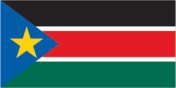
- <strong>description:</strong> three equal horizontal bands of black (top), red, and green; the red band is edged in white; a five-pointed gold star is in the middle of a blue isosceles triangle based on the left side<br><br><strong>meaning: </strong>black stands for the people, red for the blood shed in the struggle for freedom, green for the land, and blue for the Nile; the gold star represents the unity of the country's states
- note
- <strong>note 1:</strong> similar to the flag of Kenya<br><br><strong>note 2:</strong> South Sudan has one of two national flags that display six colors as part of the primary design -- the other is South Africa's
The flag of South Sudan is composed of three equal horizontal bands of black, red with white top and bottom edges, and green. A blue equilateral triangle which spans about two-fifth the width of the field is superimposed on the hoist side with its base on the hoist end of the field. At the center of this triangle is a five-pointed yellow star.
- svg
- https://flagcdn.com/ss.svg
presidential republic
9 July 2011 (from Sudan)
AU, EAC, FAO, G-77, IBRD, ICAO, IDA, IFAD, IFC, IFRCS, IGAD, ILO, IMF, Interpol, IOM, IPU, ITU, MIGA, UN, UNCTAD, UNESCO, UPU, WCO, WHO, WMO
- Highest court(s)
- Supreme Court of South Sudan (consists of a chief justice, deputy chief justice, and 5 additional justices); the 2011 Transitional Constitution of South Sudan calls for 9, rather than 5 additional justices
- Judge selection and term of office
- the 2011 Transitional Constitution of South Sudan calls for the establishment of a Judicial Service Council to recommend prospective justices to the president, and for the justices' tenures to be set by the National Legislature
- Note
- <strong>note:</strong> in mid-2022, the Government of South Sudan inaugurated an ad-hoc judiciary committee, a 12-member body led by two eminent jurists, that is charged with reviewing relevant laws, advising on judicial reform, and restructuring the judiciary
- Subordinate courts
- national level - Courts of Appeal; High Courts; County Courts; state level - High Courts; County Courts; customary courts; other specialized courts and tribunals
- Legislative structure
- bicameral
- Legislature name
- Législature nationale (National Legislature)
- Chamber name
- Transitional National Legislative Assembly (Al-Majlis Al-Tachirii)
- Expected date of next election
- December 2026
- Most recent election date
- 5/10/2021
- Number of seats
- 550 (all appointed)
- Percentage of women in chamber
- 32.4%
- Scope of elections
- full renewal
- Chamber name
- Council of States (Al-Watani)
- Expected date of next election
- December 2026
- Most recent election date
- 8/2/2021
- Number of seats
- 100 (all appointed)
- Percentage of women in chamber
- 32.1%
- Scope of elections
- full renewal
red, green, blue, yellow, black, white
Independence Day, 9 July (2011)
African fish eagle
Democratic Change or DC<br>Democratic Forum or DF<br>Labour Party or LPSS<br>South Sudan Opposition Alliance or SSOA<br>Sudan African National Union or SANU<br>Sudan People's Liberation Movement or SPLM<br>Sudan People’s Liberation Movement-In Opposition or SPLM-IO<br>United Democratic Salvation Front or UDSF <br>United South Sudan African Party or USSAP<br>United South Sudan Party or USSP
Sunday
18 years of age; universal
Yes
Economy
- milk, cassava, sorghum, goat milk, vegetables, fruits, groundnuts, sesame seeds, beef, maize (2023)
- note
- <b>note:</b> top ten agricultural products based on tonnage
- Expenditures
- $1.984 billion (2023 est.)
- Note
- <b>note:</b> central government revenues and expenses (excluding grants/extrabudgetary units/social security funds) converted to US dollars at average official exchange rate for year indicated
- Revenues
- $2.513 billion (2023 est.)
- code
- SSP
- name
- South Sudanese pound (SSP) [£]
- $577.9 million
- Current account balance 2021
- -$6.55 million (2021 est.)
- Current account balance 2022
- -$596.748 million (2022 est.)
- Current account balance 2023
- $577.9 million (2023 est.)
- Note
- <b>note:</b> balance of payments - net trade and primary/secondary income in current dollars
low-income, oil-based Sahelian economy; extreme poverty and food insecurity; COVID-19 and ongoing violence threaten socioeconomic potential; environmentally fragile; ongoing land and property rights issues; natural resource rich but lacks infrastructure
- Currency
- South Sudanese pounds (SSP) per US dollar -
- Exchange rates 2020
- 165.907 (2020 est.)
- Exchange rates 2021
- 306.355 (2021 est.)
- Exchange rates 2022
- 534.511 (2022 est.)
- Exchange rates 2023
- 930.331 (2023 est.)
- Exchange rates 2024
- 2,163.104 (2024 est.)
- Exports 2021
- $4.652 billion (2021 est.)
- Exports 2022
- $5.811 billion (2022 est.)
- Exports 2023
- $4.499 billion (2023 est.)
- Note
- <b>note:</b> balance of payments - exports of goods and services in current dollars
- crude petroleum, refined petroleum, forage crops, gold, scrap iron (2023)
- note
- <b>note:</b> top five export commodities based on value in dollars
- China 51%, Singapore 29%, UAE 10%, Germany 4%, Uganda 3% (2023)
- note
- <b>note:</b> top five export partners based on percentage share of exports
- net inflows
- $83.42 million
- Agriculture
- 10.4% (2015 est.)
- Industry
- 33.1% (2015 est.)
- Note
- <b>note:</b> figures may not total 100% due to non-allocated consumption not captured in sector-reported data
- Services
- 56.6% (2015 est.)
- $4.629 billion (2023 est.)
- note
- <b>note:</b> data in current dollars at official exchange rate
- 44.1 (2016)
- Gini Index coefficient - distribution of family income 2016
- 44 (2016 est.)
- Note
- <b>note:</b> index (0-100) of income distribution; higher values represent greater inequality
- Highest 10%
- 33% (2016 est.)
- Lowest 10%
- 1.8% (2016 est.)
- Note
- <strong>note:</strong> % share of income accruing to lowest and highest 10% of population
- Imports 2021
- $4.037 billion (2021 est.)
- Imports 2022
- $6.402 billion (2022 est.)
- Imports 2023
- $4.443 billion (2023 est.)
- Note
- <b>note:</b> balance of payments - imports of goods and services in current dollars
- garments, cement, other foods, iron bars, cereal flours (2023)
- note
- <b>note:</b> top five import commodities based on value in dollars
- Uganda 33%, UAE 26%, Kenya 14%, China 10%, USA 3% (2023)
- note
- <b>note:</b> top five import partners based on percentage share of imports
- -36.8% (2015 est.)
- note
- <b>note:</b> annual % change in industrial value added based on constant local currency
- 91.44%
- Inflation rate (consumer prices) 2022
- -6.7% (2022 est.)
- Inflation rate (consumer prices) 2023
- 2.4% (2023 est.)
- Inflation rate (consumer prices) 2024
- 91.4% (2024 est.)
- Note
- <b>note:</b> annual % change based on consumer prices
- 5.091 million (2023 est.)
- note
- <b>note:</b> number of people ages 15 or older who are employed or seeking work
- total
- 5.07 million persons
- agriculture
- 63.76%
- industry
- 1.67%
- services
- 34.57%
- 82.3% (2016 est.)
- note
- <b>note:</b> % of population with income below national poverty line
- Public debt 2016
- 86.6% of GDP (2016 est.)
- Note
- <strong>note:</strong> data in 2015 dollars
- Real GDP (purchasing power parity) 2021
- $6.945 billion (2021 est.)
- Real GDP (purchasing power parity) 2022
- $6.585 billion (2022 est.)
- Real GDP (purchasing power parity) 2023
- $6.752 billion (2023 est.)
- Note
- <b>note:</b> annual GDP % growth based on constant local currency
- Real GDP growth rate 2015
- -10.8% (2015 est.)
- Real GDP growth rate 2016
- -13.9% (2016 est.)
- Real GDP growth rate 2017
- -5.2% (2017 est.)
- Note
- <strong>note:</strong> data in 2015 dollars
- Real GDP per capita 2021
- $400 (2021 est.)
- Real GDP per capita 2022
- $400 (2022 est.)
- Real GDP per capita 2023
- $400 (2023 est.)
- $1.14 billion
- Note
- <strong>note:</strong> personal transfers and compensation between resident and non-resident individuals/households/entities
- Remittances 2013
- 0% of GDP (2013 est.)
- Remittances 2014
- 0% of GDP (2014 est.)
- Remittances 2015
- 9.5% of GDP (2015 est.)
- $72.88 million
- Note
- <b>note:</b> holdings of gold (year-end prices)/foreign exchange/special drawing rights in current dollars
- Reserves of foreign exchange and gold 2021
- $341.932 million (2021 est.)
- Reserves of foreign exchange and gold 2022
- $94.914 million (2022 est.)
- Reserves of foreign exchange and gold 2023
- $72.881 million (2023 est.)
- 12.37%
- Note
- <b>note:</b> % of labor force seeking employment
- Unemployment rate 2021
- 14.1% (2021 est.)
- Unemployment rate 2022
- 12.6% (2022 est.)
- Unemployment rate 2023
- 12.5% (2023 est.)
- Female
- 17.6% (2023 est.)
- Male
- 19.4% (2023 est.)
- Note
- <b>note:</b> % of labor force ages 15-24 seeking employment
- Total
- 18.5% (2023 est.)
Energy
- Imports
- 100 metric tons (2022 est.)
- Consumption
- 566.034 million kWh (2023 est.)
- consumption per capita
- 47 kWh
- Installed generating capacity
- 136,000 kW (2023 est.)
- Transmission/distribution losses
- 23.966 million kWh (2023 est.)
- Electrification - rural areas
- 1.7%
- Electrification - total population
- 8.4% (2022 est.)
- Electrification - urban areas
- 15%
- Fossil fuels
- 93.2% of total installed capacity (2023 est.)
- hydroelectric
- 0%
- nuclear
- 0%
- renewable
- 0.34%
- Solar
- 6.8% of total installed capacity (2023 est.)
- 69 kg of oil equivalent
- Total energy consumption per capita 2023
- 2.092 million Btu/person (2023 est.)
- Crude oil estimated reserves
- 3.75 billion barrels (2021 est.)
- Refined petroleum consumption
- 11,000 bbl/day (2023 est.)
- Total petroleum production
- 146,000 bbl/day (2023 est.)
32.4%
Communications
- per 100 inhabitants
- 0 per 100
- Subscriptions per 100 inhabitants
- (2023 est.) less than 1
- Total
- 0 (2023 est.)
1 state-controlled TV channel and radio station; several community and commercial FM stations, mostly sponsored by outside aid donors; some foreign radio broadcasts available (2019)
.ss
- Percent of population
- 9% (2022 est.)
+211
- Subscriptions per 100 inhabitants
- (2023 est.) less than 1
- Total subscriptions
- 0 (2023 est.)
- subscriptions per 100
- 47 per 100
- Subscriptions per 100 inhabitants
- 30 (2022 est.)
- Total subscriptions
- 6.17 million (2023 est.)
Transportation
89 (2025)
Z8
Right
2 (2025)
- Note
- <strong>note:</strong> a narrow gauge, single-track railroad between Babonosa (Sudan) and Wau, the only existing rail system, was repaired in 2010 with $250 million in UN funds, but is not currently operational
- Total
- 248 km (2018)
Military and Security
- armored vehicles
- tanks
the South Sudan People's Defense Forces (SSPDF) are largely focused on border and internal security; areas of concern include disputed national borders, conflict spillover from neighboring Sudan, banditry, and armed rebel groups and militias that continue to operate in the country since the civil war ended in 2020<br><br>the SSPDF, formerly the Sudan People’s Liberation Army (SPLA), was founded as a guerrilla movement against the Sudanese Government in 1983 and participated in the Second Sudanese Civil War (1983-2005); the Juba Declaration that followed the Comprehensive Peace Agreement of 2005 unified the SPLA and the South Sudan Defense Forces (SSDF), the second-largest rebel militia remaining from the civil war, under the SPLA name; in 2017, the SPLA was renamed the South Sudan Defense Forces (SSDF) and in September 2018 was renamed again as the SSPDF<br><br>the UN Mission in South Sudan (UNMISS) has operated in the country since 2011 with the objectives of consolidating peace and security and helping establish conditions for the successful economic and political development of South Sudan; UNMISS has about 18,000 personnel assigned; the UN Interim Security Force for Abyei (UNISFA) has operated in the disputed Abyei region along the border between Sudan and South Sudan since 2011; its mission includes ensuring security, protecting civilians, strengthening the capacity of the Abyei Police Service, de-mining, monitoring/verifying the redeployment of armed forces from the area, and facilitating the flow of humanitarian aid; UNISFA has approximately 3,800 personnel assigned (2025)
- South Sudan People’s Defense Force (SSPDF): Land Forces (includes Presidential Guard), Air Forces, Marine (Riverine) Forces, Reserve Forces; National (or Necessary) Unified Forces (NUF)<br><br>Ministry of Interior: South Sudan National Police Service (SSNPS) (2025)
- active duty personnel
- 53,000
- note
- <strong>note 1: </strong>the NUF are being formed by retraining rebel and pro-government militia fighters into military, police, and other government security forces; the first operational NUF deployed in November 2023<strong><br><br>note 2:</strong> numerous irregular forces operate in the country with official knowledge, including militias operated by the National Security Service (an internal security force under the Ministry of National Security) and proxy forces
- percent of total labor force
- 1.17 %
- information varies; estimated 150-200,000 active Defense Forces (2025)
- note
- <strong>note: </strong>some active SSPDF personnel may be militia; the National/Necessary Unified Forces (NUF) were expected to have up to 80,000 personnel when training and integration is completed; the first batch of approximately 20,000 NUF personnel completed training in late 2022
- the SSPDF inventory is a mix of primarily of Soviet-era armaments alongside limited quantities of more modern equipment such as armored personnel carriers from UAE (2025)
- note
- <strong>note:</strong> South Sudan has been under a UN arms embargo since 2018 (extended for 1 year in May 2025)
- 2 % of GDP
- current USD
- $2,027,890,373
- Military Expenditures 2020
- 2% of GDP (2020 est.)
- Military Expenditures 2021
- 2% of GDP (2021 est.)
- Military Expenditures 2022
- 2% of GDP (2022 est.)
- Military Expenditures 2023
- 2% of GDP (2023 est.)
- Military Expenditures 2024
- 2% of GDP (2024 est.)
- percent of central government expenditure
- 8.23 %
- percent of GDP
- 1.96 % of GDP
- 18 (legal minimum age)-35 for voluntary military service for men and women; 12-24 months service (2025)
- note
- <strong>note: </strong>the UN reports that there are thousands of child soldiers in South Sudan serving in the SSPDF and militia forces although the South Sudanese Government has pledged to end the practice
- PowerIndex score
- 2.4645
Transnational Issues
- IDPs
- 1,359,795 (2024 est.)
- Refugees
- 517,471 (2024 est.)
- Stateless persons
- 18,000 (2024 est.)
- Tier rating
- Tier 3 — South Sudan does not fully meet the minimum standards for the elimination of trafficking and is not making significant efforts to do so, therefore, South Sudan remained on Tier 3; for more details, go to: https://www.state.gov/reports/2025-trafficking-in-persons-report/south-sudan/
Environment
- From petroleum and other liquids
- 1.725 million metric tonnes of CO2 (2023 est.)
- Total emissions
- 1.725 million metric tonnes of CO2 (2023 est.)
water pollution; inadequate supplies of potable water; wildlife conservation and loss of biodiversity; deforestation; soil erosion; desertification; drought
- Party to
- Biodiversity, Climate Change, Climate Change-Paris Agreement, Desertification, Ozone Layer Protection, Wetlands
- Signed, but not ratified
- none of the selected agreements
- Agriculture
- 696 kt (2019-2021 est.)
- Energy
- 59.4 kt (2022-2024 est.)
- Other
- 12.7 kt (2019-2021 est.)
- Waste
- 120.2 kt (2019-2021 est.)
20.6 micrograms per cubic meter (2019 est.)
15 % of total land area
0 % of total
49.5 billion cubic meters (2022 est.)
- 3 % of internal resources
- Agricultural
- 240 million cubic meters (2022 est.)
- Industrial
- 225 million cubic meters (2022 est.)
- Municipal
- 193 million cubic meters (2022 est.)
- Municipal solid waste generated annually
- 2.681 million tons (2024 est.)